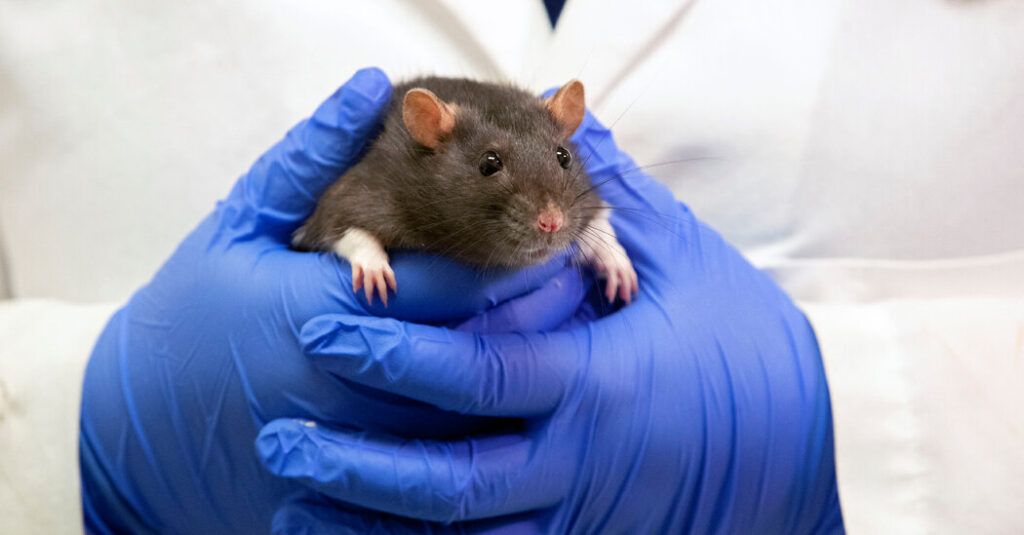
The Environmental Protection Agency will stop using rabbits, mice, rats and other mammals to test the toxicity of chemicals by 2035, the agency said Thursday.
Animal rights groups praised the move, while some environmental organizations said they worried that understanding the link between chemical exposure and cancer, or developmental or reproductive issues, would be harder to ascertain without animal testing.
Lee Zeldin, the E.P.A. administrator, announced the new policy and said it revives an effort begun during President Trump’s first term. While some testing will still be required to meet legal obligations about the safety of chemicals, Mr. Zeldin said the agency has been working to adopt methods that do not involve animals.
“We are confident we will continue to find in the weeks and months ahead, new technologies, new alternative methods that allow us to reduce animal testing on something that might be required today but it may not be necessary just a few months from now,” Mr. Zeldin said. The ban does not address fish or fish larvae.
The announcement comes on the heels of deep cuts to E.P.A. staffing levels, and the elimination of the agency’s scientific research arm that had been responsible for developing replacements for animal testing.
During President Trump’s first term, the E.P.A. moved to end testing on mammals by 2035, with an interim goal of ending it by 2025. That timeline was dropped during the Biden administration, when scientists concluded that a phaseout was premature.
“I don’t know anyone who’s not in favor of reducing the use of animals for toxicity testing,” said Christopher Frey, who served as the assistant administrator for research and development at the E.P.A. under the Biden administration.
Trump Administration: Live Updates
Updated
- Appeals court weighs Trump’s effort to use war power for deportations.
- The Trump administration cuts off funding for fetal tissue research, again.
- Trump sues JPMorgan for closing his bank accounts for political reasons.
But he said that computer models and other methods do not produce the same level of information as animal testing. “That leaves a gap, where the agency is not allowing itself to use information to fulfill its mission to use the best available science,” he said.
Thomas Hartung, a toxicology professor at Johns Hopkins University and director of its Center for Alternatives to Animal Testing, said artificial intelligence has significantly accelerated the ability to determine a chemical’s toxicity. Alternatives are widely available and are faster and cheaper than testing rats, mice, rabbits, and fish, he said.
“From my point of view this is an overdue adaptation to scientific progress,” Dr. Hartung said. “The environmental groups who say ‘more testing, more testing,’ are simply misled.”
E.P.A. officials said the agency used for the first time last year “high quality alternative scientific methods” to conduct cancer evaluations for dibutyl phthalate and di (2-ethylhexyl) phthalate, chemicals found in paints, adhesives, and cosmetics. Doing so spared an estimated 1,600 mice and rats from undergoing lab experiments, they said.
“Each year tens of thousands of animals are used in toxicity testing conducted just to meet E.P.A. requirements,” said Amy Clippinger, president of the scientific consortium for People for the Ethical Treatment of Animals. She said the new directive “sends a signal that companies can confidently bring forward non-animal data.”
Public health activists questioned the Trump administration’s motives. Jennifer Sass, a senior scientist at the Natural Resources Defense Council, an environmental group, said chemical manufacturers, which typically pay for animal testing to satisfy regulatory requirements, have criticized it as time consuming and expensive.
“I think that they’re really responding to a request pushed by chemical manufacturers along with animal welfare groups,” Dr. Sass said of the E.P.A.
The E.P.A. said it intends to identify more alternatives to animal testing and encourage external researchers to use them.
Lisa Friedman is a Times reporter who writes about how governments are addressing climate change and the effects of those policies on communities.
The post E.P.A. Promises a Ban on Animal Testing by 2035 appeared first on New York Times.