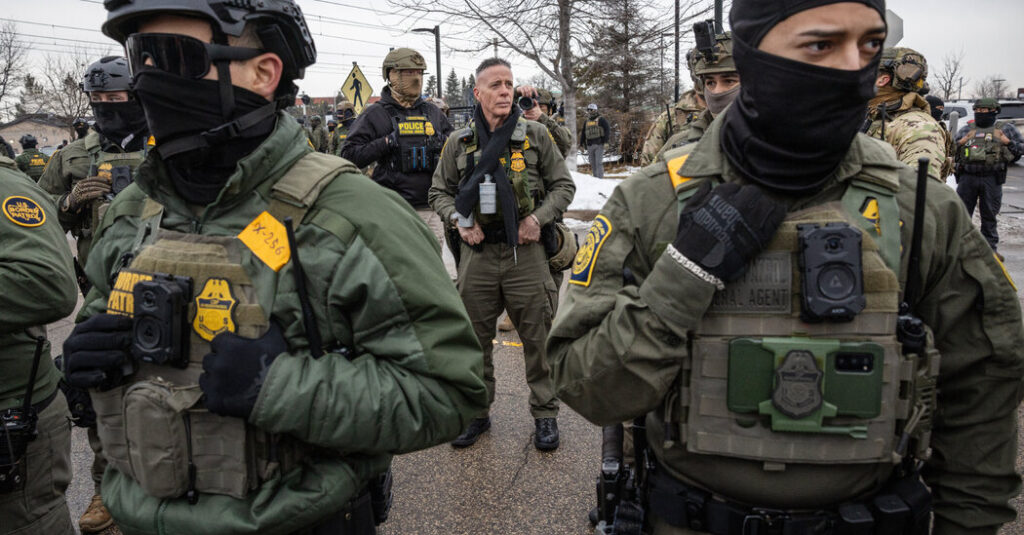
Gregory Bovino, a senior tactical commander for the Border Patrol, has been the swaggering public face of President Trump’s chaotic round of immigration raids across the country. In the wake of an immigration sweep in Chicago last fall that ignited protests all over the city, federal officials accused a local Latino man of offering a bounty on Mr. Bovino’s life.
At the time, Mr. Bovino cited the case as evidence that the situation in American cities was out of control — “something out of a third world country,” he told Fox News. “It’s a war zone out there.”
At a trial this week, though, the case against the man accused of making the threats has become the latest test for the Justice Department, which has faltered in a number of attempts to prosecute cases related to Mr. Trump’s immigration policy.
The trial, which went to a federal jury in Chicago on Thursday, focuses on a longtime Chicago resident and union carpenter named Juan Espinoza Martinez, who faces a felony charge stemming from what prosecutors said was a murder-for-hire plot.
They said Mr. Espinoza Martinez had sent private messages on Snapchat that included pictures of Mr. Bovino and a series of threatening comments, including “10K if you can take him down.”
But in testimony during the three-day trial, defense lawyers argued that the prosecution had failed to produce any evidence that Mr. Espinoza Martinez intended to pay for or carry out any assassination attempt. Rather, they said, he was simply forwarding threats he had read on Facebook.
Prosecutors had initially described him in court papers as a “high-ranking member” of the Latin Kings, a powerful criminal gang that originated in Chicago. But his lawyer, Jonathan Bedi, countered that the government “cannot show Juan is, or ever was, a gang member — no matter how many times they say it on TV.”
The government later retreated from that claim, saying instead that Mr. Espinoza Martinez had an “affinity” for the gang. At that point, the judge hearing the case, Joan Humphrey Lefkow of the United States District Court for the Northern District of Illinois, barred any discussion of alleged gang ties at the trial.
The case hinges on the private Snapchat messages, which Mr. Espinoza Martinez sent to two people. The messages included comments like “2K on info when they catch him” and “10K if u take him down,” as well as the phrase “LK on him,” an apparent reference to the Latin Kings, with a few hand-sign emojis sandwiched in the middle.
One of the recipients was Mr. Espinoza Martinez’s younger brother, Oscar, another carpenter, who testified that his brother was simply relaying posts they had both seen on Facebook.
The other recipient was the owner of a small construction business, who it turned out was also a longtime government informant. The business owner forwarded the message to law enforcement.
“When the defendant said those words, he made sure to attach a photograph of the man he wanted to be killed,” Minje Shin, an assistant U.S. attorney, said in his opening statement at the trial, adding, “Gregory Bovino was the face of the threat to his community.”
Defense lawyers said there was no dispute that Mr. Espinoza Martinez, in forwarding the posts, was expressing outrage at immigration operations in his neighborhood. But “repeating neighborhood gossip is not a federal crime,” Mr. Bedi told jurors, and “sharing Facebook posts is not a federal crime.”
It took only one day for both the prosecution and defense to present their cases. Closing arguments concluded before lunchtime on Thursday, and jurors began their deliberations.
Prosecutors allege that Mr. Espinoza Martinez, a native of Mexico, is in the United States without authorization. His brother said the defendant was living in the Chicago area with his wife and three children.
As the trial unfolded, it appeared that Mr. Espinoza Martinez had been bewildered by the charges against him. On Wednesday, jurors watched snippets of a recorded interview that federal agents conducted early on, in which Mr. Espinoza Martinez is seen agreeing to be questioned without a lawyer.
“I’m really confused about this,” he is heard to tell the agents, adding that he had not been trying to hire anybody to do anything. “I’m not going to call anybody,” he told the agents.
During closing arguments, First Assistant U.S. Attorney Jason Yonan said that Mr. Espinoza Martinez’s “intent was to get the word out, in order to solicit the murder of Gregory Bovino,” adding: “Those words are not neighborhood gossip, those words have meaning. They are not innocent and harmless words. They are a call to action.”
Dena Singer, one of Mr. Martinez’s lawyers, said in her closing argument that her client “had no means, no ability, no money — they were just words, words he heard, words he read.” She added that the photo of Mr. Bovino that her client shared “was everywhere,” and emphasized that the only people he sent the messages to were his brother and the informant.
“The fact that Juan had that picture is not surprising,” she said. “The fact that Juan didn’t like what ICE was doing is not murder-for-hire.”
Federal prosecutors are working through hundreds of arrests that have been made in connection with the ICE crackdown that began last year. Some of the prosecutions that have been attempted against people protesting the immigration raids have failed to persuade grand juries to issue indictments, a once-rare rebuke of prosecutors that has become commonplace for the Trump Justice Department.
In one case in November, a federal judge, Sara L. Ellis, castigated the Department of Homeland Security over its tactics, saying that Mr. Bovino “admitted that he lied” about “whether a rock hit him before he deployed tear gas” in Chicago’s Little Village neighborhood.
Judge Ellis’s comments came during a civil case brought by a coalition of media organizations, protesters and clergy members, in which the government was represented by senior Justice Department lawyers. Judge Ellis, an Obama appointee, said “the use of force” by immigration agents “shocks the conscience.”
A couple of weeks later, federal prosecutors in Chicago moved to dismiss their own case against two motorists who were accused of using their cars to “assault, impede and interfere with the work of federal agents.” Text messages emerged in that case showing that a Border Patrol officer had bragged after shooting a woman, Marimar Martinez, with five bullets, some of which caused multiple wounds.
“I fired 5 rounds and she had 7 holes,” the agent texted his colleagues. “Put that in your book boys.”
The Chicago Tribune reported last month that the lead prosecutor in the Espinoza Martinez case departed a few weeks before the trial was set to begin. It was not clear whether his departure was connected to the case.
The Chicago U.S. Attorney’s office, which did not respond to requests for comment for this article, is one of many that have been unsettled by President Trump’s overhaul of the Justice Department, which has undertaken a new wave of prosecutions focused on retribution against the administration’s opponents.
Resignations from the Chicago office have become so common that a letter was circulated late last summer to retirees and other former employees, sharing a link to a job portal to use if they might want to come back to the department. A copy of the letter was provided to The New York Times.
The letter shocked veterans of the office, who said that jobs there had formerly been coveted.
Danny Hakim is a reporter on the Investigations team at The Times, focused primarily on politics.
The post Death Threats or Gossip? Bovino Murder-for-Hire Trial Goes to Jury. appeared first on New York Times.