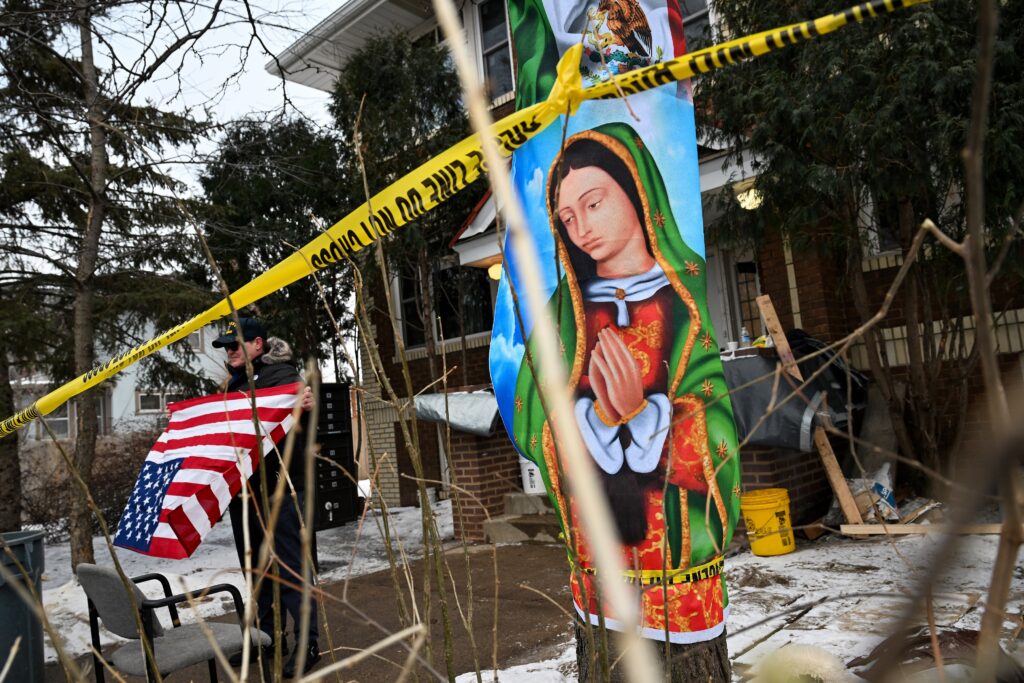
The immigration crackdown in Minneapolis is revealing divisions among Christian leaders across the country about appropriate religious responses to ICE’s most aggressive enforcement tactics.
Episcopal bishops in New Hampshire and Minnesota have in recent days told their flocks to be prepared even for death in order to protect the vulnerable. Clergy members are among those, along with union leaders and others, calling for a general strike Friday to protest U.S. Immigration and Customs Enforcement. A network of progressive groups that had urged members of the clergy to come to Minneapolis later this week said its event was spurred by “a crisis of faith communities failing to live into a vision of Beloved Community,” advertising the call to action as an extension of the religious mantle of the 1960s civil rights marches.
But an anti-ICE protest that took place inside a St. Paul church Sunday has drawn outrage from conservatives as well as skepticism from some ICE critics, who say a sacred space shouldn’t be a protest target. The Justice Department has launched a civil rights investigation of the noisy demonstration inside the Southern Baptist church, including the organizer, who is also an ordained minister.
“No cause — political or otherwise — justifies the desecration of a sacred space or the intimidation and trauma inflicted on families gathered peacefully in the house of God,” Kevin Ezell, head of the Southern Baptists’ missionary arm, wrote in a statement Monday.
Some say that failing to protest — even in uncomfortable ways — is a betrayal of basic Christian precepts.
“I believe that if someone professes to represent the Gospel of Jesus Christ and to preach it, that they should not be allowing ICE agents to drag people out of their homes,” Nekima Levy Armstrong, who led the protest at Cities Church on Sunday, said on the left-leaning show “Democracy Now!”
The Trump administration’s Operation Metro Surge, which has resulted in the arrest of more than 3,000 people in the Twin Cities in less than two months, is putting new pressure on age-old tensions between the Christian mandate to aid the poor and vulnerable and the conservative views of many U.S. Christians who want to show support for law enforcement. While many agree with the administration’s stated goal to arrest and deport undocumented people who have committed crimes, nearly two-thirds of Americans oppose such treatment of people who have no criminal record, the firm PRRI found last month. That split is pressuring Christian Americans to choose how to respond to ICE’s behavior and the increasingly confrontational actions of protesters.
“The Reformation was based on protests,” said Trey Turner, executive director of the Minnesota-Wisconsin arm of the Southern Baptist Convention, one of the biggest conservative Christian bodies in the country. “I would expect any Christian protester to represent the Lord with the same character traits described in scripture and not simply the parts about turning over tables.”
Christians he knows, Turner said, are torn between wanting to take a clear moral stand and not wanting to be part of a slide toward lawlessness.
“I believe many Christians struggle with how to view protests and protesters,” he said.
Two days after Minneapolis protester Renée Good was shot and killed by an ICE officer, New Hampshire Episcopal Bishop Robert Hirschfeld announced a stark message: He’d told his priests to “get their affairs in order.”
Speaking to a crowd at a vigil in Concord, Hirschfeld said he’d told his priests “to make sure they have their wills written, because it may be that now is no longer the time for statements, but for us with our bodies, to stand between the powers of this world, and the most vulnerable.” Hirschfeld’s address has been watched millions of times on social media.
“Someone who says ‘I am willing to put my body on the line’ doesn’t mean they will impede law enforcement, it means they may lawfully videotape, go to hearings,” or do trainings about how to protect the human dignity of migrants as well as law enforcement, the Rev. Gabriel Salguero, an Orlando pastor and leader of the National Latino Evangelical Coalition, told The Washington Post.
“But it is urgent. There is a renewed sense of urgency now,” he said, adding that the vast majority of people being detained and deported are Christian.
“You are leading to the destabilization of our churches and our families and our schools,” Salguero said. “We’re all for the deportation and detention of violent criminals, but this indiscriminate action, we don’t support that. And we won’t be silent.”
Faith leaders from more-conservative groups say their role is to provide direct support to families and congregations affected by deportations, detentions and fear but not to protest in a way that could be seen to challenge law enforcement’s legitimacy.
Turner said Tuesday that about two-thirds of the Southern Baptist Convention churches in Minnesota are majority non-White. Some SBC churches are not meeting because of fear and rumors of immigration actions, he said.
“We are a conservative denomination. I think for that reason there is a pretty close alignment with law enforcement,” Turner said. “Yet we know our brothers and sisters are hurting. We see them and are not ignoring their very real distress and needs.”
The anti-ICE protest inside a St. Paul SBC church Sunday served as a new flash point in the debate over what role churches and clergy should play at this moment. Organizers of the protest picked Cities Church after learning that the acting director of ICE’s local field office, David Easterwood, is a pastor there.
In a statement Tuesday, Cities Church Pastor Jonathan Parnell, who was leading the service when about two dozen protesters entered, said activists “accosted members of our congregation, frightened children, and created a scene marked by intimidation and threat. … Invading a church service to disrupt the worship of Jesus — or any other act of worship — is protected by neither the Christian Scriptures nor the laws of this nation.”
Other faith leaders echoed Parnell’s anger.
Robert Barron, a Minnesota Catholic bishop and well-known conservative media figure, posted on X on Monday that “I don’t care what is animating or annoying you, I don’t care what your political persuasion might be, invading a church is unacceptable and is a violation of religious liberty.”
Asked whether he thought protesting inside a church crossed a line, Hirschfeld said that he doesn’t know enough about the Cities Church protest but that “I hope the sanctuary and autonomy of churches, synagogues, mosques can be respected by all.”
Research shows Americans are divided in multiple ways over Trump’s enforcement policies.
A CNN poll conducted after Good’s death found 42 percent of Americans overall saying that they approve of the administration’s actions on immigration, down from 51 percent in March. That fall seems to have begun after a Maryland man, Kilmar Abrego García, was illegally deported in March.
A Fox News poll from mid-December found 47 percent of U.S. Catholics approved of Trump on immigration, along with 53 percent of U.S. Protestants. That figure climbed to 69 percent for White evangelicals.
Last week, Minnesota’s Episcopal bishop, Craig Loya, spoke to almost 4,000 people at a virtual vigil, telling them to be inspired by Christians who, the New Testament says, “turned the world upside down” by confronting powerful authorities to spread Jesus’ message.
“They embraced those who had been pushed aside. They cared deeply and wantonly for those the empire disregarded with its callous scorn. They put their bodies on the line over and over to stand with those being targeted,” Loya said.
Resisting, Loya said, does not mean responding with anger and scorn, or with “some naive wish that everything will be okay.” It means marching, delivering food to people afraid to leave their homes, “flooding pleas to legislators for the madness to stop” and not being overcome by weariness, he said.
Hirschfeld also drew a line between reasonable and unreasonable sacrifice.
“I wasn’t calling people to be stupid. I’m not calling people to go find a rifle to stand in front of,” Hirschfeld said. “I’m calling for and hoping they will stand with people who are vulnerable to violence.”
Scott Clement contributed to this report.
The post Christians divided over how and whether to protest ICE operations appeared first on Washington Post.