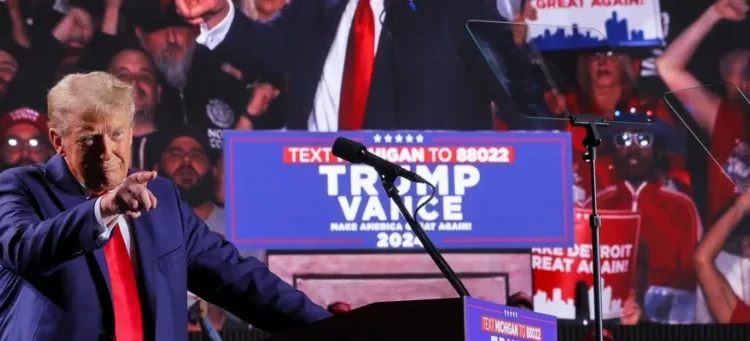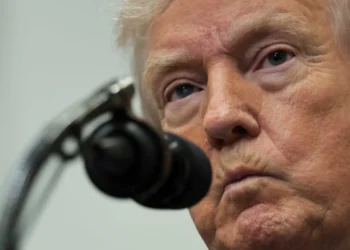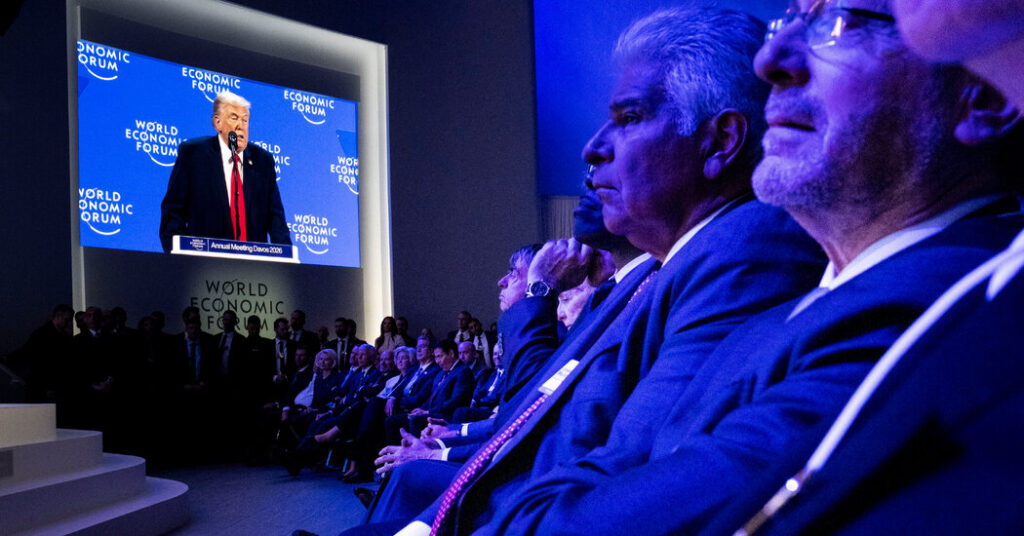
In a long, rambling address that was by turns bombastic, aggrieved and self-congratulatory, President Trump pronounced last rites on American leadership of the liberal democratic order forged by the United States and its allies after World War II.
Mr. Trump used a keynote speech at the World Economic Forum in Davos on Wednesday — a pilgrimage site for adherents of globalization — to assert that the United States was done offering its markets and its military protection to European allies he derided as freeloaders. And he vowed to advance his trade war. He characterized tariffs as the price of admission to a land of 300 million consumers.
“The United States is keeping the whole world afloat,” Mr. Trump said. “Everybody took advantage of the United States.”
By evening, Mr. Trump had flip-flopped on Greenland. He said in a social media post that he would no longer use tariffs to try to wrest control of the Danish territory, at least while discussions between his top aides and Europeans carried forth. The announcement spared the sovereignty of the island, but there was no taking back the significance of Mr. Trump’s attack on the global economic order just hours earlier.
The American president appeared in the same auditorium where, nine years earlier, the Chinese president, Xi Jinping, gave a speech claiming credentials as a champion of international cooperation. Mr. Xi captivated the village of Davos with his endorsement of what he described as “economic globalization.” His 2017 address, delivered days before Mr. Trump was inaugurated for his first term, resonated as a clear yet futile effort to stave off the trade war that soon unfolded.
“Pursuing protectionism is just like locking oneself in a dark room,” Mr. Xi said that day. “While wind and rain may be kept outside, that dark room will also block light and air. No one will emerge as a winner in a trade war.”
Then as now, deep skepticism greeted China’s bid for recognition as a responsible superpower in contrast to Mr. Trump’s vision of “America First.” China’s government has long subsidized the making of factory goods that have threatened jobs from Indiana to Indonesia. China’s surveillance state has jailed dissidents, labor organizers and journalists. Its military has menaced the self-governing island of Taiwan and neighbors in Southeast Asia. Not even its greatest allies would describe China as a paragon of fair dealing.
Yet in the near decade since, the sense has only been enhanced that China is — at least rhetorically — invested in economic values that Mr. Trump has renounced: engagement in multilateral institutions to advance its causes, faith in the wealth-enhancing powers of global trade and recognition that no country is large enough or powerful enough to go it alone.
Mr. Trump used his 90-minute turn before the global elite to underscore that contrast, even as fundamental doubts remain about the desirability of a world increasingly influenced by Beijing.
“China definitely wants to assume the mantle of being the adult in the room, while the United States continues capriciously showing hostility,” said Eswar Prasad, an international trade expert at Cornell University. “The question is whether the rest of the world is willing to accede. I don’t think the world is ready to carry full on into the embrace of China.”
Europe and China are, in some ways, natural allies in an era when the United States has opted for nationalist brio. Both remain officially committed to the concept of rules-based international trade, even as China is frequently accused of breaching the details. Both affirm the scientific reality of climate change, while mobilizing investment and know-how to combat it.
China is the global leader in clean energy technology, designing and manufacturing solar cells, wind turbines, electric vehicles and batteries. Europe, despite recent step backs, has set ambitious targets to diminish carbon emissions — a fact that Mr. Trump singled out for derision during his speech, while thumping his chest for the American return to fossil fuels.
“The United States avoided the catastrophic energy collapse which befell every European nation that pursued the green new scam, perhaps the greatest hoax in history,” Mr. Trump said.
He suggested that Chinese manufacturers were laughing while selling their wind turbines to European buyers. “They sell them to stupid people,” Mr. Trump said. “Mostly, China goes with the coal.”
In truth, the Chinese government has invested aggressively in a world-leading expansion of renewable energy while diminishing its still substantial reliance on coal.
Given that Europe’s largest economies — especially Germany — contain large-scale auto industries, and given that China has become the dominant source of electric vehicles and batteries, the two economic powers are likely to remain major industrial rivals.
The biggest wedge between them is Ukraine, said Adam Tooze, an economic historian at Columbia University and author of Chartbook, a popular newsletter. China’s steadfast refusal to condemn Russian aggression is a nonstarter in Europe, where Vladimir V. Putin, Russia’s president, is feared and reviled.
“The Europeans would stand alongside China but for Ukraine,” Dr. Tooze said. He called Russia’s war a barrier to what might otherwise be a natural form of “Eurasian multilateralism.”
Mr. Trump’s arrival was highly anticipated in Davos, and across Europe, given his threats to seize Greenland from Denmark, a fellow member of the North Atlantic Treaty Organization.
The mere possibility of a conflict between the United States and Denmark has threatened the credibility of NATO. In his speech, he repeated his laments that the North Atlantic alliance has functioned as a kind of American-furnished security charity.
“What I’m asking for is a piece of ice, cold and poorly located, that can play a vital role in world peace and world protection,” Mr. Trump said. “It’s a very small ask compared to what we have given them for many, many decades.”
A day before Mr. Trump’s address, his commerce secretary, Howard Lutnick, declared during a panel discussion in Davos that the world trading system — constructed largely on American designs — was part of history.
“Globalization has failed the West and the United States of America,” Mr. Lutnick said.
Also on Tuesday, Mark Carney, the prime minister of Canada, provided a counterweight to the worldview espoused by the Trump administration. He lamented the “rupture” of the world order and marked “the beginning of a brutal reality where the geopolitics of the great powers is not subject to any constraints.”
Mr. Trump offered a reminder of his willingness to impose tariffs on friends and enemies alike.
In what appeared to be an off-the-cuff departure from his scripted remarks, the president recounted the story of how, last year, he decided to impose steep tariffs on imports from Switzerland.
Initially, he opted for 30 percent levies in an effort to close an American trade deficit with Switzerland, he said.
Then he spoke with the country’s president, Karin Keller-Sutter. “A woman,” Mr. Trump said. “And she was very repetitive. She said: ‘No, no, no, you cannot do that, 30 percent. You cannot do that. We are a small, small country.’”
The call prompted Mr. Trump to increase the tariffs to 39 percent.
“She just rubbed me the wrong way, I’ll be honest with you,” Mr. Trump said, adding later, “She was so aggressive.”
Then he got a visit from Rolex, the Swiss watchmaker. And then he agreed to reduce the tariffs to 15 percent.
“We brought it down to a lower level,” Mr. Trump said. “Doesn’t mean it’s not going up.”
Peter S. Goodman is a reporter who covers the global economy. He writes about the intersection of economics and geopolitics, with particular emphasis on the consequences for people and their lives and livelihoods.
The post China Wins as Trump Cedes Leadership of the Global Economy appeared first on New York Times.