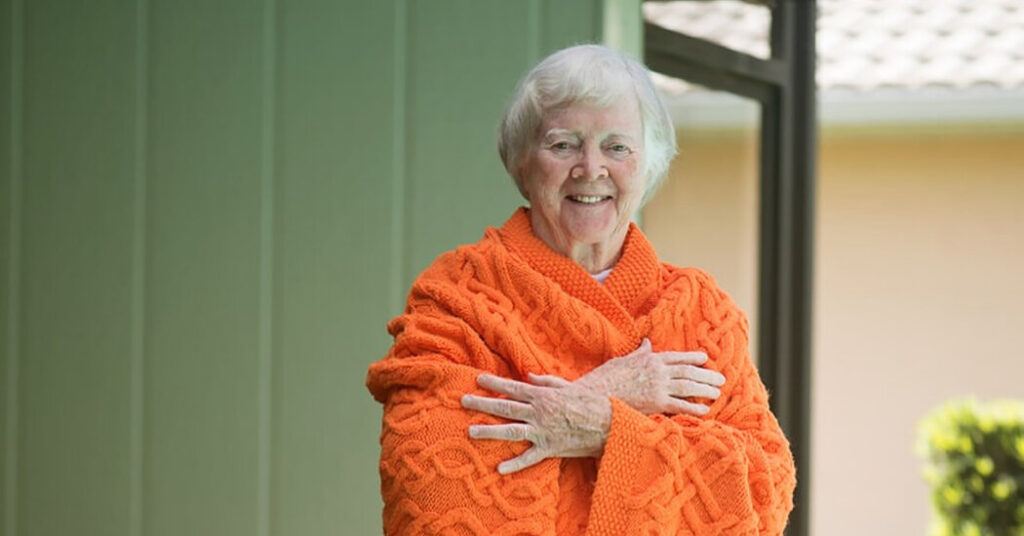
Barbara G. Walker, a self-taught knitter whose boredom with basic designs inspired her to catalog stitch patterns from around the world and to invent about 1,000 patterns of her own, making her a revered figure among the kniterati, died on Dec. 21. She was 95.
Her death, at a long-term care facility in Sarasota, Fla., was announced on her website by her son, Alan Walker, who said the cause was metastatic abdominal cancer.
“Barbara came at knitting unlike anyone else,” Trisha Malcolm, the former editorial director of Vogue Knitting, said in an interview, adding, “It was a game changer for all of us.”
Ms. Malcolm continued: “Before, if you wanted to make, say, a striped sweater, the instructions would say, ‘These are the different sizes you can make, and this is how much yarn you’ll need, and this is how many stitches you need to cast on, and this is how to decrease the stitches for the sleeves.’”
Ms. Walker “didn’t really do that,” Ms. Malcolm said. “Her thing was to show you the swatches of stitch patterns, and you’d use those designs to create a unique garment.”
Her know-how filled seven foundational books. Combined, they have sold hundreds of thousands of copies, according to Schoolhouse Press, which, in the late 1990s, began reissuing the guides that Ms. Walker wrote for the publisher Scribner’s in the 1960s and ’70s.
The reissues include her first book, “A Treasury of Knitting Patterns” (1968), along with two of the three follow-up volumes, and “Mosaic Knitting,” the title of which was a term she coined to describe her method of working with two colors to create various motifs and textures.
Ms. Walker was celebrated for devising ways to reduce the complexity and tedium of certain needle-centric tasks.
“If Barbara found an issue with how something had long been done, she was always looking to contribute, to figure out how she could improve on it,” Kristina McGowan, a knitting pattern designer, said in an interview. “More so, she’d ask, ‘How can I make the process more enjoyable?’”
Among other innovations, Ms. Walker came up with a better way to decrease a stitch — that is, to reduce the stitch count, a necessary part of shaping a garment.
She was also hailed for creating concise symbols and new vocabulary for the grid-based knitting instructions known as charts.
“Some knitters prefer to have everything written out, step by step,” Ms. McGowan said. “But for others, a chart is preferable because it conveys instructions efficiently and provides a useful visual reference.”
A forward slash, for example, was Ms. Walker’s signal to knit two stitches together. A forward slash with a dot: Purl two stitches together. (Purling, the reverse of knitting, produces a bumpy texture rather than a smooth terrain of V-shaped stitches.)
In some cases, exasperation was the mother of invention. “Barbara was always looking to figure out a way not to do things she didn’t like,” Ms. McGowan said.
For instance, she said, Ms. Walker didn’t like bobbins, the small devices used to hold separate strands of yarn, preventing tangles when knitters were working with several colors. Her workaround was slipped stitches — simply moving stitches from the left needle to the right, without either knitting or purling them.
She was no fan, either, of the traditional way of knitting sweaters, skirts and dresses — in separate sections that were later assembled with a tapestry needle and yarn. She presented an alternative in “Knitting From the Top” (1972).
“She said that knitting had a flow, and that you should take advantage of knitting’s fluid properties and create a garment that way,” Ms. McGowan said. “It was genius.”
Barbara Goodwin Jones was born on July 2, 1930, in Philadelphia and grew up in that city’s suburbs. Her father, Edward Jones, was employed by a paper manufacturer; her mother, Dorothy (Goodwin) Jones, managed the household.
She graduated in 1952 from the University of Pennsylvania’s College of Women, where she majored in journalism. Later that year, she married Gordon Walker, a research chemist, and the two moved to Washington, D.C., where Ms. Walker had gotten a job with The Washington Star. They subsequently relocated to Morristown, N.J., where they raised their son and Ms. Walker taught modern dance for a time.
In college, when a sorority sister had tried to teach her to knit, she felt like a “complete idiot,” Ms. Walker wrote in a 2024 essay for the magazine PieceWork. “I just couldn’t get it. I made a hopelessly messy, ragged swatch, threw it away and said that knitting was not for me.”
But in her mid-30s, when she was making clothes for the family on her sewing machine, she reconsidered the matter: Some homemade sweaters, she thought, might be nice after all.
She resolved to try knitting again, turning to an instructional pamphlet put out by a yarn company, and dutifully followed a basic design for a plain sweater. (Knit a row, purl a row. Knit a row, purl a row. And on and on.)
“Before I reached the end of this project, I was intensely bored by its super-repetitive operation,” Ms. Walker wrote in PieceWork.
Deliverance came in the form of knitting magazines, which showed her that sweaters and other wardrobe staples could be made with a wide array of stitch patterns.
Ms. Walker, who never again followed anyone else’s directions for knitting, immediately began collecting interesting motifs. There were no readily available texts on stitch patterns in the United States, she wrote in PieceWork. But she found what she was looking for in books published in England by the eminent British knitting experts James Norbury and Mary Thomas. She also mined the stacks at the Library of Congress for historical examples.
After a few years of hunting and gathering, Ms. Walker had hundreds of motifs sorted into categories like ribbings, twist-stitch patterns, yarn-over patterns, eyelet patterns, lace and cables. They became the basis of her first book, “A Treasury of Knitting Patterns.”
“It wasn’t just that these patterns made a sweater more interesting to look at,” Meg Swansen, an owner of Schoolhouse Press, said in an interview. “They made the sweater more interesting to knit.”
Knitting was one of many subjects that Ms. Walker, a serial autodidact, fixed on and researched down to the ground. At various times, she probed feminism, religion (she was a perfervid atheist), the occult and spirituality, writing widely on some of those topics.
She published an autobiography, “The Skeptical Feminist: Discovering the Virgin, Mother and Crone,” in 1987, as well as the novel “Amazon” (1992) and the short story collection “Feminist Fairy Tales” (1995). She also created and hand-painted a well-regarded feminist Tarot card deck in the mid-1980s.
But knitting was something of a constant. “I’ll bet Barbara always had something on her needles,” Ms. Swansen said.
Ms. Walker, who was the subject of a 2011 video interview, “Stitch Heaven Salutes Barbara G. Walker,” had a voluminous output: At her death, she had produced 15 afghans, several bedspreads, some 300 garments and around 600 meticulously detailed outfits for the 400 fashion dolls and action figures in her collection.
She also designed, knitted and wrote the instructions for garments that she sold to yarn companies for their publications, a sideline she abandoned when she attended a knitting convention and saw her work being sold for four or five times what she’d been paid for it.
Her husband died in 2017. Her son, Alan, is her only known survivor.
“Barbara researched a lot about knitting and invented a lot and wanted to get it all out there,” Ms. Swansen said. “She wanted to disseminate information. But she wasn’t an evangelist for knitting.”
She “obviously loved it and was skilled at it, but she didn’t proselytize,” Ms. Swansen added. “She was like, ‘Here it is. If you can use it, that’s great.’”
The post Barbara G. Walker, Guru to the Kniterati, Is Dead at 95 appeared first on New York Times.