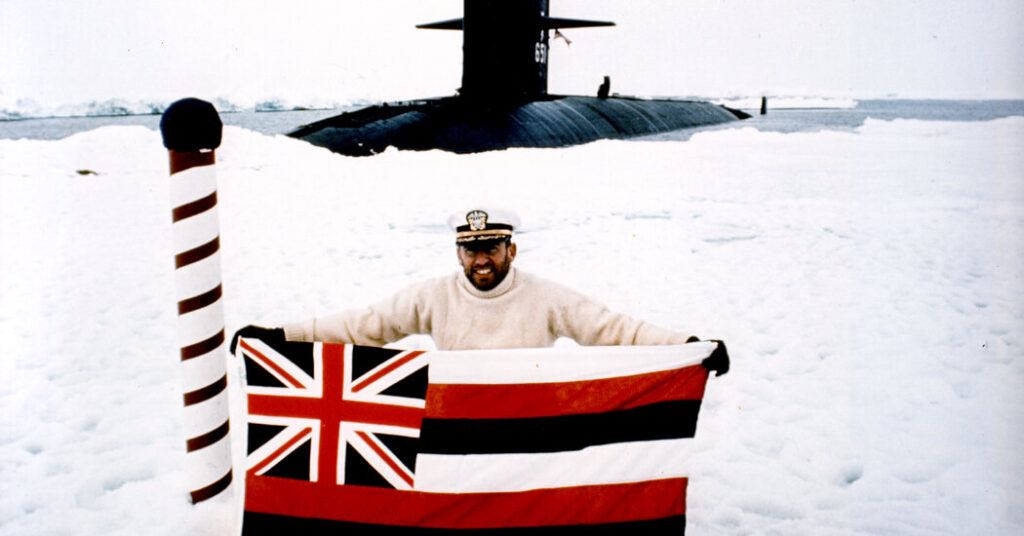
The terrifying news came to Alfred S. McLaren, skipper of the U.S. nuclear submarine Queenfish, in the form of a messenger’s tap on the shoulder while he and several of the crew were watching the western “Shane.”
It was August 1970, and the men were in the submarine’s mess, taking a well-deserved break during one of the most harrowing missions of the Cold War: mapping the Arctic sea floor off the Soviet Union’s northern coast.
The trip required the 300-foot boat to chart a painstakingly slow and unbelievably dangerous passage through narrow underwater channels formed by immense keels of ice. The mission was so secret that there was no rescue plan. If they got stuck, there was no one to save them.
The messenger said the submarine had come to an emergency stop. Commander McLaren rushed to the control room.
They were in an underwater dead end. Ice loomed just 20 feet above, and closer on both sides. The sea floor lay 10 feet below.
Commander McLaren and his crew had to backtrack, foot by foot, a few turns of the propeller at a time through the frigid darkness. If they drifted even a few feet, they might fatally damage the boat.
“Steady calm and patience were the watchwords for us all as we worked to achieve and preserve each small gain in astern direction so as to extract ourselves from the undersea cocoon in which we had found ourselves,” Commander McLaren — who was promoted to his highest rank, captain, soon after the expedition — wrote in his memoir, “Unknown Waters” (2008).
When they finally reached safety, the crew let out a sigh of relief — but not a cheer. They still had hundreds of miles to go before they finished the mission in Nome, Alaska.
The near disaster, Captain McLaren wrote, “would haunt my mind and my dreams for the rest of the voyage and for years to come.”
Captain McLaren died on Sept. 19 at a hospital in Durham, N.C. He was 93. The cause was complications from surgery, his wife, Avery Russell, said. His death was not widely reported at the time.
During a 26-year career in the Navy, Captain McLaren participated in 20 submarine missions, many of them highly classified, including three to the Arctic. He received the Distinguished Service Medal for the 1970 mission.
During his first Arctic trip, in 1960, his submarine surfaced at the North Pole. It was August, and the crew made the most of the relatively warm weather by playing the first known baseball game at the pole.
“We took great care to make sure the pitcher’s mound was on the pole,” Captain McLaren told The New York Times in 1999. “If you hit a home run, you’d circumnavigate the globe; if you hit into right field, you’d hit into tomorrow, and if the right fielder caught the ball, he’d throw it back into yesterday. Sliding took on new meaning, and I’m still not sure what day the game ended.”
During his 1970 mission with the Queenfish, the submarine partially surfaced to get its bearings. Through the periscope, Captain McLaren could see a polar bear and two cubs. They saw the submarine, too, and swam right up to the lens.
“The cross hairs are on her nose,” he told The Times in 2002. “And I’m thinking, ‘How am I going to explain teeth marks on my periscope when I get back to port?’”
He and his crew were often charged with studying the geography and climate of the Arctic, research that was intended to help with military planning and had the side benefit of providing a base line for later climate research.
Part of the 1970 mission was to retrace the route of the Nautilus, America’s first nuclear-powered submarine, which had sailed beneath the North Pole in 1958, taking measurements of the ice along the way. Captain McLaren and his crew took their own measurements for comparison.
After retiring from the Navy in 1981, he became an expert on the effects of climate change on sea ice. In 1986, he received a doctorate in polar geography from the University of Colorado with a dissertation comparing the measurements taken by the Nautilus and the Queenfish — one of the first academic studies to show that the Arctic ice cap was shrinking.
He wrote more than 50 peer-reviewed scientific articles on the subject, served as a research professor at the University of Colorado and ran Arctic Analysts, a company that evaluated data for government agencies.
Later still, he became a fixture in the booming world of maritime archaeology, diving to shipwrecks like the Titanic and the Bismarck, a German battleship sunk during a battle with the British Navy in 1941.
Captain McLaren made several dives to the Titanic and, in 2002, he was part of the team that proved the Bismarck had been scuttled by its crew, not sunk by the British. The next year, he was among the first people licensed to pilot the Deep Flight Aviator, a winged submersible that uses aeronautic principles to “fly” underwater.
It almost goes without saying that Captain McLaren was a longtime member of the Explorers Club, the venerable society of adventurers, scientists and travelers that is based in New York City. He served as its president from 1996 to 2000.
“Fred was a larger-than-life character, a submarine captain whose life left a powerful wake wherever he went,” the club’s current president, Richard Wiese, said in a statement. “Just about everyone who met him has a ‘Fred story.’”
Alfred Scott Johnson was born on Aug. 9, 1932, in Lake Arrowhead, Calif., an unincorporated town in the San Bernardino Mountains northwest of Los Angeles. His father, Alfredo Johnson, was a hotel manager, and his mother, Martita (Brennan) Johnson, was a painter.
Alfred was a child when his parents divorced, and his mother married William McLaren, a Navy captain who later adopted him. The family moved frequently; Alfred bragged that he attended 32 schools before graduating from high school.
In addition to his 1955 undergraduate degree from the U.S. Naval Academy in Annapolis, he received a master’s degree in international affairs from George Washington University in 1968 and a master’s degree in polar studies from the University of Cambridge in England in 1982.
He had originally hoped to be a Marine Corps pilot but, after being assigned to the Navy, he gravitated toward service on submarines. In 1957, Adm. Hyman G. Rickover, who oversaw the development of the nuclear Navy, selected him as one of 50 officers for training on nuclear-powered submarines.
Captain McLaren retired in 1981 after the Navy fired him from his position as the director of the Naval Underwater Systems Center. An investigation had found that he had improperly hired and promoted a civilian employee with whom he was romantically involved, Mary Durland. His lawyer at the time denied he had done anything improper.
He later married Ms. Durland. That marriage and his first one, to Mary Eisenhower, both ended in divorce.
He married Ms. Russell in 1987. Along with her, he is survived by four children from his first marriage, Alfred Jr., John, Erin McLaren and Margot McLaren; four grandchildren; and three great-grandchildren.
In addition to his memoir, he wrote two other books, “Silent and Unseen: On Patrol in Three Cold War Attack Submarines” (2015) and “Emergency Deep: Cold War Missions of a Submarine Commander” (2021).
“Retirement isn’t in my vocabulary,” he told the magazine Elevation Outdoors in 2016. “There’s still too much I want to achieve.”
Clay Risen is a Times reporter on the Obituaries desk.
The post Alfred McLaren, 93, Dies; Submariner Led Secret Cold War Missions appeared first on New York Times.