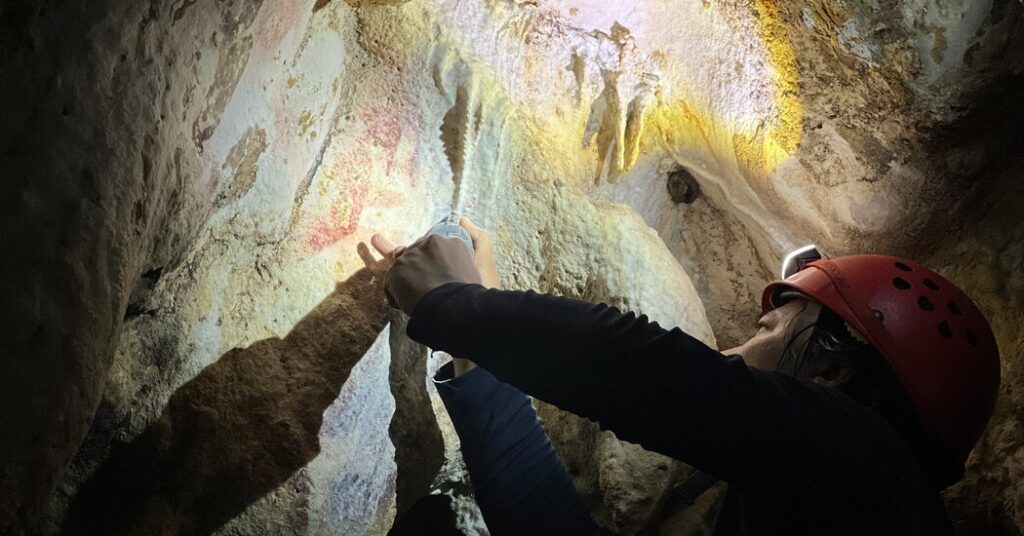
An ancient handprint in a cave on an Indonesian island may be the oldest known rock art, created at least 67,800 years ago.
The work was dated by a group of experts from Australia and Indonesia in a study published on Wednesday in Nature.
It is inside the Liang Metanduno cave on the island of Muna, part of the Southeast Sulawesi province in Indonesia. The cave has long been a popular tourist attraction for the paintings on its walls, created thousands of years ago.
Then, in 2015, Adhi Agus Oktaviana, a co-author of the study, found that an even older work might be hiding underneath. It was faint and easy to mistake for a natural color change in the rock, but it looked like a stencil of a hand.
“It was hiding in plain sight all this time,” said Adam Brumm, a professor of archaeology at Griffith University in Australia and a co-author of the study.
Mr. Brumm and his colleagues dated the work by assessing the age of calcium carbonate deposits that formed on the cave walls and over the artwork, a technique known as uranium-series analysis. That provides a minimum age — in this case at least 67,800 years.
Paul Bahn, a British expert on prehistoric rock art, added a note of skepticism to the finding of the new minimum age. “This in itself does not make this motif necessarily older than ones they have previously dated,” he wrote in an email about the study. “So claims in the media for ‘the oldest cave/rock art in the world’ are nonsense,” he continued. “This is simply some of the oldest such art known at present.”
The artwork depicts a hand with paint around it. In this case, the fingers seem to have been modified to look sharper and more claw-like, something commonly seen in cave art in other parts of Sulawesi, according to the researchers.
“The fingers are so long and pointy that it has the effect, almost, of Nosferatu’s claw-like hand,” Mr. Brumm said.
“As far as I can tell, it is extremely faded,” Mr. Bahn said, “so I would need to see much stronger evidence that this effect was done deliberately rather than, for example, pigment slipping beneath the fingers when sprayed.”
The scientists who published the study were unclear about why hands were depicted this way, but Mr. Brumm said he believed it might be because “they were trying creatively transform an image of a human hand into something else.”
Paul Pettitt, a professor of palaeolithic archaeology at Durham University who was not part of the study, said in an email that the researchers’ dates for the handprint “appear to be sound.”
He noted that it was still unclear exactly when the art was created. The hand stencil was created sometime earlier than 67,800 years ago, but, he said, “We don’t know by how much earlier that is.”
While the researchers did not rule out that species predating humans created the artwork, the study concluded that the handprint was most likely created by Homo sapiens, citing the “added technical and stylistic complexity” of the fingers and the work’s “close fit with the known arrival time of our species in the region.”
Professor Pettitt said it was plausible another species could have created the work. He said that Neanderthals also used hand stencils and suggested that “other potential human groups, such as the poorly understood Denisovans,” could be responsible.
The area was already considered by some experts to be the site of the earliest known representational cave art in the world. A captivating scene elsewhere on the island, which displays human-animal hybrids, was found to be at least 43,900 years old, according to the same team of researchers in a 2019 study. In 2024, they revised that to 51,200 years ago after testing the artwork using a new technique.
The researchers said they believed the hand stencil, with its claw-like fingers, could represent the same ancient belief system as that of their 2019 discovery.
“The new results further indicate the importance of Indonesia in the emergence of human figurative and nonfigurative art,” Professor Pettitt said.
The artwork also adds to the scientists’ understandings of the Aboriginal people of Australia, whose ancestors are believed to have crossed from Asia 60,000 to 70,000 years ago via a series of islands.
One of the routes scientists believe they could have taken is via a chain of islands that includes Sulawesi.
With the finding of this rock art, Mr. Brumm said, “it does make it considerably more likely that that was the pathway taken by early modern humans to get to Australia.”
Claire Moses is a Times reporter in London, focused on coverage of breaking and trending news.
The post A 67,800-Year-Old Handprint May Be the World’s Oldest Rock Art appeared first on New York Times.