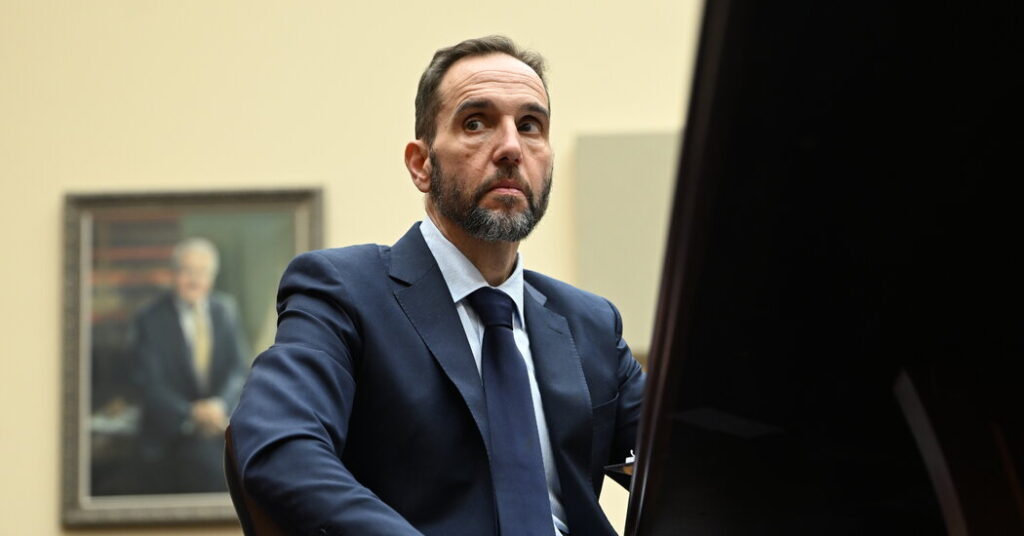
The former special counsel Jack Smith appeared before Congress on Thursday to defend his decision to bring two criminal indictments against Donald J. Trump after he left office in 2021.
Mr. Smith’s restrained five-hour testimony to the House Judiciary Committee was the first and perhaps only chance he will have to make his case in an official forum that he was justified in filing the two sets of charges against Mr. Trump in 2023. In separate indictments, Mr. Smith accused Mr. Trump of seeking to overturn his defeat in the 2020 presidential election and of illegally removing reams of highly classified documents from the White House and taking them to Mar-a-Lago, his private club and residence in Florida.
Much of what Mr. Smith told lawmakers reprised the testimony he gave last month in a videotaped deposition behind closed doors. In his remarks, he repeatedly denied that he had acted out of partisan animus, and bemoaned the Trump administration’s own efforts to use the Justice Department to go after the president’s enemies.
Here are a few takeaways from his testimony.
Smith’s work was under scrutiny, not his findings
Republican members of the committee spent most of their time attacking various procedural steps that Mr. Smith took in his prosecutions of Mr. Trump in an effort to suggest that he had acted out of political motives. They had less to say, however, about Mr. Smith’s repeated assertion that if the two cases — both of which were dismissed after Mr. Trump won re-election — had gone to trial, there was sufficient evidence to secure convictions.
Skipping from complaint to complaint, the Republican members noted that Mr. Smith had obtained phone records for several Republican lawmakers who were in touch with Mr. Trump and his allies about their plans to overturn the election; issued subpoenas to dozens of Republican fund-raising groups allied with Mr. Trump; and made payments to confidential human sources in the course of his investigation of the election interference charges.
The Republicans expressed outrage about all of these tactics — even though Mr. Smith explained that they were standard tools of criminal prosecutions and that he had followed both the law and the procedures of the Justice Department in using them.
The political attacks were familiar
Instead of raising serious qualms about Mr. Smith’s methods, the committee majority often fell back on familiar political attacks, claiming that he and his team had “weaponized” the criminal justice system on behalf of the Biden administration — an accusation that Mr. Smith repeatedly and adamantly denied.
Several times, under questioning by Democratic lawmakers, Mr. Smith said that he had never received orders from the attorney general at the time, Merrick B. Garland, or from anyone else in the Biden administration about how to pursue his cases against Mr. Trump.
“I am not a politician and I have no partisan loyalties,” Mr. Smith said during his opening statement.
He said that, after three decades as a prosecutor, he had simply followed the facts and the law without “fear or favor.”
“No one should be above the law in this country, and the law required that he be held to account,” he said of Mr. Trump. “So that is what I did.”
Smith remained unbowed by personal broadsides
When asked whether he had any regrets about his investigations, Mr. Smith said he had only one: that he had not expressed more appreciation for the F.B.I. agents and prosecutors who worked under him.
Several of those agents and prosecutors have been fired by the Justice Department because of their service to Mr. Smith. They have also faced efforts by members of Congress to impugn them and their work.
Moreover, Mr. Smith insisted that he would not be cowed by any of the vitriolic broadsides that Mr. Trump has continued to make against him personally. Those included a message that was posted online in the middle of the hearing by an official White House social media account, saying, “Jack Smith is a deranged animal, who shouldn’t be allowed to practice Law.”
Mr. Smith acknowledged that he believed that Trump officials would “do everything in their power” to indict him “because they’ve been told to do so by the president.” But he said he would not bend in the face of the threats.
“I will not be intimidated,” he declared
Trump’s punitive approach raises concerns about the rule of law
The accusations by Republicans that Mr. Smith had weaponized the criminal justice system came as Mr. Trump’s own Justice Department has done exactly that in ways that have not been seen in a generation. Democratic members — most notably Representative Jared Moskowitz of Florida — pointed out that the Trump administration had gone after dozens of the president’s perceived enemies, bringing charges against some, opening investigations against many more and using other punitive tactics like stripping people of their security clearances.
Mr. Smith expressed concern that the Trump administration was abandoning the traditional norms of criminal prosecution, and he urged the lawmakers to stand up for the rule of the law.
“The rule of law is not self-executing,” he said. “It depends on our collective commitment to apply it.”
He refused to apologize for prosecuting Mr. Trump.
“My belief is that if we do not hold the most powerful people in our society to the standards of the rule of the law, it can be catastrophic,” he said.
Alan Feuer covers extremism and political violence for The Times, focusing on the criminal cases involving the Jan. 6 attack on the Capitol and against former President Donald J. Trump.
The post 4 Takeaways From Jack Smith’s Testimony Before Lawmakers appeared first on New York Times.