The Trump administration is eager to strip naturalized Americans of their citizenship, and the reasons seem to vary wildly.
Official grounds include fraudulent citizenship applications, financial wrongdoing, violent crime and ties to gangs or drug cartels. But the president has also added justifications that are more subjective and idiosyncratic. “I’d do it in a heartbeat if they were dishonest,” he said in a recent interview with The Times. Or if they “complain” too much or “cause trouble” or if they “hate our country.” The administration is even setting a quota for how many denaturalization cases it hopes to take up: 100 to 200 per month.
This escalation of what had become an uncommon practice — the United States denaturalized an average of 11 citizens per year from 1990 to 2017 — would do more than reaffirm the hypocrisy of a president and a party that long claimed to support lawful immigration. It reveals a willful misunderstanding of what it means to become an American citizen, of all that propels people to leave the place where they were born and to embrace a new one, this one, as their own. And it reiterates the administration’s zeal to redraw the limits of belonging in this country.
When you redefine who gets to be American, you are also redefining what it means to be America.
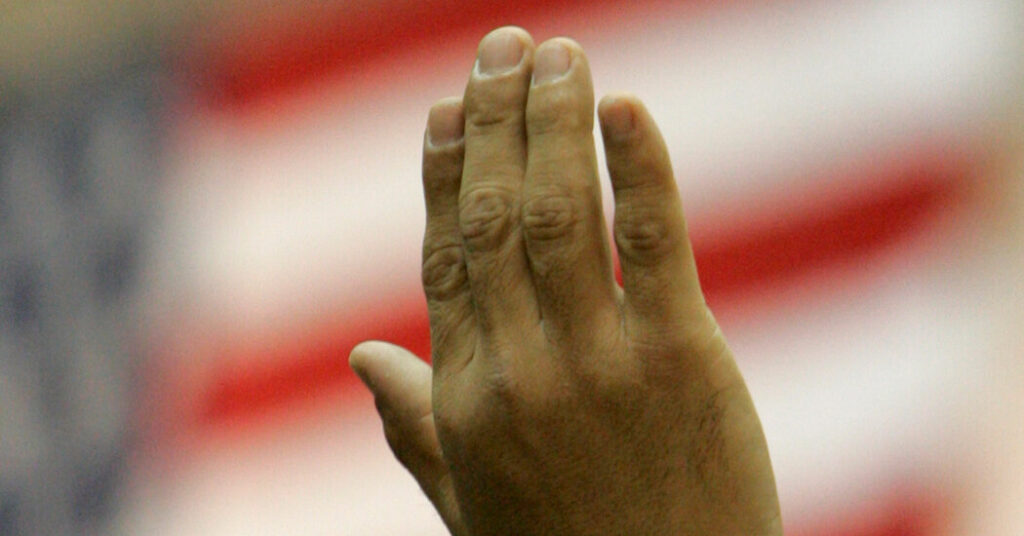
Naturalization is not merely a bureaucratic transaction. It is not just about filing paperwork or applying for a blue passport. It is the commitment to an idea, the culmination of a personal and political transformation, the fulfillment of a long-held ambition. I became an American citizen in 2014, at age 43, when I stood in a federal building in Maryland and swore an oath to “support and defend the Constitution and laws of the United States against all enemies.” But I’ve slowly been becoming one all my life.
You could seize the certificate of naturalization that I received that day from the Department of Homeland Security, which attests that I have “complied in all respects with all of the applicable provisions of the naturalization laws” and am “entitled to be admitted as a citizen of the United States,” and declare it invalid. But you would not denaturalize me.
You could go back to when I filed my application, and you could search for fraud or for a fleeting error that you can pretend is fraud, a wrong date or a missing accent mark or a typo, and you could try to use that to take back my citizenship. Still, you would not denaturalize me.
You could take the form letter I received from a prior American president (“We embrace you as a new citizen of our land, and we welcome you to the American family”) that hangs above my desk at home, and you could bust the frame apart and rip the paper into pieces, and even then you would not denaturalize me.
To denaturalize me, you would have to do more than revoke my papers. You would have to revoke my life. You would have to unmake every step along the path that brought me here from Peru, first as a child, later as a young man. You’d have to identify the convictions and experiences that have bound me to the United States and pry them out of me, all of them.
That is not possible, even for a government with such powers and resources as ours.
To denaturalize me, you would have to go back to my early childhood in the 1970s, to when my family had just arrived in California, green cards in hand, and you would have to keep me from hearing the confidence and certitude with which my father spoke about the United States. He simply called it “este país”: this country.
In este país, he said, I would have opportunities. In este país, I could educate myself and earn a good living. In este país, I was free to think for myself. How many times, during my earliest years in this country, did I hear him go on and on about this country?
To denaturalize me, you’d have had to make him unsay it — or you’d have to make me forget it.
You’d have to come with me, in the 1980s, when my family returned to live in my native Lima, where my American-accented Spanish earned me the schoolyard nickname “gringo.” I soon shed the accent and polished my Spanish, but the name stuck throughout my high school years. Even in my native land, my bond with America marked me. To denaturalize me, you’d have to change that name, break that bond.
To denaturalize me, you’d have to keep me from reading, in my early teens, my father’s copies of John Jakes’s eight-volume American Bicentennial series, improbably heroic stories of American valor and sacrifice, stories that showed me that America means a daily choice between high-minded principles and self-serving impulses, between a welcome and a slap. You’d have to undo my continued reading, in the decades since, of American politics and history, a fixation that I’ve come to understand as part of my effort to claim a spot.
To denaturalize me, you’d have to keep me from returning to the United States at age 17; from educating myself in American universities, as my father had hoped; from making a home here; from seeing my children born in America’s capital. You’d have to nullify my votes in U.S. elections, undo my travels throughout the country and erase my years of writing — sometimes admiring, often critical — about the American experience. And you’d have to retract my old arguments with my father about whether este país was living up to its promise.
“American” is not just the legal status I’ve obtained; it is the life I have lived. I am a Peruvian citizen by birth, but I am an American citizen by choice. I voted with my feet. My U.S. citizenship does not just mean that I am a naturalized American; it means that America has become second nature. It is embedded in me, and it cannot be stripped away, not without doing violence to the whole.
If you cannot denaturalize me, you can instead try to de-Americanize America. Even more so than the president he so obsequiously serves, Vice President JD Vance seems intent on achieving this. On various occasions, he has downplayed the ideals that define this country, favoring instead the notion of America as a geographic entity reserved for a certain kind of people.
“America is not just an idea,” he said in a speech at the Republican National Convention in 2024. “It is a group of people with a shared history and a common future. It is, in short, a nation.” He spoke of his family’s cemetery plot in eastern Kentucky and of the many generations laid to rest there, generations that built this country.
“That’s not just an idea, my friends,” he said. “That’s not just a set of principles. Even though the ideas and the principles are great, that is a homeland. That is our homeland. People will not fight for abstractions, but they will fight for their home.”
.op-aside { display: none; border-top: 1px solid var(–color-stroke-tertiary,#C7C7C7); border-bottom: 1px solid var(–color-stroke-tertiary,#C7C7C7); font-family: nyt-franklin, helvetica, sans-serif; flex-direction: row; justify-content: space-between; padding-top: 1.25rem; padding-bottom: 1.25rem; position: relative; max-width: 600px; margin: 2rem 20px; }
.op-aside p { margin: 0; font-family: nyt-franklin, helvetica, sans-serif; font-size: 1rem; line-height: 1.3rem; margin-top: 0.4rem; margin-right: 2rem; font-weight: 600; flex-grow: 1; }
.SHA_opinionPrompt_0325_1_Prompt .op-aside { display: flex; }
@media (min-width: 640px) { .op-aside { margin: 2rem auto; } }
.op-buttonWrap { visibility: hidden; display: flex; right: 42px; position: absolute; background: var(–color-background-inverseSecondary, hsla(0,0%,21.18%,1)); border-radius: 3px; height: 25px; padding: 0 10px; align-items: center; justify-content: center; top: calc((100% – 25px) / 2); }
.op-copiedText { font-size: 0.75rem; line-height: 0.75rem; color: var(–color-content-inversePrimary, #fff); white-space: pre; margin-top: 1px; }
.op-button { display: flex; border: 1px solid var(–color-stroke-tertiary, #C7C7C7); height: 2rem; width: 2rem; background: transparent; border-radius: 50%; cursor: pointer; margin: auto; padding-inline: 6px; flex-direction: column; justify-content: center; flex-shrink: 0; }
.op-button:hover { background-color: var(–color-background-tertiary, #EBEBEB); }
.op-button path { fill: var(–color-content-primary,#121212); }
Know someone who would want to read this? Share the column.
Why would the vice president of the United States, the same man who swore an oath to “support and defend the Constitution of the United States,” speak so dismissively of the principles that are meant to govern the nation? Certainly, people will fight for their home, but even more so, they’ll fight for the right to live freely in that home. Absent that right — that abstraction — what exactly are we defending?
Without the ideals set forth in the Declaration of Independence, without equality before the law, without the consent of the governed, America would be a place like any other, neither distinctive nor exceptional. It would cease to be este país.
By exalting the place over the idea, by diminishing the creedal nature of America, Vance shows us who he thinks really belongs here. If you’re not from the place, if you can’t point to generation upon generation that has lived here before, you are somehow a lesser American. He hails Americans who can trace their ancestors to the Revolutionary era or the Civil War, and he warns that we cannot just “swap” in what he calls “low-wage serfs” from elsewhere.
In recent social media posts, federal agencies have underscored their adherence to this worldview. “One Homeland. One People. One Heritage. Remember who you are, American.” That one’s from the Department of Labor. The same Department of Homeland Security that issued my citizenship certificate 11 years ago now posts this message: “The stakes have never been higher, and the goal has never been more clear: Remigration now. Help Arrest Them. Help Deport Them.” And an Immigration and Customs Enforcement recruitment ad promises, “We’ll have our home again,” a partial echo of a song favored in white-nationalist circles.
Our home. One heritage. Arrest them. Remember who you are. All citizens may be Americans, but apparently some are more American than others.
By contrast, the Constitution of the United States does not establish hierarchies of citizenship. “All persons born or naturalized in the United States and subject to the jurisdiction thereof are citizens of the United States and the state wherein they reside,” the 14th Amendment reads. That “all” is encompassing; it does not parse lineage or landholdings. “All” means all.
When Vance, in an almost childlike desire to please his boss, banged on the table in approval at a cabinet meeting last month after the president demeaned Somali Americans in Minnesota as “garbage” who “come from hell” and “do nothing but bitch,” the vice president made clear what kind of Americans he believes are the real thing. Real Americans don’t point out America’s tensions and contradictions, Vance has argued; they must simply express “gratitude” for what they’ve been granted — as if quiescence and deference were traditional American values.
Pick up the Declaration of Independence, however, and you’ll see that America’s founders bitched plenty. They complained of a tyrannical leader who “obstructed the administration of justice” and “excited domestic insurrections amongst us.” They assailed that monarch for “cutting off our trade with all parts of the world,” for “quartering large bodies of armed troops among us” and for “protecting them, by a mock trial, from punishment for any murders which they should commit on the inhabitants of these states.”
They also criticized that leader, by the way, for “obstructing the laws for naturalization of foreigners.”
This administration is hardly the first that has sought to denaturalize foreign-born citizens. Throughout its history, the United States has listed various criteria for such action. A fraudulent application, the lack of “good moral character” and race have been relevant criteria. (People of Indian descent, for example, were deemed racially ineligible for naturalization in the 1923 Supreme Court ruling in United States v. Bhagat Singh Thind.) Anarchists, such as Emma Goldman, lost their citizenship, as did some members of the German American Bund during World War II. At other times, voting in foreign elections, marrying a foreigner or taking up residence abroad too soon after acquiring American citizenship have been reasons for denaturalization.
Who do members of the current administration wish to denaturalize? Essentially, foreign-born citizens they do not like. In his Times interview, the president seized on Ilhan Omar, a Somali American member of Congress from Minnesota, calling her a “disaster” and a “troublemaker” who does nothing but “complain, complain, complain.” She should “absolutely” lose her citizenship, he said.
When President Trump says he would denaturalize citizens who “hate our country,” it helps to remember how frequently he conflates love of America with love for him. In defending his pardons of the Jan. 6 rioters, he said, “These were people that actually love our country.” And he once branded Democratic lawmakers as traitors to the United States just because they did not clap for him at a State of the Union address. “Can we call that treason?” the president asked. “Why not? I mean, they certainly didn’t seem to love our country very much.”
The administration’s actions aim to curtail the breadth of Americanness, to place its perceived enemies beyond a zone of not just patriotism but also legitimacy. If you work for the wrong government agency, speak the wrong language, support the wrong party, hail from the wrong city or state or country, read the wrong history or hold the wrong political positions, then you inhabit a different America, one with fewer rights and protections, one where the consent of the governing, not of the governed, matters most. The overwhelming presence of federal immigration agents in Minneapolis — outnumbering even the city’s police officers — is but one example of these new rules. Once confined to that zone of illegitimacy, you are not a citizen but a traitor, not a protester but a domestic terrorist, not a newcomer but an eternal outsider.
Is it worth it? Is purging America of immigrants so crucial that in the process you must unmake America itself? Or is this how you intend to denaturalize me — by turning the country I joined into one I cannot recognize?
The tragedy is that immigrants know well and hold dear the same American principles that the president and vice president so readily downplay or violate. Many of us were drawn here and sought citizenship here because of those ideals. We studied them; we believe in them; we’ll cling to them in whatever language we speak. We are duty bound to uphold them; unlike native-born citizens, we took an oath to do so. Their endurance gives meaning to the sacrifices we made to get here.
You could strip all immigrants out of this country but not without doing violence to the whole.
Naturalization is not a moment; it’s a life. Even the Department of Homeland Security understands this, or it once did. When I became an American citizen, I received, along with my certificate, a sheet of paper labeled “Important Information for New Citizens.” It covered not just my rights but also my responsibilities as an American, listing them side by side, in bullet points. “Our system of government relies on an active and engaged citizenry,” it reads. “Your efforts will help ensure that America’s promise of freedom, democracy and liberty is secured for generations to come.”
The first right the sheet lists is the freedom to express myself; the first responsibility is to defend the Constitution, that old American blueprint so full of abstractions. Other responsibilities span the daily life of a citizen: Stay informed. Participate in the democratic process and in the life of my community. Respect the law and the rights of others. There’s nothing about constant expressions of gratitude or sufficient applause for a leader and certainly nothing requiring mindless subservience. With good reason: Obeisance and docility have never struck me as particularly American qualities.
The last responsibility listed on the sheet is to “defend the country if the need should arise.” That need, I believe, is now arising.
America is not the plot you own or the ancestry you claim; it is what you are and what you strive to become. Citizenship is not about where you live in America or how long you’ve lived in America. It is about how you live in America.
That is why there is something deeply unnatural about denaturalization. That’s why you cannot denaturalize me. Not so long as this country is still este país.
The Times is committed to publishing a diversity of letters to the editor. We’d like to hear what you think about this or any of our articles. Here are some tips. And here’s our email: [email protected].
Follow the New York Times Opinion section on Facebook, Instagram, TikTok, Bluesky, WhatsApp and Threads.
The post You Can’t Denaturalize Me appeared first on New York Times.