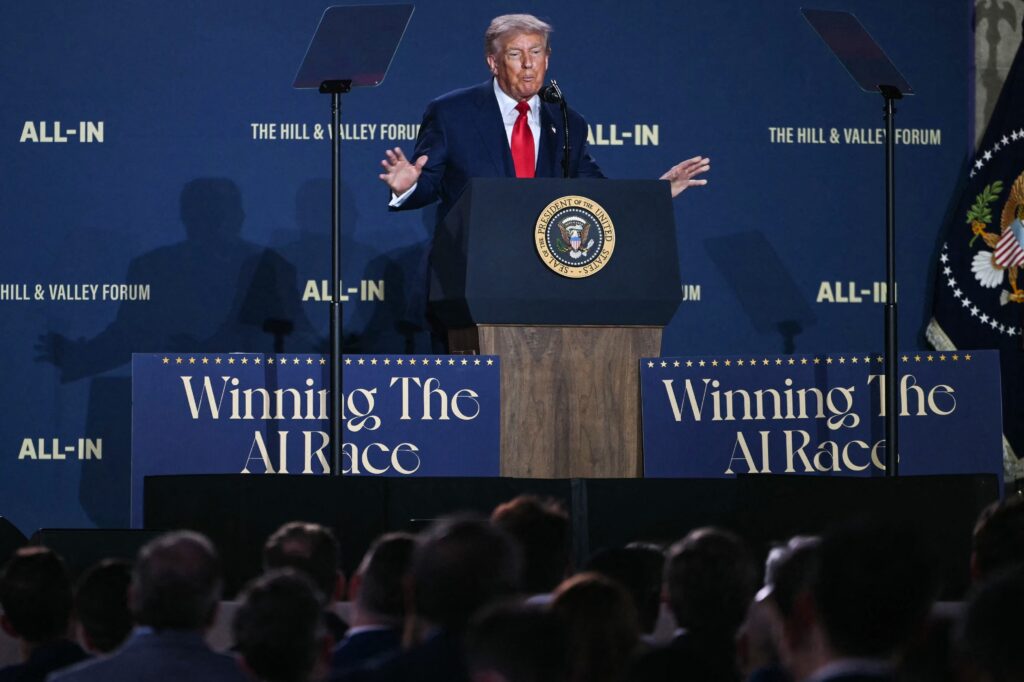
Facing a public worried that highly intelligent computers and a new generation of robots are coming for their jobs, the White House is embarking on a campaign to show that artificial intelligence will actually unleash an economic renaissance — and that President Donald Trump deserves a large dose of the credit.
A report issued by the president’s economic advisers Wednesday calls it the “Trump Revolution.”
In the White House’s telling, America is pulling ahead in the race to dominate AI technology, priming the economy for rapid growth and helping the nation surpass China and Europe. But that sunny take has to contend with a public that is largely gloomy about what AI will mean for the country and their job prospects. Poll after poll in the past year have found that Americans are skeptical the technology will do more good than harm for their work and the country, a challenge for an administration that has prioritized moving as fast as possible on AI.
Jacob Helberg, a senior State Department official and one of the authors of the report, said there is “mass hysteria in some places about jobs dislocation.”
“The economy is incredibly dynamic,” said Helberg, who worked in the tech industry before joining the Trump administration, “and we’re seeing the potential for a lot of new jobs and new job categories that we can’t even conceive of today that will likely come about into existence over the next few years as the AI revolution matures.”
Trump is expected to tout his administration’s efforts to propel the U.S. economy forward at a speech at the World Economic Forum in Davos on Wednesday. He plans to call on Europe — where officials have taken a more cautious approach to AI — to abandon policies that American officials warn are causing stagnation across the Atlantic.
The technology has become increasingly powerful since the public launch of OpenAI’s ChatGPT in late 2022, but economists remain uncertain about exactly what AI will mean for the economy as a whole. Forecasts cited in the White House analysis present a range of possibilities, from modest increases in growth to huge booms on par with the Industrial Revolution. Similar questions remain about whether AI systems will unlock gains in how efficiently people can work or push them out of a job entirely.
Technology industry executives and Trump administration officials spent the past year touting that AI investments were helping power the economy and revive U.S. manufacturing jobs — amid predictions that widespread use of AI might also wipe out vast numbers of white-collar jobs. The new economic advisory report doesn’t say whether AI will ultimately be helpful or harmful for workers.
There remains split opinions, too, about how much of an economic boost is coming from AI. Economists at JPMorgan Chase said this month that technology companies’ spending on AI data centers and related investments had no effect on U.S. economic growth in the first nine months of 2025.
That conclusion from an analysis of government data is uncommon among economic forecasters. But it shows the growing pushback to the narrative in Silicon Valley and Washington that U.S. corporations’ AI investments are keeping the wobbly U.S. economy afloat.
Little of the uncertainty is on show among Trump’s advisers — even if they implicitly acknowledge the public gloom. David Sacks, the tech investor and White House AI czar, has logged research about the upsides of AI on his X feed as “narrative violations.”
“AI is creating too many jobs!” Sacks wrote last week, linking to a report that data center construction is facing a shortage of construction workers.
On the key question of jobs, the White House paper acknowledges that evidence of current effects of AI on the job is mixed. But it argues that the lesson from history is that new technologies eventually create new kinds of better-paying jobs.
Trump’s team — with the backing Sacks and other leading figures in the industry — has sought to promote investments in AI and push aside regulations that could hinder its development. The report highlights changes to the tax code, efforts to ease rules on the building of data centers and trade deals governing the sale of high-end computer chips. In December, the president also issued an executive order directing the Justice Department to sue states that have laws officials believe will slow innovation.
“This past year has been one of the most dramatic accelerations of the prioritization of technology in the history of American government,” Michael Kratsios, the head of the White House science and technology office, said at a Washington Post Live event in Davos on Tuesday.
Jason Furman, an economics professor at Harvard University and former adviser to President Barack Obama, said that while the White House report is a reasonable — if generally optimistic — summary of the latest studies on AI, it wildly overstates the impact of Trump’s policies.
“I think directionally Trump has been helpful to AI,” he said, but “it’s a small part of the story of what happened to AI over the past year.”
There are signs that the White House’s embrace of AI carries political risks. Polling in June by the Pew Research Center found that about half of Republicans and Democrats alike are “more concerned than excited” about what the technology will mean for daily life. Nearly two-thirds of adults the center surveyed in 2024 thought AI would lead to job losses.
Some figures within the broader MAGA movement have called for a rethink, especially as heated battles have broken out in communities across the country over proposals to build vast data centers that guzzle water and sap electrical grids. They include former congresswoman Marjorie Taylor Greene (R-Georgia), whose alliance with Trump broke down in part over AI, as well as Sen. Josh Hawley (R-Missouri) and Republican Govs. Ron DeSantis of Florida and Sarah Huckabee Sanders of Arkansas.
In the past week, Trump has acknowledged some of the concerns, highlighting commitments by tech giant Microsoft not to push up power bills in communities with data centers. The administration assembled governors at the White House on Friday to tackle electricity costs in a group of 13 Mid-Atlantic states.
The tech industry itself is grappling with how to frame its message as Silicon Valley programmers find the ways they do their jobs rapidly changing as AI tools churn out lines of serviceable computer code and leading AI companies seek to justify their huge investments.
Chaya Nayak, who leads OpenAI’s work on helping people develop AI skills, told lawmakers at a House hearing last week that the company’s technology will “give anyone the power to turn ideas into income” but added, “some jobs will actually be lost.” (The Washington Post has a content partnership with OpenAI.)
And in Davos, this week, Dario Amodei, the chief executive of AI firm Anthropic, sketched out a future of both high economic growth and high unemployment.
“That’s not a combination we’ve almost ever seen before,” he said at an event hosted by the Wall Street Journal. “There’s gonna need to be some role for government in the displacement that’s this macroeconomically large.”
The post White House boasts of a ‘Trump Revolution,’ countering fears of job-killing robots appeared first on Washington Post.