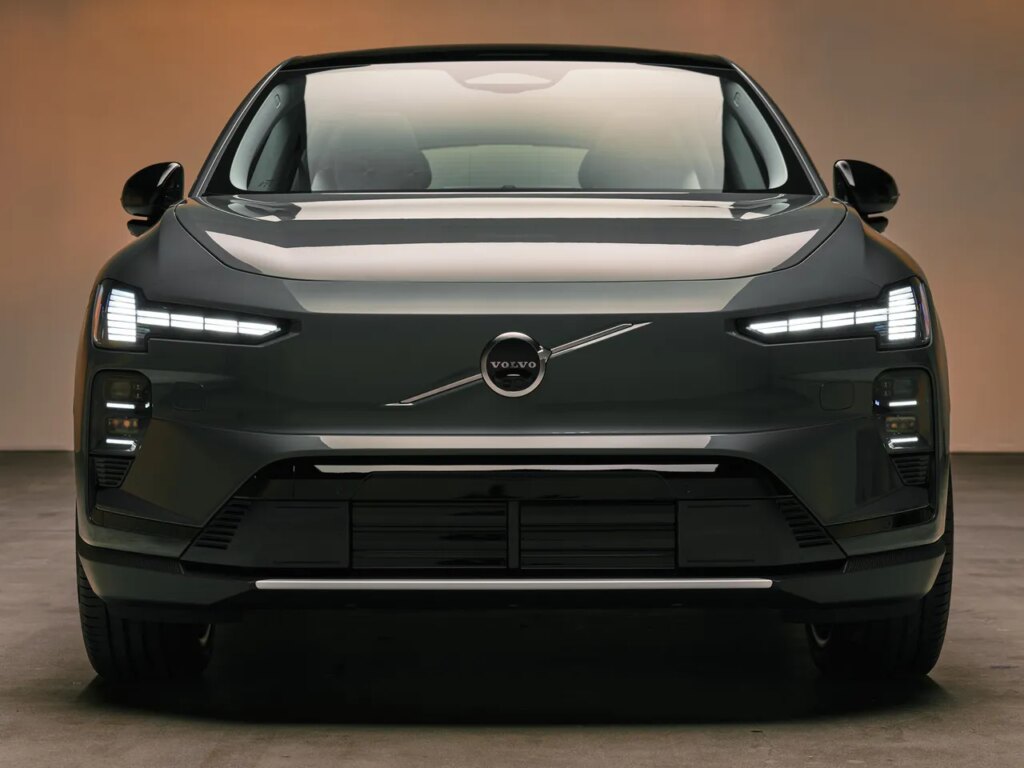
Alongside the chosen few in WIRED’s breakdown of the most anticipated EVs coming this year, the arrival of the Volvo EX60 has also been eagerly awaited. This mainly because of the impressive stats surrounding the car; the headline claim is a range of more than 400 miles.
Sitting between the EX40 and EX90, the new EV looks more like a sibling of the entry-level EX30, which is a good car but too fast for it’s own good. Plus, the reveal images here from Volvo initially seem to show that the design team has figured a way to remove the unsightly lidar roofline bulges that in some eyes ruined the finished aesthetic of the EX90. (A Volvo designer at the EX90’s launch admitted to me the team had problems dealing with the hump.) However, I’m told that these images here show the new car without the lidar system installed, and that if your EX60 does have the optional lidar spec then, unfortunately, the humps will be there.
This is important because Volvo knows the look is not good. The brand went to great lengths to hide the lumps on the EX90 launch pictures—showing the car in the very far distance was my favorite tactic—and here with the EX60, it has chosen to reveal its latest EV to the world using the model where the tech is not even in the car. This choice to show the off EX60 with a preserved straight roofline is clearly deliberate, at best aimed at keeping the design team happy, and at worst possibly misleading to unsuspecting customers looking to buy the flagship model.
With 503 miles of maximum range (measured using the WLTP standard), this should still be a very impressive 400-plus miles on the US’s EPA estimate. Plus the EX60 is all-wheel drive and, thanks to an 800-volt architecture, it can add 210 miles of range in 10 minutes—provided you happen upon a 400 kW fast-charger and your battery is in the 10 to 20 percent sweet spot when you roll up. The amount of range you get from a 10-minute fast charge drops to 173 miles using the EPA cycle, but this still it puts it very much in the same box as the excellent new BMW iX3. Volvo is saying in the best possible conditions just 19 minutes should be good to get you from 10 to 80 percent. Drag coefficient is a very respectable 0.26, which will help the car reach those high range targets.
Also, Volvo is to be commended here by committing to full EV and not backtracking to offer combustion or hybrid versions as well. That said, the combustion version of XC60 will still be available for some years yet, so the company isn’t entirely all-in on electric.
For the EX60, Volvo is using cell-to-body technology, which means that the battery cells are placed straight into the body, so the outer casing becomes part of the stiffness of the body itself. Volvo claims this improves energy density by 20 percent, while reducing weight and taking up less space. Not many other manufacturers have gone down this road yet, but expect to see more doing so.
A new underbody, chassis, and suspension improves on the setup in the current EX90. Volvo is also very pleased with how it has used megacasting to make sections of the car, such as the entire rear underbody, cast by an 8,400-ton casting machine into giant, single aluminum pieces. This replaces around 100 separate parts with a single sheet of metal, and it makes the whole body structure stiffer and lighter. This is not novel to Volvo; Tesla and XPeng are using this same manufacturing technique in some EVs.
As with BMW and Jaguar right now, Volvo is keen to highlight the computing power of the EX60. Its Snapdragon Cockpit Platform uses the Nvidia Drive AGX Orin and a new Qualcomm 8255 CPU, making EV’s “brain” capable of more than 250 trillion operations per second. It’s also the first Volvo to feature Google Gemini integration, again going toe to toe with BMW, which announced at CES in January that the iX3’s Intelligent Personal Assistant was powered by Amazon’s Alexa+.
Volvo’s Pilot Assist Plus means you can travel on highways at speeds of up to 80 mph while the system steers and lane changes for you. But the driving assistance software is not “eyes off.”
Volvo invented the modern three-point seat belt back in 1959, so I’m particularly keen to see an entirely new version of this iconic safety tech revealed for the first time in the EX60: the world’s first multi-adaptive safety belt. Differing from the conventional system you know, this belt apparently uses real-time sensor data to adjust tension based on your body characteristics, the traffic conditions, and the severity of a crash.
As has been the fashion for some years now, conventional exterior door handles have been ditched, but this time in favor of small pull-tabs similar to what you might see on the Ford Mustang Mach-E. However, to satisfy proposed Chinese regulations requiring mechanical release handles on the inside and outside of every car, operable without tools after accidents, these are mechanical tabs rather than electrically operated. It will be interesting to see if this workaround, allowing designers to still have doors uninterrupted by messy handles, will catch on.
Lastly, there’s also an alternative flavor of the EX60 coming. The Cross Country version has different exterior colors and design elements intended to give it an ever-so-slightly more “adventurous” look. (Think wider wheel-arch claddings and black upper door moldings.) Air suspension adds another 20 mm travel to provide more comfort on those country roads.
Deliveries of the EX60 should start around the summer, but no prices have been announced yet.
The post Volvo EX60 Electric SUV: Range, Specs, Availability, and Price appeared first on Wired.