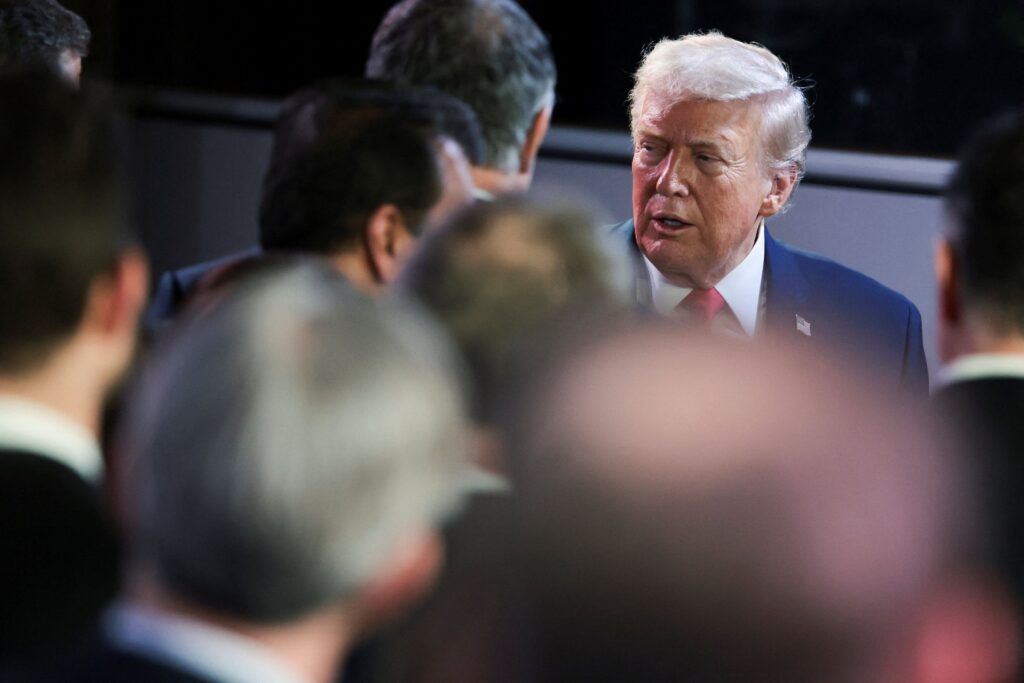
President Donald Trump took his crusade against Somali migrants to the world stage on Wednesday, questioning the intelligence of a community that has become a frequent target of his tirades.
Speaking before foreign dignitaries and corporate executives at the annual meeting of the World Economic Forum in Davos, Switzerland, the president alluded to an ongoing fraud scandal in Minnesota involving dozens of Somali residents, continuing a pattern of attacks against African migrants that has spanned both of his administrations.
“Can you believe that? Somalia — they turned out to be higher-IQ than we thought,” Trump said. “I always say these are low-IQ people. How do they go into Minnesota and steal all that money?
His statements in Davos echo his repeated broadsides against migrants from majority-Black countries that some community members have said led to harassment and bomb threats.
Trump’s acerbic words about certain minority groups frequently become policy that disadvantages a much larger swath of people, said Andre Perry, the director of the Center for Community Uplift at the Brookings Institution.
“These comments about immigrants, Somalis or whoever, eventually that becomes policy,” Perry said. “When we kind of just let this go as, ‘Oh, that’s just Trump being Trump.’ No, that’s Trump foreshadowing policy.”
In a closed-door meeting in 2018, Trump questioned why the United States was accepting immigrants from “shithole countries” such as Haiti, El Salvador and several African countries and not from places such as Norway. During a 2024 presidential debate, he amplified debunked claims that Haitian immigrants in Springfield, Ohio, were eating people’s pets, adding that they were “destroying” the city.
Trump’s antipathy toward the Somali community in Minneapolis dates back to at least 2016, when he pointed to a stabbing rampage in the region carried out by a Somali immigrant and called it part of a bigger problem.
Many Somali refugees fled three decades of government instability and repeated droughts. The vast majority came to the United States legally, and many even voted for Trump during the 2024 presidential election, said Jaylani Hussein, executive director of the Minnesota chapter of the Council on American-Islamic Relations.
“This isn’t about illegal immigrants,” said Hussein, who immigrated from Somalia to the U.S. in 1993. “This is about his continuous attack against Black people. He wants to get as many Black people out of here as possible. That’s why he has spent so much time attacking Haitians and African immigrants.”
Many Minnesota Republicans, who have successfully courted Somali voters in recent years, criticize fraud in the state’s social services system without targeting the Somali community, Hussein said. “Instead [they have] gone after the government for failing to protect the money because they know they have no way of winning statewide without their support,” he said.
In three Minneapolis neighborhoods with large East African populations, support for Democrat Kamala Harris fell significantly compared with support for Joe Biden in 2020, according to an analysis of precinct results by the Minnesota Star Tribune.
Trump nearly increased his support among Black voters between the 2020 and 2024 presidential elections from 8 percent to 15 percent, according to the Pew Research Center. But his approval rating among Black Americans has dropped from 24 percent during his first three months in office to 13 percent in polls this fall, according to an average of eight nationwide polls compiled by The Washington Post.
Abigail Jackson, a White House spokeswoman, didn’t directly respond to a question about what the president was trying to convey about the Somali American community in Minneapolis. Instead, she defended Trump’s statements at Davos. “President Trump is right. Aliens who come to our country, complain about how much they hate America, fail to contribute to our economy, rip off Americans, and refuse to assimilate into our society should not be here,” she said in a statement.
Trump’s ascent to the White House was fueled by racial grievance, particularly against immigrants, as he has stoked fear of an migrant influx into America that would strain finite resources and irrevocably change the character of the nation.
Last week, the administration announced plans to indefinitely halt processing visas from 75 countries, nearly half of which are African and mostly-Black Caribbean nations. The pause aims to limit applicants deemedlikely to rely on government benefits for their basic needs, administration officials said.
While the president was in Switzerland, the Department of Homeland Security announced a new immigration operation in Maine, home to sizable communities of Somali immigrants and asylum seekers from several other African countries. It is the latest state to be targeted as part of the Trump administration’s sweeping deportation push that has also included Chicago and Minneapolis.
Last year, the Trump administration drastically cut the number of refugees that would be allowed into the country. But it made an exception for White South African descendants of French and Dutch settlers who arrived to the continent in the 17th century and ultimately instituted the system of apartheid.
Westenley Alcenat, a professor of history and Africana studies at Scripps College, said that while Trump’s fixation on Somalis can be seen as an escalation, Black immigrants have endured similar attacks for decades. “Whether it be the rhetoric of they’re dirty, they bring in crime, they bring in drugs, they bring in disease, none of this is new,” he said. “You just have to look back to how Haitians were talked about in the 1980s to get a better understanding of this moment.”
Amy B Wang and Adam Taylor contributed to this report.
The post Trump brings his attacks on Somalis onto the world stage at Davos appeared first on Washington Post.