Since the beginning, guests at Children’s Fairyland have been welcomed by a sculpture inspired by the nursery rhyme “There Was an Old Woman Who Lived in a Shoe,” now a pink, oversized ankle boot with a crooked roof and eye-popping, candy-like buttons. Today, the shoe is raised on a concrete, plant-adorned platform, but it originally sat flat on the ground, forcing grown-ups to duck to enter the park.
That was more than just a quirk of design. It was a mission statement.
The 10-acre garden wonderland, nestled around Oakland’s urban sanctuary of Lake Merritt, has maintained one core rule since it opened its gates on Sept. 2, 1950: “No child without an adult, and no adult without a child.” For Fairyland aims to show the world through the eyes of a young’un — a place filled with curiosity, but also perhaps a bit off-kilter, where one can walk into a whale and find a fishbowl, slide down a dragon and get lost in an “Alice in Wonderland” maze of cards.
And yet, for more than 75 years now, Fairyland has had a grown-up sized influence. Fairyland is considered the first “storybook”-style park in the country, launching a national fad. Legend has it that Walt Disney visited Fairyland while Disneyland was in the planning stages and was so taken with it that he poached some staff. Fairyland’s “magic keys,” which unlock audio tales throughout the park, were an innovation felt across numerous industries. And the park has been instrumental in the puppet space, home to what’s said to be the oldest ongoing puppet-focused theater in the country. Those at L.A.’s own long-running Bob Baker Marionette Theater today cite Fairyland as an inspiration.
It is Fairyland’s thesis that continues to feel revolutionary. And that’s a belief that the way to understand, learn and grow is via the stories we tell one another, and those narratives need no fancy tech or digital accouterments.
“Families want simplicity,” says Kymberly Miller, Fairyland’s CEO. “They want to come in and be like, ‘I feel really safe here.’ It’s a contained space. It’s big but it’s small. Kids can run around and make up things to do with the canvas of Fairyland.”
To enter Fairyland, and it’s estimated that about 150,000 people do each year, is to not just set foot into a handcrafted fantasyland but to also step back in time. It persists at a time theme parks have increasingly targeted a young market with a host of upscale tricks. Legoland, for instance, will this March open a new land in Lego Galaxy with a family roller coaster as its signature attraction. Also this year, the Universal Kids Resort is slated to open in Frisco, Texas. It’s a smaller Universal Studios geared toward a younger audience but featuring cinematic brands such as “Shrek” and “Jurassic World.”
The nonprofit Fairyland is downright quaint in comparison — tickets are under $20, with steeper discounts for Oakland residents. Surviving societal, technological and bureaucratic shifts, it’s become the little park that could, its durability a statement of defiance in our fast-paced, divisive world.
And its story begins once upon a time.
Children’s Fairyland was the vision of Arthur Navlet, a retired owner of Oakland’s largest nursery. On a visit to the Belle Isle Aquarium in Detroit, Navlet and his wife were smitten by the park’s children zoo, which, as detailed in the book “Creating a Fairyland” by Randal J. Metz, a former Fairyland art director who currently leads the park’s puppet program, exhibited the animals amid fairy tale-like enclosures. Navlet had an idea for a fanciful park in Oakland, and took the concept to the Lake Merritt Breakfast Club, a long-standing civic-focused group dedicated to preserving and sustaining Lakeside Park.
With the organization, and soon the city, behind him, Navlet tapped painter and sculptor William Russell Everitt to create the Fairyland look. It wasn’t always a smooth partnership. Everitt, for instance, created a model of an English cottage that Navlet thought was a bit too realistic. Everitt, writes Metz, took a baseball bat to the tiny sculpture and stormed out of the room. But he didn’t quit the project, and future designs were full of oblong shapes, zig-zagging roofs and slanted walls, designs that were playful but also a nonsensical view of reality.
And thus the Fairyland-style was established. Copy-cats soon followed around the country. In California alone, Fairyland helped inspire the likes of Fairytale Town in Sacramento and Fresno’s Storyland. Fairyland, meanwhile, kept innovating.
“They started adding puppetry and magic and all these things kids absolutely loved,” says Metz. “That started here at Fairyland. There was no other place that was doing that at the moment. After Fairyland opened in 1950, Life magazine did a big full-color spread, and then all over the United States people wanted to build Fairylands.”
While Fairyland started a national trend, perhaps the most famous person to visit the park was Disney, who, says Metz, arrived at Fairyland on Easter Sunday in 1954, a year before Disneyland opened in July 1955. While the Walt Disney Family Museum and other Disney historians say there is no official record of Disney visiting the park, local newspapers of the era documented his appearance and many, including Metz, take it as fact that Disney spent an afternoon at Fairyland.
Metz writes in his book that Disney was particularly taken with Fairyland’s mini post office, which allowed children to send letters straight from the park. Disneyland to this day has mailboxes in the park. Many draw a comparison to Fairyland’s Willie the Whale and Disneyland’s Monstro at the start of the Storybook Land Canal Boats, as both aim to swallow guests. The parks also share a love of garden-strewn pathways and an emphasis on breaking up environments with trees, mixing fantasy and nature to create a calming, safe-feeling environment. And Disney, of course, hired Fairyland’s director Dorothy Manes to work on Disneyland.
“She was one of the few women in administrative leadership,” says Cindy Mediavilla, a retired lecturer from UCLA’s department of information studies and author of the book, “The Women Who Made Early Disneyland.”
To Mediavilla, she is an overlooked Disneyland personality, working to set up tour school groups, help define children’s activities and be an advocate for Disneyland’s overly congenial hospitality. “She was credited with coming up with response to people who come up and say, ‘We love Disneyland. Thank you so much,’” says Mediavilla. “She was credited with coming up with the phrase, ‘It’s been my pleasure.’”
She also helped maintain Disney’s direct line to Fairyland, as Disney in 1957 would once again poach from Fairyland, this time puppeteer Bob Mills to run Disneyland’s budding marionette program. Fairyland’s importance in the area of the puppet arts would be hard to overstate. Celebrities in the space, such as Frank Oz, apprenticed at Fairyland, and Metz continues to run multiple shows per day, both revivals and original creations.
Metz’s workshop is directly behind Fairyland’s puppet stage, and it’s a mini marionette museum, filled with books, pictures and, of course, puppets. Behind his desk hangs a Pinocchio puppet he made for the Walt Disney Co., and retired puppets from Highland Park’s Bob Baker Marionette Theater can also be found in Metz’s nook. It’s a treasure trove, as intermixed with Fairyland’s puppets will be those from Walt Disney World’s Epcot, such as a fiery red Pantalone from the theme park’s Italy pavilion.
“Children’s Fairyland, for a lot of puppet theaters, including Bob Baker Marionette Theater, is really the one that we look to,” says Winona Bechtle, Bob Baker’s director of partnerships.
“How do you build out a space and experience around a puppet show?” Bechtle continues. “Of course, they’re different than us, as they have the infrastructure of the amusement park around them, but it’s a full-scale immersive experience that takes you beyond a small stage in a church or a community theater. When you’re at Fairyland, there’s a pomp and circumstance to entering the park, approaching the theater and taking a seat. Us, as puppeteers at Bob Baker Marionette Theater, continue to remain inspired by it.”
Not all of Fairyland’s innovations stuck. In its early days, the park hoped to establish a “pet lending library,” and briefly advertised that guests could borrow rats, guinea pigs, lizards, snakes, foxes and more for a two-week period. It’s safe to say it didn’t get off the ground, although Fairyland today does house donkeys, goats, chickens and bearded dragons, among other animals, for children to meet.
And yet Fairyland’s magic keys, introduced in 1958, would inspire not just other parks but museums and zoos around the country. The conceit sounds simple today: Kids are given a small plastic key, for which they insert in a box near an installation and then are regaled with music and a short nursery rhyme or folktale. It was the brainchild of Bay Area television host Bruce Sedley, who also fashioned himself as an amateur inventor.
“That’s the icon of Fairyland,” says artist Jeff Hull, an Oakland native who once acted at Fairyland as a child performer and has created numerous immersive art projects, including “The Cortège”last fall in L.A.
“You put the magic key in these boxes that look like storybooks and now you’re hearing an audio track that corresponds to an installation? That in itself is immersive art,” says Hull. “That’s storytelling. That’s an installation as performance. That’s the recipe for what so many people have continued to do and expand on.”
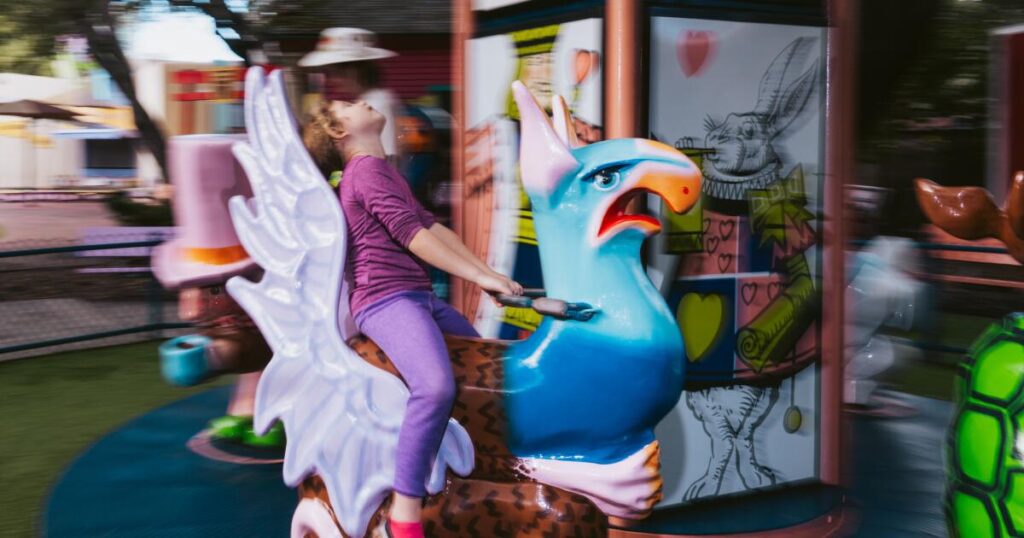
To now walk among Fairyland is to feel as if an arm is being extended, an invitation to play, to be silly and to wonder. Children’s Fairyland is full of hand-painted delights. Stroll a path and look down and spy some smiling sunflowers hidden in the bushes. There are fun house mirrors, a whimsical train, a mechanical Geppetto waving in a workshop and a cat ready to set sail atop the mast of a ship.
There’s even a mini chapel — yes, a chapel — complete with stained glass windows initially designed by children, for those who need a meditative break from running the grounds. A vintage Ferris wheel, themed to “Anansi’s Magic Web,” is an opportunity to rediscover the folktale via the attraction’s netting-like design.
Maintenance is a large expense for the park, as most sets need to be repainted yearly due to a combination of environmental and hands-on wear, but the park is also vibrant and in conversation with nature. The striking red-and-bronze sculpture of the smiling Ching Lung the Happy Dragon, for instance, circles around and through a towering tree.
“We believe very strongly in ‘kiddie tech,’” says Metz. “We wanted everything to be hands-on. When children are excited about a set at Fairyland, we try to let them imagine they are in it. Henceforth Alice in Wonderland’s tunnel, and going through the cards and pretending you’re one of Alice’s people.”
Carissa Baker, a Los Angeles native who is now an assistant professor of theme park and attraction management at the University of Central Florida, says that Fairyland created its own stamp on children’s architecture and fairy-tale imagery. “Now, we look at the elaborate spaces of theme parks, and we have all these elaborate forms of fantasy environments,” Baker says. “But I kind of see the seed of these fantasy environments in a place like Children’s Fairyland.”
Miller has been overseeing Fairyland for about five years, and she talks of setting the tone for the park’s next seven decades. First, she’s been working on expanding the park’s access. Those, for instance, who receive any sort of financial assistance can visit the park for $5 per person, a program started in 2023 that now serves close to 20,000 people. Next up is building structures to house the park’s eight-person maintenance team to better manage repairs and upkeep.
Broadening Fairyland’s story content is also a goal. Later this year, Fairyland will debut a puppet program inspired by Native American folklore as Metz and Miller seek to continue to diversify Fairyland’s offerings.
“There’s people whose stories are not being told in the park,” says Miller. “Most of the stories told here are Northern European in nature. So it’s really my job to unpack some of that with staff and figure out how to create more access.”
And long-term, Miller would love to add some fresh fairy tale installations. That would require successful fundraising endeavors, but Miller stresses any future additions would be in line with what already exists, meaning a focus on imaginative play rather than “digital expression.”
Old fashioned, yet inventive and timeless. That’s the Children’s Fairyland way.
The post This California theme park inspired Disneyland, Bob Baker Marionettes — and tickets are $19 appeared first on Los Angeles Times.