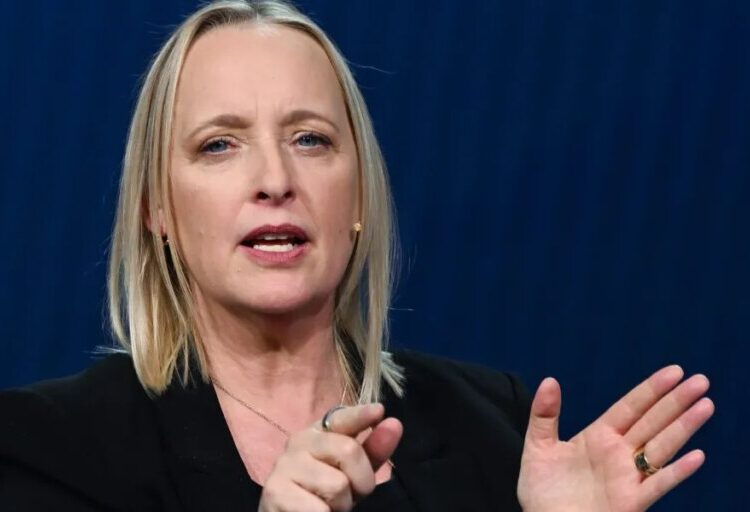
Yvonne St Cyr strained her body against police barricades, crawled through a broken Senate window, and yelled “push, push, push” to fellow rioters in a tunnellike hallway where police officers suffered concussions and broken bones.
She insisted she did nothing wrong. A federal judge sentenced her to 30 months in prison and imposed $2,270 in financial penalties for her actions at the U.S. Capitol on Jan. 6, 2021, declaring: “You have little or no respect for the law, little or no respect for our democratic systems.”
St Cyr served only half her sentence before President Donald Trump’s January 2025 pardon set her and almost 1,600 others free.
But her story doesn’t end there. St Cyr headed back to court, seeking a refund of the $2,270. “It’s my money,” the Marine Corps veteran from Idaho said in an interview with The Washington Post. “They took my money.” In August, the same judge who sentenced her reluctantly agreed, pointing to a legal quirk in her case.
“Sometimes a judge is called upon to do what the law requires, even if it may seem at odds with what justice or one’s initial instincts might warrant. This is one such occasion,” U.S. District Judge John D. Bates wrote in an opinion authorizing the first refund to a Jan. 6 defendant.
The ruling revealed an overlooked consequence of Trump’s pardon for some Jan. 6 offenders: Not only did it free them from prison, it emboldened them to demand payback from the government.
At least eight Jan. 6 defendants are pursuing refunds of the financial penalties paid as part of their sentences, according to a Post review of court records; judges agreed that St Cyr and a Maryland couple should be reimbursed, while five more are appealing denials. (St Cyr and the couple are still waiting to receive their payments, however.) Others are filing civil lawsuits against the government seeking millions of dollars, alleging politically tainted prosecutions and violations of their constitutional rights. Hundreds more have filed claims accusing the Justice Department, FBI and other law enforcement agencies of inflicting property damage and personal injuries, according to their lawyer.
The efforts are the latest chapter in an extraordinary rewriting of history by the president and his allies to bury the facts of what happened at the Capitol, sustain the false claim that the 2020 election was rigged, and recast the Jan. 6 offenders as victims entitled to taxpayer-funded compensation.
“Donald Trump and the DOJ want taxpayers to reimburse a violent mob for the destruction of the U.S. Capitol. The Jan. 6 nightmare continues,” said Rep. Joe Morelle (D-New York), the top Democrat on the House Administration Committee, which oversees the Capitol’s security and operations.
The pro-Trump mob that ransacked the Capitol caused almost $3 million in damage, according to a 2022 estimate by the Justice Department. The losses included smashed doors and windows, defaced artwork, damaged furniture and residue from gas agents and fire extinguishers. Defendants were sentenced to more than $1.2 million in restitution and fines, according to a tally by The Post.
But the government recovered less than $665,000 of those court-ordered payments, according to a source with first-hand knowledge who spoke on the condition of anonymity because of fear of retaliation. Sen. Alex Padilla (D-California) and Sen. Sheldon Whitehouse (D-Rhode Island) are pushing legislation — backed by some law enforcement officers who defended the Capitol on Jan. 6 — to block government payouts to rioters. Without any Republican co-sponsors, the legislation is not expected to proceed.
“The audacity of them to think they didn’t do anything, or to think that they’re right and then get their money back,” said former Capitol police officer Harry Dunn, who attended the sentencing of St Cyr and other Jan. 6 offenders. “It’s frustrating and it should not happen. They should have to pay more.”
Stacy Hager, a 62-year-old former warehouse supervisor, made his first trip to Washington, D.C., for the Jan. 6 rally. The lifelong Texan wasn’t that interested in politics before, but he was certain that Donald Trump was the rightful winner of the 2020 election.
Wearing a Trump hat and waving the Texas flag, Hager took photos and videos of himself roaming through the Capitol. He was convicted on four misdemeanor charges related to disorderly conduct and trespassing; he paid $570 in penalties and served seven months in jail, a punishment he describes as totally unjust and “a living hell.”
Hager still believes, fervently, that fraud marred the 2020 vote and that Trump won, though no new evidence has surfaced to contradict the findings of Justice Department officials, cybersecurity experts and dozens of judges appointed by Democrats and Republican alike.
“You tell me why I shouldn’t be entitled to getting my money back,” Hager said. “The government took money from me for doing the right thing, for standing up for the people’s vote. That’s the reason we were there — for a free and fair election.”
About one month after Trump’s pardon in January 2025, Hager was the first of the Jan. 6 defendants to ask for his money back, court records show. “It’s a principle thing,” Hager said. Among the other defendants seeking refunds: A Utah man who forfeited almost $63,000 he made from selling videos recording some of the worst violence at the Capitol. A Georgia teenager who paid $2,200 in fines after he shoved a police officer and sat in Vice President Mike Pence’s chair in the Senate chamber.
While the charges and punishments vary, the defendants seeking refunds share one legal quirk: All of them were appealing their convictions when Trump pardoned them on Jan. 20, 2025. After the pardon, courts vacated their convictions and dismissed their indictments following requests from federal prosecutors, as the Department of Justice that once prosecuted the Jan. 6 defendants now takes their side.
It’s routine for a criminal defendant who has paid financial penalties to get the money back if the conviction is vacated and the case is dismissed. But the attack halting the peaceful transfer of power for the first time in American history pushed the criminal justice system into uncharted territory.
And now, the legal debate over whether certain Jan. 6 defendants should receive refunds is forcing courts to weigh two obscure Supreme Court decisions — 140 years apart — involving a pardoned Confederate sympathizer and a woman convicted but later acquitted of sexually assaulting her children.
Judges who have denied refunds have all referenced a case brought by John Knote, whose West Virginia property was confiscated and sold for $11,000 under a law empowering the Union to seize Confederate property. Citing President Andrew Johnson’s pardon of former Confederates on Christmas Day 1868, Knote asked the court to reimburse him $11,000. The Supreme Court ruled in 1877 that money deposited in the U.S. Treasury could not be returned without an act of Congress.
Jan. 6 defendants, however, are looking to a much more recent Supreme Court opinion — written by liberal icon Ruth Bader Ginsburg — to bolster their argument that the government owes them money. In that 2017 case, Colorado resident Shannon Nelson paid about $700 in penalties before her sexual assault conviction was overturned on appeal. At a later trial, she was acquitted of the alleged crimes against her children. The high court said Nelson was now “presumed innocent” and entitled to a refund.
In approving St Cyr’s request for reimbursement, Bates referred to the Nelson case 39 times. The other D.C. District Court judge who has ruled in favor of refunds for Jan. 6 defendants, Chief Judge James E. Boasberg, also cited the Nelson case in December. “When a conviction is vacated, the Government must return any payments exacted because of it,” he wrote.
Hager returned to Washington this month to gather with other Trump supporters to mark the five-year anniversary. He and other Jan. 6 defendants stay in close touch online.
“We’re like a family,” Hager said, wearing a weathered baseball cap celebrating America’s 250th birthday and a T-shirt proclaiming his love for Jesus Christ. “We have a great bond, the kind that political persecution forms.”
Andrew Taake’s journey through the criminal justice system illustrates one of the most dramatic twists in a Jan. 6 case. He attacked police officers with bear spray and a “whip-like weapon,” according to a plea agreement he signed in 2023. Now he is suing the federal government for $2.5 million, claiming his civil rights were violated by a wrongful prosecution and mistreatment in prison.
Taake was on pretrial release on a pending charge of online solicitation of a minor when he traveled from Houston to Washington, D.C., in January 2021. He attended the “Stop the Steal” rally headlined by Trump and was among the first to breach the restricted area around the Capitol. One of the police officers who said Taake assaulted him with bear spray, Nathan Tate, filed a statement in court that said the experience left “a lifelong scar.”
“He came to the Capitol with multiple weapons,” Tate wrote. “He was not there for peaceful protest. He was there to be violent. He should not be allowed to claim victimhood today.”
Taake pleaded guilty to one count of assaulting, resisting or impeding law enforcement officers using a dangerous weapon. He was sentenced in 2024 to 74 months in prison.
His prison time was cut short by Trump’s pardon. Two weeks later, he was taken into custody by Houston-area law enforcement on the 2016 child solicitation charge. He pleaded guilty to a second-degree felony, was sentenced to three years in prison and ordered to register as a sex offender.
But because Tate had already served more than three years in the Jan. 6 case, he got credit for time served and did not return to prison, records show. In September, he filed a lawsuit against the federal government that tells a very different story than the plea deal.
In the suit filed in D.C. District Court, Taake claims he used the bear spray to protect a fellow protester and that another officer disfigured his hand by stomping on it. He accuses prosecutors of using false evidence and manipulating him into the plea deal. In prison, he said he was mistreated by medical staff and assaulted by other inmates. “He should be compensated for his pain and suffering because it doesn’t get much worse than that,” said Taake’s lawyer, Peter Ticktin, a longtime Trump ally.
Tate, who now who works as social studies teacher in La Plata, Maryland, was shocked to hear about Taake’s lawsuit. “He can say my allegations are false but it’s documented, you can literally see what took place,” he said. “It was real for me.”
In the most far-reaching effort on behalf of Jan. 6 offenders, Missouri lawyer Mark McCloskey is trying to build support for a government-backed compensation panel, similar to the fund that has distributed billions of dollars to families of victims in the Sept. 11, 2001, attack. McCloskey attracted national attention in 2020 when he and his wife pointed guns at Black Lives Matter protesters marching past their home; they pleaded guilty to firearms charges but were pardoned by the Missouri governor.
McCloskey said he has advocated for the Jan. 6 fund in four meetings with Justice Department officials, including Ed Martin, the director of a unit tasked with investigating Trump’s political opponents.
Martin, who helped plan and finance Trump’s rally that preceded the rampage through the Capitol, has said publicly that he supports “reparations” for Jan. 6 defendants.
Trump also has expressed support for government payouts. Asked about compensating Jan. 6 offenders in a March 2025 Newsmax interview, Trump said, “Well, there’s talk about that. … A lot of the people in government really like that group of people. They were patriots as far as I was concerned.”
But McCloskey is still waiting for the Justice Department to act. “We have had all positive responses but until President Trump pulls the trigger, it isn’t going to happen,” McCloskey said. “The president needs to take a position on it.”
In December, McCloskey sought to build momentum by postinga photo of himself on social media that he said showed him delivering claims to federal law enforcement agencies from about 400 Jan. 6 clients. The property damage and personal injury claims — a prerequisite to filing lawsuits against the government under the Federal Tort Claims Act — describe homes ransacked during arrests, lost jobs and broken families, McCloskey said.
The White House and the Justice Department declined to comment on McCloskey’s efforts.
Another Jan, 6-related lawsuit against the federal government comes from several leaders of the Proud Boys who were found guilty of engaging in a seditious conspiracy to keep Trump in power despite his electoral defeat. The suit seeking $100 million, filed in federal court in Florida last year, echoes Trump’s claims that the investigation into the Jan. 6 attack was illegitimate and politically motivated.
The lead plaintiff, Henry “Enrique” Tarrio, called for charges against Jan. 6 prosecutors when he addressed the gathering in Washington, D.C., to mark the fifth anniversary this month. “The thing I am searching for,” Tarrio said, “is retribution, retaliation.”
Since Trump returned to office one year ago, many Jan. 6 prosecutors have been fired or resigned. Hager’s prosecutor, Adam Dreher, was demoted to Superior Court last year, he said, in retaliation for his work on Jan. 6 cases. He left the department a few months ago to return to his home state of Michigan and practice law. The Justice Department declined to comment on Dreher’s record.
Dreher was an administrative law judge in Detroit on Jan. 6, 2021. The riot at the Capitol inspired him to come to Washington as a federal prosecutor, he said, just as years earlier, the Sept. 11, 2001, terrorist attack moved him to join the military.
“It made me want to be part of trying to help things get back to normal, to hold people accountable and make sure the rule of law was something we could rely on,” he said. “That all we did is being unraveled has been very difficult to watch.”
The post They ransacked the U.S. Capitol and want the government to pay them back appeared first on Washington Post.