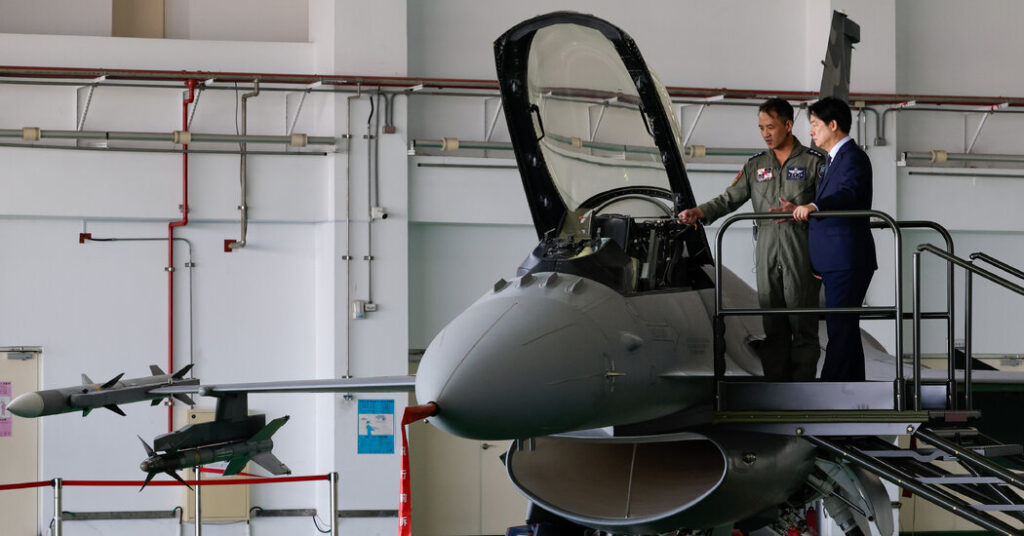
A political quagmire in Taiwan has stalled plans by its President Lai Ching-te to sharply increase military spending, even as President Donald Trump has pressed the island to pay more for its own defense against China’s campaign to bring the island under its control.
Opposition lawmakers who dominate the legislature have blocked Mr. Lai’s ambitious proposal to spend $40 billion across eight years on military equipment from moving forward without concessions from Mr. Lai.
For Taiwan, the impasse has implications beyond just a domestic political fight. It could raise questions about Taiwan’s ability to strengthen its defenses at a time when Mr. Trump is urging America’s allies and partners to shoulder more of the burden for their own security. Mr. Lai has pledged to lift military and security outlays to more than 3 percent of Taiwan’s economy this year to mollify the United States, the island’s chief security backer against Beijing.
But Mr. Lai’s plan is caught in a tangle of budgetary and legal disputes between his party and the opposition parties. Both sides have used hardball tactics and accused each other of acting unlawfully.
Breaking with longstanding practice, Mr. Lai’s premier refused to sign off on a law passed by the opposition-controlled legislature that would shift some tax revenues from the central government to local administrations. Opposition lawmakers, in turn, denounced the premier’s move to stymie the revenue law as unconstitutional. They have also called Mr. Lai a dictator and moved to impeach him, an effort that is largely symbolic.
“We have never experienced such a massive crisis of constitutional rule of law as we have right now,” Weng Hsiao-ling, a lawmaker from the Nationalist Party, the main opposition party, said in an interview. “Executive power is not operating according to the law.”
Members of Mr. Lai’s Democratic Progressive Party, for their part, say that the opposition is trying to paralyze his administration. They accuse some opposition politicians of taking their cues from Beijing and of endangering Taiwan’s security by holding up defense spending. They are frustrated that the opposition has twice rejected Mr. Lai’s nominations to Taiwan’s constitutional court, effectively sidelining the body that could help defuse such disputes.
Su Chiao-hui, a lawmaker from the Democratic Progressive Party, said that the opposition’s blocking of nominees damaged Taiwan’s ability to resolve conflicts. “They changed the rules, and the referee is gone,” she said.
The friction reflects growing divisions in Taiwan over whether to hold tight to its relationship with the United States or try rapprochement with Beijing.
Mr. Lai’s party says that Taiwan is its own country, and stronger defense and deeper ties with the United States are the way to protect Taiwan against China.
Trump Administration: Live Updates
Updated
- Air Force One turns back after an electrical issue.
- House Foreign Affairs members call for Machado to govern Venezuela.
- Pressured by Trump to fight cartels, Mexico sends 37 accused criminals to the U.S.
The Nationalist Party, however, favors expanded ties with Beijing. Some of its leaders, including its chairwoman, Cheng Li-wun, have suggested that Mr. Lai’s strategy will escalate tensions with China. They have said that they generally support military spending to protect Taiwan, but have emphasized their skepticism about Mr. Lai’s plans.
“There’s an increasingly clear partisan divide of perception in Taiwan in terms of views of the U.S., views of China,” said Wei-ting Yen, a political scientist at Academia Sinica, a Taiwanese research academy.
Tensions between the two sides grew last year after Mr. Lai’s party backed a recall campaign to oust dozens of Nationalist Party legislators, which ultimately failed.
Nationalist lawmakers are not in a “terribly good mood to make further compromises with Lai,” said Alexander C. Huang, an international security expert who was formerly that party’s director of international affairs.
Opposition lawmakers have blocked deliberations on Mr. Lai’s military spending plan, as well as the annual budget, demanding, among other things, that Mr. Lai first appear before the legislature for questioning. The opposition has also pointed to what it says are unacceptably long delays in deliveries of U.S. weapons, including F-16 fighter jets.
“We’ve paid up, but the weapons are nowhere to be seen,” Fu Kun-chi, a Nationalist Party leader, said last month. “We support national defense, but don’t support being fleeced in arms purchases.”
Compromise may still be possible. The Nationalists have pushed for more public disclosure of details; the government has said that revealing some details would compromise security, but gave lawmakers a private briefing this week and released more information.
The U.S. representative in Taipei, Raymond Greene, has backed Mr. Lai’s military spending proposals and urged the parties to work together, while the State Department pledged to work with industry to deliver equipment more quickly.
Some officials from Taiwan’s governing party hope that lawmakers from a smaller opposition party, the Taiwan People’s Party, will break with the Nationalists, giving Mr. Lai the votes to pass his plans. He appears buoyed after Taiwan and Washington signed a framework agreement to reduce Mr. Trump’s tariffs.
Washington may increase pressure on the opposition, aware that a public breach with the United States would be politically fraught for any party in Taiwan.
“The opposition Nationalists naturally hope to keep a balance between China and the U.S.,” said Su Tzu-chiao, a political scientist at Soochow University in Taipei, “but they cannot directly oppose the U.S.”
Chris Buckley, the chief China correspondent for The Times, reports on China and Taiwan from Taipei, focused on politics, social change and security and military issues.
The post Taiwan’s $40 Billion Military Spending Plan Stalled by Political Impasse appeared first on New York Times.