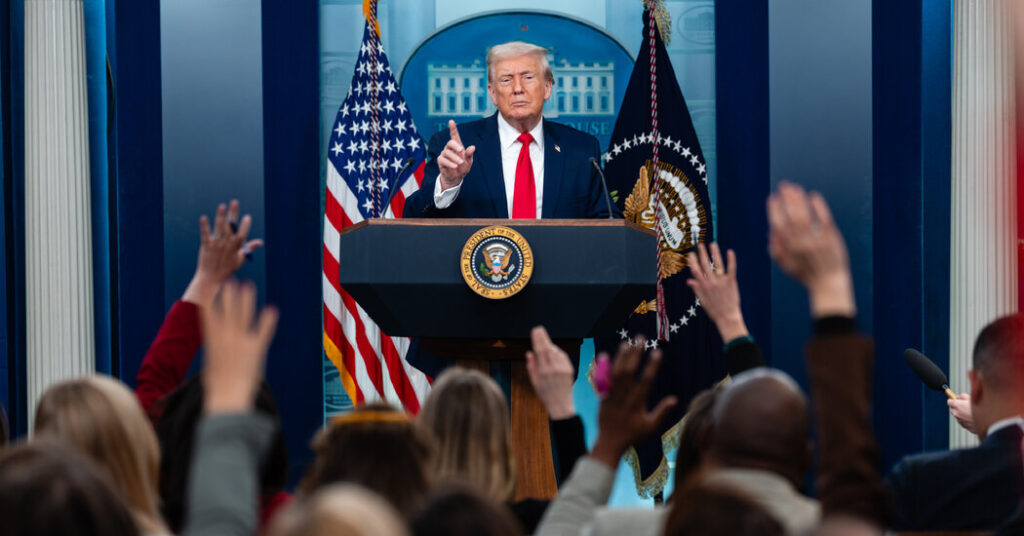
Stocks stabilized on Wednesday, recouping much of Tuesday’s sell off after President Trump backed down from his previous threat of imposing more tariffs on any European ally that went against his plan to take over Greenland.
Mr. Trump said that the tariffs, originally planned to start at the beginning of next month, were no longer necessary because he had reached “the framework of a deal” related to Greenland with European counterparts.
News of de-escalation between the allies fueled a late-afternoon rally, with the S&P 500 up about 1.5 percent.
The rally followed a drop on Tuesday of 2.1 percent, which was one of the biggest one-day declines in months.
Other signs of worry also faded as stock prices recovered. The price of gold, which had risen sharply for the third day in a row, eased to a gain of 0.5 percent. The precious metal, which is seen as a haven in times of stress, has risen 75 percent over the past year, soaring to levels never previously recorded, as central banks and some investors increasingly look to pivot their investments away from the United States.
That same angst over U.S. political uncertainty appeared to push the dollar lower in the morning before a recovery in the afternoon. Still, while the dollar strengthened against the Swiss Franc, euro and Danish Krone, it weakened against the Australian Dollar, Norwegian Krone and Swedish Krone.
The dollar has been treading water in recent months, after a sharp drop at the beginning of President Trump’s second term in office.
“The consensus entering 2026 was that political volatility would diminish, tariff headlines would fade and affordability concerns would restrain new trade measures,” said Seema Shah, chief global strategist at Principal Asset Management.
A survey of metals analysts conducted by the LBMA, an industry group, found that most of the market watchers expected gold to breach $5,000 per ounce for the first time this year. “Persistent geopolitical uncertainty — from conflicts to institutional tensions — keeps safe‑haven demand elevated,” the survey found.
The upheaval in global markets signaled a return of the trade policy-driven volatility that has defined much of the second Trump administration. The slide in stocks began on Tuesday after Mr. Trump threatened a new round of tariffs against eight European nations unless they facilitated a U.S. takeover of Greenland, setting off fears that a new period of tit-for-tat trade restrictions would weigh on global growth.
The tumultuous trading ended a period of relative market calm. The S&P 500 in the United States and the Nikkei 225 in Japan had both reached record highs this month.
Tuesday’s sell-off then spilled into Asia overnight, with Taiwan’s Taiex index falling more than 1.5 percent, while Japan’s Topix dropped 1 percent. Trading was more mixed in Europe, with the German DAX index nudging lower, while stocks in Britain and France inched higher.
Another factor roiling global markets has been a sell-off in Japanese government bonds. Yields on those long-term bonds have surged this week, as investors called into question Japan’s fiscal discipline after Prime Minister Sanae Takaichi’s call for a snap election and costly pledge to cut sales taxes.
In an interview with Fox News at the World Economic Forum in Davos, Switzerland, U.S. Treasury Secretary Scott Bessent said that the sell-off in Japanese government bonds had spilled over into the U.S. Treasuries market.
While some investors characterized the Trump administration’s latest threats against Europe as a familiar negotiating tactic designed to elicit concessions before being withdrawn, some investors have shown a diminished tolerance for uncertainty.
“Markets recently have seen a clear trend of capital flight from the U.S. market,” said Takahide Kiuchi, the executive economist at Japan’s Nomura Research Institute. “To restore stability to financial markets, the Trump administration may be forced to reassess its tariff policies toward Europe,” he said.
Joe Rennison writes about financial markets, a beat that ranges from chronicling the vagaries of the stock market to explaining the often-inscrutable trading decisions of Wall Street insiders.
The post Stocks Rebound After Trump Backs Off European Tariffs appeared first on New York Times.