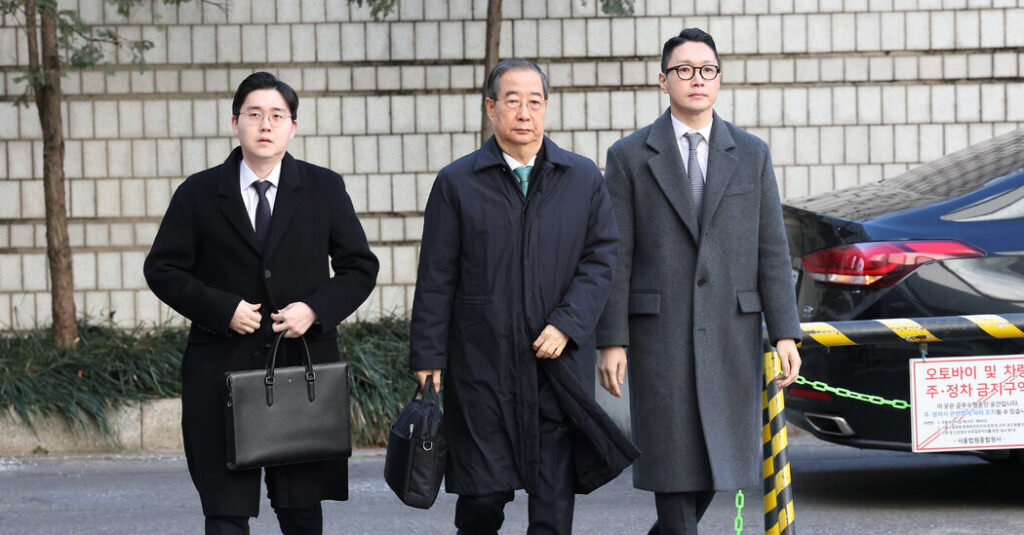
Han Duck-soo, a former prime minister and acting president of South Korea, was sentenced to 23 years in prison on Wednesday after a three-judge panel in Seoul convicted him of collaborating in former President Yoon Suk Yeol’s brief imposition of martial law in late 2024.
Mr. Han, 76, was formally arrested at the courtroom after the presiding judge, Lee Jin-kwan at the Seoul Central District Court, finished reading his nationally televised verdict and sentence.
Judge Lee defined Mr. Yoon’s imposition of martial law as an act of insurrection that “could have pushed South Korea back into dictatorship” and convicted Mr. Han of “playing a key role in an insurrection.”
A separate panel of judges at the same court is scheduled to rule on Feb. 19 whether Mr. Yoon was a ringleader of an insurrection, as prosecutors have argued. Prosecutors in that case have demanded the death penalty for Mr. Yoon.
In Mr. Han’s case, prosecutors had originally sought a prison term of 15 years. But the court said on Wednesday that Mr. Han deserved a harsher punishment.
More on South Korea
-
A Dissident’s Next Act: Kwon Pyong recounted for the first time the series of gambles that got him out of China by jet ski, and almost a year later, out of South Korea.
-
Standoff With Doctors: Doctors at medical facilities across South Korea walked off the job in a one-day strike on June 18, expanding a months-old protest against the government’s health care policies.
-
An Impeachment Threat: President Yoon Suk Yeol has been accused of intervening in an inquiry into the accidental death of a South Korean marine during a peacetime search and rescue operation.
-
Parliament Election: South Koreans delivered a stinging defeat to Yoon and his party, giving the opposition one of its biggest electoral victories in recent decades and pushing Yoon to the verge of being a lame duck.
“As prime minister, he had the duty to do everything he could to defend the constitution and laws,” Judge Lee said. “But he shirked that responsibility and decided to participate in the insurrection because he thought it could succeed.”
Mr. Han was serving as Mr. Yoon’s handpicked prime minister when Mr. Yoon declared martial law on the night of Dec. 3, 2024. Mr. Yoon banned all political activities and sent troops to take over the National Assembly, which he called a “monster” that he said had “paralyzed” his administration. Mr. Yoon was also accused of plotting to arrest his political rivals, including opposition leaders.
Troops raided the constitutionally independent National Election Commission without a court warrant under Mr. Yoon’s order to search for evidence of election fraud, which he cited as part of the reasons he was declaring martial law.
The martial law lasted only six hours, as the opposition-led National Assembly voted it down while citizens held back troops to prevent them from raiding its main voting hall. But it plunged South Korea into its biggest political crisis in decades, in which Mr. Han played a prominent role.
Mr. Han, the No. 2 in the government hierarchy, became the acting president after the National Assembly impeached Mr. Yoon and suspended him from office less than two weeks after his martial law collapsed. Then, Mr. Han himself was impeached by the Assembly on charges of collaborating in Mr. Yoon’s declaration of martial law. He was later reinstated as prime minister and acting president when the Constitutional Court said it had found no evidence against him.
After Mr. Yoon was formally removed from office, Mr. Han tried — and failed — to win the presidential nomination for Mr. Yoon’s People Power Party.
Things turned against Mr. Han after a special counsel was appointed last year to investigate Mr. Yoon’s declaration of martial law.
Mr. Han insisted that he had first heard of Mr. Yoon’s martial law plan the night he declared it and that he had voiced his objection to Mr. Yoon, saying it would damage the country’s economy and international reputation. But the court on Wednesday said there was no evidence of his objection.
Instead, Judge Lee found Mr. Han guilty of “supporting the need and rationale” for Mr. Yoon’s “insurrection” and “self-coup” that “disrupted constitutional order.”
The judge said Mr. Han played an active role in convening a cabinet meeting on the night of martial law to try to help Mr. Yoon. That met the legal requirement that Mr. Yoon had to discuss his plan for martial law with his cabinet members before declaring it. When cabinet members refused to sign a document proving that such a meeting had taken place with proper procedures, Mr. Han even helped fabricate such a document, Judge Lee said.
Mr. Han was also found guilty of collaborating with Mr. Yoon’s home minister in a plot to cut electricity and water supplies to broadcasters and newspapers deemed unfriendly to Mr. Yoon during martial law.
Mr. Han repeatedly denied receiving or seeing any documents related to martial law during the cabinet gathering. But closed-circuit TV footage later showed him receiving such documents and pocketing them. The court also convicted him of perjury.
When Judge Lee asked whether he had anything to say before being arrested on Wednesday, Mr. Han said he would “humbly accept the court’s decision.” Mr. Han and his lawyers have a week to appeal the ruling.
Choe Sang-Hun is the lead reporter for The Times in Seoul, covering South and North Korea.
The post South Korean Ex-Premier Gets 23 Years in Prison for Role in Martial Law appeared first on New York Times.