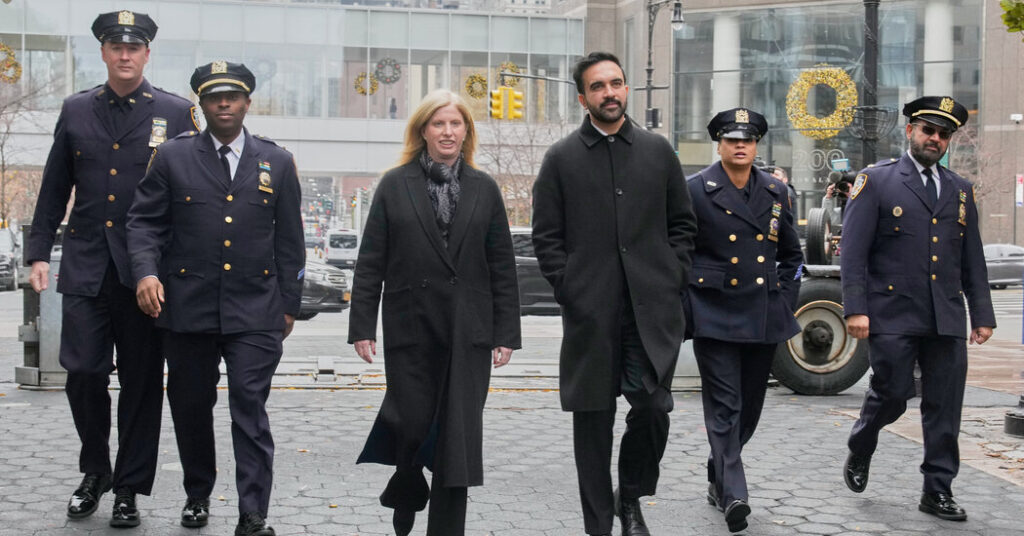
Days after Zohran Mamdani was elected mayor of New York City, Jessica Tisch settled in at her parents’ Upper East Side dining room table for a customary family Shabbat lunch.
“So, what are you going to do?” said her father, James Tisch, the chairman of Loews Corporation.
Much of the city was wondering the same thing. Would Ms. Tisch — who was appointed police commissioner by Mayor Eric Adams in 2024 and quickly earned a reputation for reducing crime — stay at her post under the new administration?
In many ways, the idea was far-fetched. Mr. Mamdani, 34, is a Muslim whose political identity was shaped by his opposition to Israel and who once called the New York police “racist, anti-queer & a major threat to public safety.”
Ms. Tisch, 44, is Jewish, a supporter of Israel and a member of a prominent billionaire family, with cousins and aunts who donated more than $1 million to Mr. Mamdani’s chief campaign opponent, former Gov. Andrew M. Cuomo. She speaks of police officers as heroes, not as oppressors.
But the city’s business community — unnerved by the unexpected political ascendance of an inexperienced socialist politician who had campaigned on taxing the rich — was desperate for Ms. Tisch to remain. So too was Gov. Kathy Hochul.
Serving as police commissioner had long been Ms. Tisch’s dream job, and in October Mr. Mamdani said he would ask her to remain. But would she?
At the Shabbat lunch, according to a person told about the discussion by a member of the family, Ms. Tisch’s decision was on everyone’s mind.
Finally, a trusted adviser looked up from his bowl of matzo ball soup and weighed in.
Ms. Tisch’s 10-year-old son, Harry, told his mother that she should go for it. People across the country would be inspired by her and Mr. Mamdani’s ability to transcend their differences, he said.
Merryl Tisch, the family matriarch and the chair of the State University of New York board of trustees, looked at her daughter and shrugged. “Out of the mouths of babes,” she said. “You have your answer.”
About a week later, after meeting Ms. Tisch in person just once to discuss the job, Mr. Mamdani formally asked her to stay on, and she accepted.
Whether they can work together is an open question. In keeping Ms. Tisch, the mayor has entrusted his political fate to someone whose approach to policing is at odds with many of the principles he built his career on.
It could go sideways in any number of situations. Crime could rise. Terrorism could re-emerge. Protests against Israel or immigration agents could erupt. Or — this is New York, after all — who knows what the drama could be?
But there is probably no person more critical to the mayor’s success than Ms. Tisch. Public safety is the No. 1 priority of New Yorkers, polls say, and Mr. Mamdani will have no political capital for his affordability agenda if the streets are dangerous.
“New York City is always a cauldron where something can explode, and it’s often something you don’t even anticipate,” said Ester Fuchs, professor of public policy at Columbia University.
Mr. Mamdani and Ms. Tisch declined to comment for this article. But at least for now, the mayor seems to be mostly deferring to his commissioner on matters of policing.
Ms. Tisch’s role has left some in his political base frustrated with what they see as a betrayal of their ideals. Those in the business community are celebrating what they consider a significant victory. And everyone in town is wondering how in the world the two will make it work.
Standing Ovation at the Rainbow Room
A police commissioner serves at the mayor’s pleasure. But unlike many mayoral appointees, Ms. Tisch has a powerful constituency of her own.
At the Rainbow Room high above Rockefeller Center last month, 300 of the city’s business leaders gathered for the annual meeting of the Partnership for New York City, whose members include representatives of the city’s most powerful corporations, law firms and banks.
Ms. Tisch delivered the keynote address, highlighting recent successes in driving down crime and attracting more recruits. She brought the crowd to its feet, said Kathryn Wylde, who was the longtime chief executive officer of the group until her retirement last week.
At the end, Barry Diller, the civic and media business titan, acknowledged that many in the room wished Ms. Tisch had run for mayor herself. “I was hoping you were going to get promoted to a new job,” Mr. Diller said, according to Ms. Wylde, “but for now I’m just glad you have this one.”
It is easy to appreciate why Mr. Mamdani’s political success might rattle Ms. Tisch’s supporters. Not long ago, he had advocated defunding the police. During his campaign for mayor, he was critical of certain policing tactics, including the city’s so-called gang database and the Strategic Response Group, a specialized police unit that helps maintain control at large-scale events, including, sometimes, protests. He has plans to create a new agency to respond to mental health crises, which he has said would supplement the Police Department.
Still, since the mayor and the commissioner began working together, they have developed a comfortable rapport and seem to like each other. The two have a weekly in-person meeting.
They seem to have quickly gotten past a bump in the road in December, when The New York Post reported that one of Ms. Tisch’s brothers called Mr. Mamdani an “enemy” of Jewish people in a speech at a charity event. Ms. Tisch quickly contacted Mr. Mamdani’s staff to apologize.
In the past few weeks, they have been texting and talking as Ms. Tisch helps the mayor learn how the 50,000-person Police Department, with its $6 billion budget, operates. And the commissioner is in regular contact with Dean Fuleihan, the first deputy mayor.
But Mr. Mamdani and Ms. Tisch have not always been in lock step.
A week after the mayor’s inauguration, two civilians were shot and killed by New York police officers. One man with a makeshift knife had barricaded himself inside a Brooklyn hospital, alongside a patient and an unarmed security guard; the other had aimed what appeared to be a handgun at officers in the West Village.
The next morning, the mayor issued a cautious message on social media, angering some in the Police Department who believed it showed a lack of support for the officers. He later offered another reaction, more supportive of the police.
Ms Tisch was unambiguous. “There is every indication that their actions were nothing short of heroic,” she said on social media.
Pride parade
The mayor and the commissioner first met at the city’s Pride parade last June, said Ryan Merola, her chief of staff. This was just days after Mr. Mamdani had shocked the political establishment by winning the Democratic primary.
Ms. Tisch stood at the side of the parade route, taking part in a protest with gay officers who had been barred by organizers from marching while dressed in their full uniforms, which include guns. Mr. Mamdani marched in the parade with the New York attorney general, Letitia James, who made the introduction.
Their first meaningful interaction came about a month later when Ms. Tisch received a phone call from Mr. Mamdani after a gunman stormed a Midtown Manhattan office building, opened fire and killed four people including a police officer, Didarul Islam. “She explained to him the formalities that come with the funeral of an officer killed in the line of duty,” said Mr. Merola, “and appreciated his interest in reaching out to the family.”
Mr. Mamdani had been traveling abroad at the time of the shooting and had called from Uganda. Upon his return, he went directly from the airport to visit with the officer’s family.
A few days later, the service for Mr. Islam was held at a mosque in the Bronx. Ms. Tisch sat in front, near the officer’s immediate family, and delivered a eulogy.
“The night Didarul was killed, condolence messages poured in from every corner of the world,” Ms. Tisch said. “His death united millions in prayer, and there was one refrain that echoed again and again: ‘May God grant him Jannah.’ For two billion Muslims, Jannah is the ultimate reward for living a righteous life of faith, kindness and good deeds. It is paradise. And it is also one of the Islamic faith’s great mysteries, because these wondrous blessings are beyond human comprehension.”
Mr. Mamdani attended the funeral, sitting quietly and reverently in the section reserved for the congregation, and showed a sensitivity that impressed the commissioner, said Mr. Merola.
Similarly an aide to Mr. Mamdani said he was moved by Ms. Tisch’s remarks. “Mamdani hadn’t seen a non-Muslim public figure show as much interest and make as much of an effort in engaging with the faith in a speech like that,” said the mayor’s spokeswoman, Dora Pekec.
Political Calculations
Even before Mr. Mamdani won the election, he was under political pressure to ally himself with Ms. Tisch.
Over the summer, the attorney general, Ms. James, recommended that he keep the commissioner in place, according to a person familiar with their discussions. The Rev. Al Sharpton, the community leader and past critic of the police, also let Mr. Mamdani’s team know that he supported her, he said in an interview.
In September, Gov. Kathy Hochul told Mr. Mamdani she would endorse him if he promised to keep Ms. Tisch on, according to a spokesman for the governor.
(After this article was initially published, Anthony Hogrebe, the spokesman, said in a text message: “While the governor recommended that Mayor Mamdani make every effort to keep Commissioner Tisch as head of the N.Y.P.D., it was not presented as a condition of her endorsement.”)
In mid-November, Mr. Mamdani announced Ms. Tisch’s appointment, underscoring her track record in fighting police corruption, crime “and standing up for New Yorkers in the face of authoritarianism.”
The decision resonated immediately. “There is not a single move he could have made that would do more to convey to Jewish leaders that he is committed to keeping everyone in New York City safe,” said Mark Levine, the city’s newly elected comptroller.
But for some left-wing organizations, it felt like a betrayal.
Within Our Lifetime, a pro-Palestinian group led by the prominent activist Nerdeen Kiswani, circulated a public statement calling the decision a “political alignment with the N.Y.P.D.’s legacy of racialized policing, surveillance and repression, and a retreat from the values of justice and liberation that Mamdani’s campaign claimed to champion.”
It was signed by more than 100 groups, include some chapters of the Democratic Socialists of America, Mr. Mamdani’s political organization.
In an interview, Ms. Kiswani said the mayor’s appointment of Ms. Tisch is “antithetical to so many of the social justice issues we heard him talk about.”
The Association of Legal Advocates and Attorneys, whose members represent low-income New Yorkers, similarly called for Mr. Mamdani to dismiss Ms. Tisch. (The labor union did not respond to a request for comment.)
Mr. Fuleihan played down the criticism in an interview. “The job is being done very well,” he said of Ms. Tisch’s appointment. “Not everyone’s going to agree with every single thing that we do.”
Different styles
The mayor and the police commissioner appeared at their first joint news conference earlier this month. Mr. Mamdani stood before a throng of reporters and cameras at Police Department headquarters. “It is a privilege to be here with you at One Police Plaza,” he said.
Not long ago, it would have been impossible to imagine him standing at a lectern deep inside the city’s law enforcement machine, praising the department and applauding its officers.
Ms. Tisch welcomed her new boss, with whom she told reporters, “I am developing a close and productive working relationship.”
Their styles could not have been more different.
Ms. Tisch spent 20 minutes delivering a blizzard of data showing record declines in crime — she had to stop twice for water breaks. But it took Mr. Mamdani less than a minute to get to the heart of it.
“Each of those percentage points,” he said, “adds up to dining room tables without an empty seat, lives free from the dark cloud of grief, children that grow up with a parent at home.”
Watching it all was Ms. Hochul, looking like a matchmaker at a wedding.
During the news conference, the mayor touted his plan to create a $1 billion Department of Community Safety, which would work to prevent crime and address mental health crises, freeing up police officers “to do the work that they signed up to do,” he said.
The mayor declined to answer specific questions about whether he has urged Ms. Tisch to abandon policing tactics that he criticized during his campaign.
But in broad terms, he indicated that she is in charge of her department. “I made the decision to retain Police Commissioner Tisch because of the work that she was doing,” he told reporters.
It is still early days, and the relationship between New York’s new mayor and his police commissioner is still young. They are two ambitious professionals who have devoted their careers to public service and whose approaches, while different, could also be complementary.
When Ms. Tisch accepted Mr. Mamdani’s offer, Ms. Wylde said, the police commissioner expressed optimism that she could effectively lead the department and get along with her new boss.
“She said — let me remember her exact words — ‘I only play to win.’”
Katherine Rosman covers newsmakers, power players and individuals making an imprint on New York City.
The post She’s a Billionaire. He’s a Socialist. Can They Get Along? appeared first on New York Times.