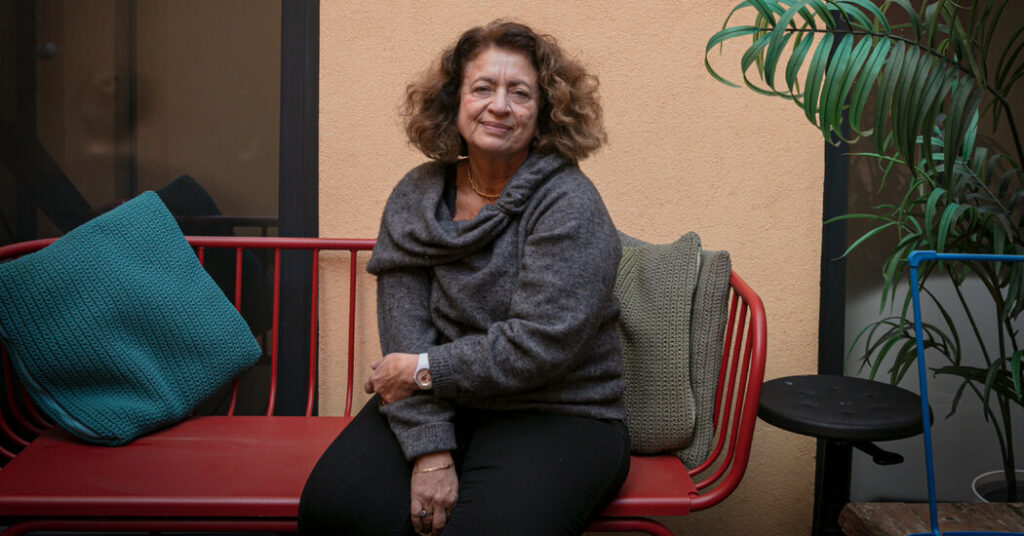
As a veteran doctor treating pregnant women in the suburbs of Paris, Ghada Hatem-Gantzer realized that most of her patients needed more than she could offer them.
Dr. Hatem-Gantzer, an obstetrician gynecologist, often oversaw care for women who had suffered sexual abuse, self-harm or alcoholism. She would urge them to see a psychologist, seek legal advice and file a police complaint. If the patient seemed tense, she might also recommend a physiotherapist.
The challenge, Dr. Hatem-Gantzer found, was that all these services were dispersed across an archipelago of state institutions, instead of being centralized in one building. As a result, the women struggled to find the help they needed, meaning that their complex traumas often went unaddressed.
“It was so complicated,” Dr. Hatem-Gantzer, 66, said in a recent interview. “Whereas if I tell you, ‘Well, next door is the therapist, the cop is there, then you can go to the support group, you can go to yoga on Mondays and do theater on Tuesdays’ — now that’s something else.”
Dr. Hatem-Gantzer built that “something else” almost 10 years ago in St.-Denis, one of Paris’s poorest suburbs, on a patch of muddy ground next to a hospital where she led the maternity ward. Here, she established a one-stop shop, known as “House of Women,” where female victims of violence have access to a wide range of social, legal and medical assistance, all in the same building.
It was a labor of love that almost failed. Sponsors were hard to convince. Even after securing the land, it took years to start building. At one point, she almost gave up.
Now, almost a decade after it opened, her project has become the template for how hospitals across France treat female victims of violence. About 30,000 women have been treated in its halls since 2016. Thirty similar centers have opened in France and neighboring Belgium, and four others will be inaugurated in the coming months.
The prototype invented by Dr. Hatem-Gantzer is such a success that two recent French prime ministers have each separately said that France’s 100 or so regional authorities each needed one of their own. A movie about the creation of the first facility in St-Denis will be released in March.
In short, Dr. Hatem-Gantzer set off an “earthquake” and established herself as a “role model” for the rest of the medical profession, said Anne Ferrer-Villeneuve, a hospital director who was inspired by Dr. Hatem-Gantzer to set up a similar facility.
Dr. Hatem-Gantzer created “a real response to a need that we saw, but whose scale we had not appreciated,” said Dr. Ferrer, the director of the University Hospital of Montpellier, a major medical center in southern France.
Dr. Hatem-Gantzer was born in 1959 in Beirut, Lebanon, to a father who was a telecommunications engineer and a homemaker mother. She was 15 when the Lebanese civil war erupted. As fighting raged in the streets outside, Dr. Hatem-Gantzer recalled, she sheltered on her building’s staircase, seeking refuge in books by Jean-Paul Sartre, Albert Camus, Simone de Beauvoir — “anything I could get my hands on,” she said.
When she finished high school, she left for Paris, where she studied medicine and quickly fell in love with obstetrics, a job she found “both exciting and terrifying.”
She went on to work at various maternity wards in Paris, helping hundreds of women give birth — including, as I recently found out, my own mother. Though most of her patients came from well-to-do backgrounds, she realized that many of them had suffered from domestic violence, prompting her to wonder if she could do more for her patients than offer them only medical treatment.
Her frustration at the limitations of her profession swelled in 2011 after she was appointed as head of the maternity ward in the largest hospital in St.-Denis, a hardscrabble area home to many immigrants. Her patients often lived in poverty, suffered from domestic abuse or were victims of female genital mutilation. Many, having recently arrived in France, barely spoke its language.
“It was an explosive cocktail,” Dr. Hatem-Gantzer said. “To the fact of being a woman was added all the difficulties of St.-Denis that came with poverty and migration.”
Giving in to family pressure, one patient had left a stable job in her home country to live in a small, unsanitary apartment in Paris with an alcoholic husband who beat her. Another patient, about 15 when Dr. Hatem-Gantzer met her, had fled her home in West Africa after suffering genital mutilation and forced marriage. Migrating through northern Africa toward France, she was raped several times and robbed.
Listening to these women, Dr. Hatem-Gantzer said, was “a source of anger.”
Around 2012, she started thinking of ways to offer them better care, and the idea of a single facility dedicated to treating violence started taking shape. The director of the hospital said Dr. Hatem-Gantzer could build the center on a vacant parking lot near the hospital — but only if she found the money herself.
When it became obvious that she wouldn’t receive significant public funds, she started seeking private ones. Eventually, she convinced three donors, including the Kering Foundation, a philanthropic group run by the owners of Gucci. But it wasn’t enough.
“In the United States, you can come in and say, ‘I have a project, I’m raising funds,’ and people will say, ‘OK, I’ll bet on it, we’ll see how it goes.’ In France, it’s not like that at all,” she said.
By 2015, still short of funds, Dr. Hatem-Gantzer thought she had reached the end of the road. She called her three sponsors and said she would return the money. “They told me, ‘don’t even dream about it,’” she said. With their help, she found other private sponsors, and the project was back on track.
“It’s like, you have to cross the Atlantic, and when you’re in the middle, you don’t ask yourself whether you want to continue or not. At one point, I just had to keep rowing,” Dr. Hatem-Gantzer said.
The house finally opened in July 2016, some 20 rooms spread across two floors. Designed by a friend of Dr. Hatem-Gantzer, it has a small garden and bright multicolored walls, with windows letting the light in from all sides. At its heart is a small patio with colorful furniture — a nod to the architecture of homes in the Middle East. It’s Dr. Hatem-Gantzer’s favorite spot.
The facility offers each patient a personalized treatment, with access to psychologists, psychiatrists, social workers, legal counsels and planned parenthood representatives, as well as general practitioners and gynecologists. It also organizes abortions and repairs genital cutting. A police officer is stationed inside one day a week, so women can file complaints on site.
A year after its opening, the #MeToo movement erupted in the United States, and it later trickled through French institutions, giving greater momentum to projects like House of Women.
“The world changed. When I talked about this in 2013, people didn’t understand what I was talking about,” Dr. Hatem-Gantzer said. But MeToo was “like a kind of explosion, everywhere,” she said.
Gradually, other hospitals and institutions began to follow suit, first in Brussels, in 2017, and then in Bordeaux, France, in 2019. That interest accelerated in 2021, when Dr. Hatem-Gantzer was given 10 million euros — about $11 million — by two private foundations to expand the project across France.
She also expanded the original house in St.-Denis, where patients can now practice gardening and yoga, learn French, attend jewelry and photography workshops, and join trips to museums and theaters. Some of their art pieces hang on the house’s walls, in between pictures of feminist icons.
During a French class last month, one of the patients burst into tears after her teachers and classmates surprised her with a birthday cake. “You have given me all the love I never had,” she told them before blowing out her candles. It was the first time, she told the gathering, that someone had ever thought of celebrating her birthday.
Dr. Hatem-Gantzer is no longer involved in day-to-day operations at the house. Most of her time is now devoted to awareness programs in schools and companies, and fund-raising, though she still performs operations to repair genital mutilation and offers advice to the center’s leadership.
“She’s a night light, a compass,” said Marianne Sonda, a manager at the house.
Her next major project is a new center for patients aged 3 to 25 suffering from sexual violence, which will soon open in Paris amid a reported increase in sexual assaults against children in schools.
Despite her success, Dr. Hatem-Gantzer considers her job far from over. Speaking at a lecture to raise awareness about sexual violence in universities last month, she couldn’t help but notice the absence of men in the room.
“That’s my greatest despair,” she said, “and I think my career will end without this figure really improving every time we speak about sexual violence.”
Ségolène Le Stradic is a reporter and researcher covering France.
The post She Listened to Women’s Pain. Then She Transformed How It Was Treated. appeared first on New York Times.