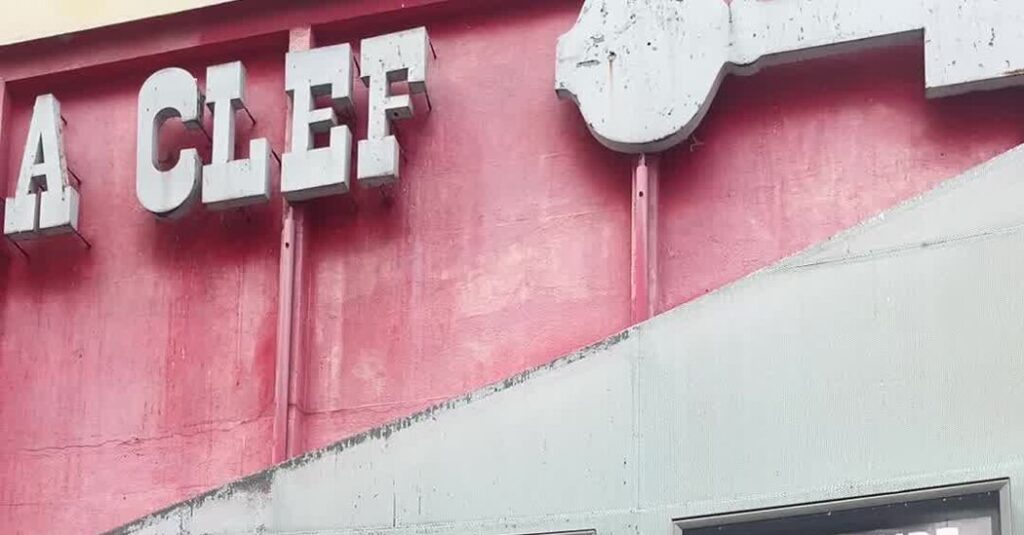
When the Paris movie theater La Clef closed its doors in 2018, its fate seemed sealed. For Parisians, it was a familiar story: another independent cinema falling victim to dwindling audiences in the era of soaring rents and streaming platforms. But La Clef refused to go down without a fight, and last week it reopened after a saga that kept its supporters on the edge of their seats for years.
After a string of legal battles, takeover bids and a fund-raising drive that drew in help from Quentin Tarantino, Martin Scorsese and David Lynch, La Clef celebrated its reopening on Jan. 14. Now run by a collective of students, filmmakers and cinephiles, it bills itself as Paris’s only volunteer-run cinema, with no fixed ticket prices and entry by donation.
La Clef, which started out as a more traditional, commercial operation in 1973, went on to win a reputation as one of the city’s leading art-house movie theaters. But by 2018 its audience had shrunk and the building’s owner, Caisse d’Epargne bank, decided to close it and put the building up for sale.
Refusing to accept their fate, a handful of former employees pulled together a collective of loyal supporters that squatted the building for several years. What followed was a protracted period of legal limbo, which ended last year when the squatters raised enough money to buy the building and restore its function as a cinema.
For La Clef’s inaugural screening on Jan. 14, the collective chose a fitting title: “Talking about Trees,” a 2019 Sudanese documentary about four filmmakers who band together to save an abandoned cinema. Viewers showed up in their hundreds, and many were turned away once La Clef’s two screening rooms, which seat 120 and 60, reached capacity.
The line stretched several blocks down Rue Monge in the Latin Quarter district. It was mostly a young crowd, dotted with a handful of longtime supporters who remembered the early days of La Clef.
“I’ve spent so many hours in this cinema,” said Marianne Richard, a retired teacher who drove for over an hour from her home outside Paris to attend the opening. “I used to be a student at the Sorbonne Nouvelle University, just around the corner,” she said. “I would always sneak off here to catch a film between classes.”
La Clef was founded by Claude Frank-Forter, the son of textile manufacturers who sold their business when it became clear that their sons didn’t want to take it over. Frank-Forter, then in his late 20s, used his portion of the proceeds to realize his dream of running an independent movie theater and poached the esteemed programmer Bernard Martinand from France’s national film center, the Cinémathèque Française. Together they organized a program of films by underrepresented and emerging international talents.
Yet despite being embraced by Paris cinephiles, La Clef struggled to compete with television, which was widespread in France by the 1970s. In 1981, Frank-Forter sold La Clef to Caisse d’Epargne.
The bank transformed one of the three screening rooms into a social club for its employees but allowed the others to continue running, showing auteur and experimental filmmaking. Sanvi Panou, a Togo-born actor and filmmaker, ran La Clef as a center for Black filmmaking for 20 almost years from the early ’90s, before passing the baton to an art-house film association in 2010. But audience numbers dwindled, and the theater shut in 2018.
The squatters arrived a year later. Calling itself La Clef Revival, the collective remained in the building for the next two and a half years.
In an interview, Héléna Delamarre, a former La Clef squatter, recalled the experience fondly. “It was a great time — intense, but fun,” she said. “We had to be constantly vigilant against the police, making sure the building was occupied at all times.”
During this period, the collective organized free daily screenings that were attended by more than 25,000 spectators — among them the French filmmaker Leos Carax and the American documentarian Frederick Wiseman, who dropped by in public shows of solidarity.
In March 2022, however, the police evicted the squatters and the screens went dark.
“After the eviction, the collective very quickly decided to try to buy the place,” said Kira Simon-Kennedy, a documentary film producer and member of La Clef Revival. “That kicked off the next phase, which was fund-raising. We needed to find a legal way to not just become the next tenants, but to actually own the walls and keep it forever.”
Some of France’s leading cultural figures, including the actor Mathieu Amalric and the Nobel Prize-winning writer Annie Ernaux, supported the fund-raising drive. Word also quickly spread among international filmmakers, and Tarantino and Scorsese both made sizable donations and recorded video messages to rally more donors to the cause.
“Why should we be upset about the disappearance of yet another cinema?” Scorsese asked in an essay for Libération newspaper. “Because it matters. Every theater matters.” The case of La Clef was particularly important, he added, “because it was brought back to life by people who came together for the love of cinema and the freedom it offers.”
An art sale at the Palais de Tokyo museum in 2023 — which included works donated by the photographer Wolfgang Tillmans and by Lynch, who painted as well as making movies — also brought in money.
With the help of more than 5,000 donors, the collective’s endowment fund was able to buy the building for nearly 3 million euros, about $3.2 million, in June 2024. It remained closed for the next 18 months while restoration work was carried out — a process that involved removing asbestos from the walls, installing a new cafe and bar space, and setting up production studios that emerging independent filmmakers can now rent out.
La Clef’s program now comprises a diverse array of boundary-pushing, and often political, works. Over the next few weeks, it plans to screen a documentary on Colombia’s FARC guerrillas and a visual essay by the Lithuanian avant-garde filmmaker Jonas Mekas, as well as a series of shorts by Palestinian directors.
“We really hope that this whole struggle for La Clef shows it’s possible to take space out of the commercial, speculative real estate market and run something collectively,” Simon-Kennedy said. “And we want to transmit everything that we’ve learned to anyone who wants to do something similar.”
The post Saving a Paris Movie Theater, With Help From Scorsese and Tarantino appeared first on New York Times.