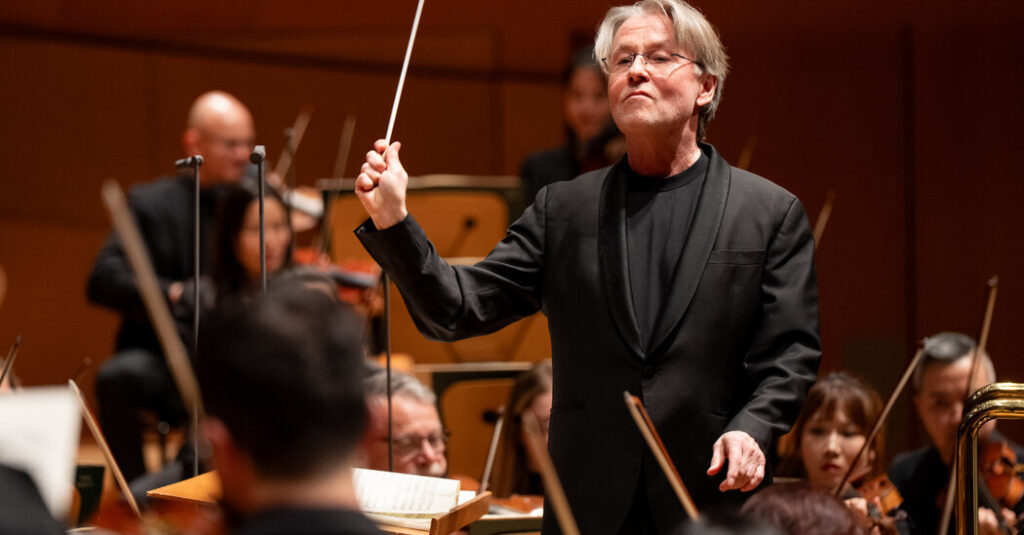
The audience was clearly happy to see Esa-Pekka Salonen.
When he stepped out onstage at Walt Disney Concert Hall to conduct the Los Angeles Philharmonic on Jan. 9, his walk to the podium was greeted not with polite applause, but with the kinds of roars usually reserved for sports stars and celebrities.
A sense of occasion was in order. Salonen, the Philharmonic’s former music director, maintains a close relationship with the orchestra, and his return to Disney Hall for a series of rollicking, spectacular concerts this month was his first time back since being named the Philharmonic’s creative director in September.
He starts the job, which was created for him, this fall, with a commitment to six weeks at the podium next season. He won’t be the music director (an open position, with Gustavo Dudamel leaving soon for New York), but he will be doing enough to make you wonder whether the Philharmonic needs one at all, or whether anyone would want to do it with Salonen already there.
Shouldn’t the Philharmonic want a new music director, though? This orchestra, perhaps the most forward-looking one in the country, daringly hired Salonen before he was known as a great maestro. He cemented that reputation in Los Angeles, just as Dudamel, who was appointed in his mid-20s, has done since 2009. Now, rather than hire a promising young conductor, it has invented a job for someone who is about as established as possible.
To be fair, you can understand the appeal: Salonen brings musical excellence and an excitingly ambitious, event-based approach to programming that was on full display this month.
His first program assembled rarities by Sibelius and Debussy, as well as a brilliant recent work by Gabriella Smith and the delightfully outrageous Scriabin tone poem “Prometheus.” Far from a typical orchestra evening, it called for two vocal soloists, a choir and a pianist (a splendid Jean-Yves Thibaudet). As if that weren’t enough, there was also a light installation by Grimanesa Amorós that hung benignly in front of the hall’s organ, with an opening around the console made of tendrils that draped and curled like plants at the mouth of a cave.
Salonen premiered the Smith piece, “Rewilding,” with the San Francisco Symphony last year, near the close of his short-lived music directorship there. Plenty of conductors look like they’re simply keeping time when leading contemporary works. But, as is often the case with Salonen, you could sense the same interpretive care he would have given a classic by Beethoven.
That helps for a score like “Rewilding,” whose 25 minutes contain a lot of openness and freedom in pitch and tempo. At times, the music evokes a field recording, with erratic chirps and natural sounds conjured through dull plucks, scratched strings and mallets hitting the spokes of spinning bicycle wheels.
But there is also a broad architecture to “Rewilding,” a steady but subtle journey to a blossoming apotheosis that Salonen shaped with steady control, the way he would later with “Prometheus,” which can sometimes feel like it’s all climax.
There’s a modesty to Salonen’s style. He doesn’t conduct with grand gestures, nor does he work up an athletic sweat. He moves like someone who has digested a score so thoroughly that he embodies it, with a lightly dancing sensuality in Debussy’s “La Damoiselle Élue” and a coiled tension in “Prometheus” that repeatedly unwound to release flares of sound and vivid drama, matched by Thibaudet’s spellbinding fingerwork at the piano.
Control was key the next week, in a single-work program of Ferruccio Busoni’s monumental Piano Concerto, an unpredictable 70-minute sprawl, with a little camp and a lot of virtuosity, that leads to a delirious choral finale. It can be tempting to revel in the music’s excesses too much and too soon; the score should come with a warning label.
The performances on Saturday and Sunday, with the pianist Igor Levit, were so well balanced, and helped by the clear acoustics of Disney Hall, that parts of the score felt rendered in stereoscopic depth and detail. Salonen kept the Philharmonic players at a reserve in the introduction, then as his arms began to bloom, the sound followed until Levit entered with booming, radiant chords. Salonen conducted as if carefully turning the dial on a speaker’s volume, making room for passages at either extreme: moments of meditative delicacy and carnivalesque outbursts alike.
Salonen’s performances had local luminaries and celebrities in the audience, in a very Los Angeles way. But one person was notably, painfully absent: Frank Gehry, the titan of architecture and lifelong music fan, who designed Disney Hall and was a fixture at concerts each season until his death in December at age 96.
Gehry and Salonen opened Disney Hall together and remained friends. Salonen even composed musical homages to the architect and his work, including “Wing on Wing,” written for the hall’s inaugural concert.
That piece returned to Disney Hall on Tuesday in “Music for Frank,” a starry gathering of mostly Gehry’s intimates to memorialize him through works that he loved. “Wing on Wing” movingly incorporates recordings from interviews with Gehry, fragments abstracted into noise with isolated words, such as a surprising mention of fish. When it was new, that felt like a celebration. On Tuesday, it was also an improvised, fitting memorial.
The rest of the piece has remarkable acoustic prescience. Before the hall opened, Salonen had imagined a work that exploits its sound to breathtaking effect. On Tuesday the floor rumbled with low strings and brasses; winds, often drowned out, could be heard as clearly as soloists. With a sense of theatricality, two singers let out wordless vocalise from various perches in the auditorium, or in motion while storming the stage.
Here was music tailored to this hall, performed by the orchestra that premiered it and conducted by its composer, who had written a score inspired by the building and the visionary architect who made it possible. Salonen really was home.
Joshua Barone is an editor for The Times covering classical music and dance. He also writes criticism about classical music and opera.
The post Old Is New Again: Salonen Returns to the Los Angeles Philharmonic appeared first on New York Times.