“Marty Supreme” is full of shocking moments. There are unexpected bursts of violence. A bathtub falls through the ceiling. But perhaps the most shocking is a simple line of dialogue.
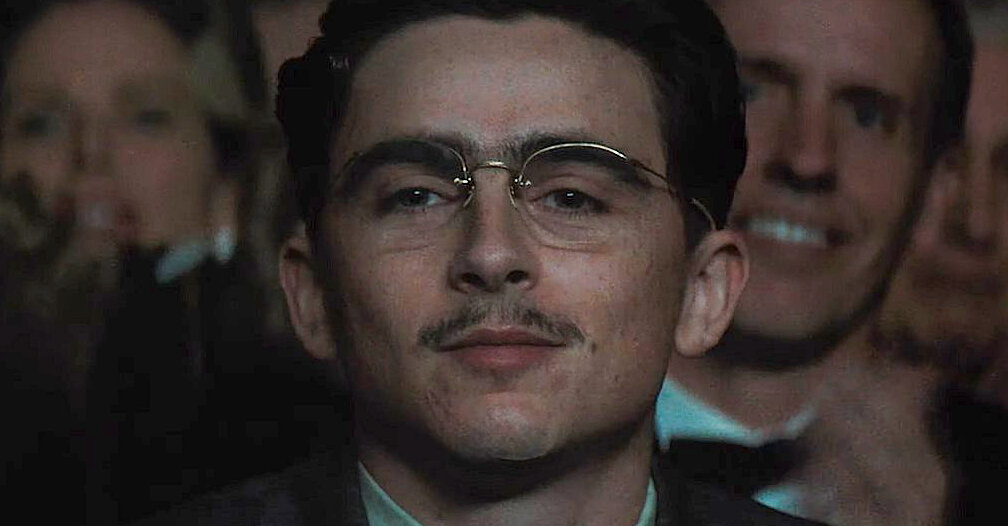
The table-tennis phenom Marty Mauser (Timothée Chalamet) is being interviewed by two stodgy reporters at the Ritz in London. Asked about a Hungarian rival in the British Open, Marty says he’s going to do to that player what “Auschwitz couldn’t.” He continues, with a deadpan look in his eyes, “I’m going to finish the job.”
I’ve seen “Marty Supreme” three times, and every time Marty utters those words there’s been a palpable shift in the audience: nervous titters or stunned gasps.
Marty quickly backtracks: He’s allowed to say that, he contends, because he’s Jewish. But the moment is so abrasive, it sticks in your craw. It’s also crucial to understanding the movie’s relationship to Marty’s Jewishness, an aspect of his persona that has provoked a lively discussion online. For some viewers, the portrayal of a ruthlessly ambitious American Jew borders on the antisemitic. For others, myself included, “Marty Supreme” is one of the great Jewish movies, an unapologetic depiction of the Jewish American experience in all of its complications.
The director Josh Safdie and his co-writer, Ronald Bronstein, have an abiding affection for bombastic Jewish heroes who ruffle feathers. Their previous collaboration, “Uncut Gems,” which Safdie directed alongside his brother, Benny, was set in Manhattan’s Diamond District and followed a compulsive gambler (Adam Sandler) who can’t get through a Passover Seder without some mishegas.
The brand of Jewish man who interests Safdie is not a model minority. The director is drawn to brash hustlers who make decisions that get themselves and the people around them into loads of trouble. And yet these characters are written with love and a deep understanding of the evolution of Jewish New York.
In fact, Marty’s very existence is a bit of magical thinking. The real-life versions of Marty — Jewish table-tennis stars like his namesake Marty Reisman — are footnotes in sports history. Marty Mauser may not achieve the greatness he longs for, but he is a representative of a generation of Jews whose dreams didn’t quite come true but who deserve recognition all the same.
That’s the big-picture version of what Safdie and his cohorts are doing with “Marty Supreme.” In the narrative, they dig deeper into the knotty reality of what it would have been like for a 23-year-old Jewish American man in 1952.
All too often we’re used to depictions of post-World War II Jews that emphasize their suffering. Think back to “The Brutalist” (2024) about a virtuosic architect reckoning with his trauma as a Holocaust survivor while trying to rebuild his life in America. Even a movie like “The Pawnbroker” (1965), by Sidney Lumet, which is much closer in tone to “Marty Supreme,” tempers the causticness of its hero, a survivor, with his personal sorrow.
Marty Mauser did not personally endure the Holocaust the way these men did. He would have been an American teenager when World War II ended, hearing about the elimination of his people (and probably some of his relatives). To him, being a Jew is associated with the tragedy, but it’s equally associated with the Lower East Side tenements he’s desperate to escape and isn’t proud of. Asked about his background, he lies and says he was an orphan, mythologizing his hardscrabble life, and ignoring his mother (Fran Drescher), whom he thinks of as a kvetch. It’s this dichotomy that leads him to make the Auschwitz joke to British journalists. After their uncomfortable silence, he describes himself as “the ultimate product of Hitler’s defeat.”
And in a way, he’s right. Marty may have made a crass joke about the Holocaust, but he’s proud of his Jewishness. He wears a Star of David. He chisels off a piece of an Egyptian pyramid to bring home to his mother, at which point he says, “We built that.” And when he meets the pompous gentile tycoon Milton Rockwell, he brags about his friend Bela (Géza Röhrig), the same man about whom he made the Auschwitz crack.
When Rockwell says his son, who served in the South Pacific, lost his life “liberating” Bela, Marty jumps in not just to explain that Bela’s camp was liberated by the Soviets, but also to egg Bela to tell the story of his time in Nazi captivity. From there, Bela relates a haunting tale about how he was sent into the woods to dismantle bombs because of his table-tennis skills. One day he spotted a bee, followed it to its hive, and smeared the honey all over his body, and allowed his fellow prisoners to lick it off him for sustenance. The flashback is illustrated viscerally in lyrical chiaroscuro with tongues plunging into Bela’s hairy chest. It looks like something out of a Goya painting.
Bela is based on the table tennis champion Alojzy Ehrlich, who did in fact defuse bombs for the Nazis, and more unbelievably did smuggle honey on his body for his fellow Jews in Nazi custody, at least according to Marty Reisman’s own memoir, in which he refers to him as Alex. Reisman wrote that Ehrlich was a “brave man,” and it’s clear Marty Mauser thinks that about Bela as well. In having Bela tell Rockwell about the honey, Marty is bolstering his own self-image by way of his Jewish pride: He’s arguing, perhaps with a bit of stolen valor, that he’s of the same stock as Bela, undermining Rockwell’s own self-importance, which Marty continues to do. The flashback cuts directly into the scene of Rockwell’s wife, Kay (Gwyneth Paltrow), showing up at Marty’s hotel room.
Yes, Marty is not a straightforwardly honorable guy. In fact, he’s a little stinker who quite literally leaves a trail of bodies in his wake as he seeks the money to pay for his trip to the world championships in Tokyo.
The argument that “Marty Supreme” is bad for the Jews dovetails with the notion that Marty is an unlikable, at times selfish, character and therefore not a positive role model for Jewish people. And, yes, there are moments when stereotypes are invoked. Marty’s friend Wally (Tyler Okonma) tells him, “Don’t be greedy, you [expletive] Jew.” But to take Wally’s words at face value would undermine the complicated portrait Safdie and Bronstein have constructed.Marty is not seeking money out of a desire for riches. His pursuit of cash is entirely in service of his pursuit of table tennis glory, a goal rooted in his genuine talent. When he tells people like Wally that he’ll pay them back, he’s being genuine: He truly thinks he’ll be on the cover of a Wheaties box.
If there’s an aspect of Marty’s upbringing that leads to his downfall, it’s his Americanness not his Jewishness. His nationality is what gives him the ability to “dream big,” as the tagline says. It’s also what puts him at odds with the table tennis establishment, which views his grandstanding as uncouth. Meanwhile, back home, he exists in the liminal space of being privileged compared to someone like Wally, a Black man, but still looked down upon by the upper class establishment embodied by Rockwell, who wants all Jews to grovel. He wants Bela to thank him because of the efforts of his son — who wasn’t even anywhere near Europe — and he eventually wants to humiliate Marty, forcing him to drop his trousers and receive a spanking for his insolence.
Marty is a jolt to the system, because even though Rockwell is a jerk to him, he doesn’t suffer the way we expect Jews of the post-war period to onscreen. Instead he’s allowed to be audacious, sexy and driven. He is, as he says, “Hitler’s worst nightmare”: a Jew who makes no apologies for his Jewishness and highlights that on a global stage. And that is reason to celebrate.
The post ‘Marty Supreme’ Has a Lot to Say About Being Jewish in America appeared first on New York Times.