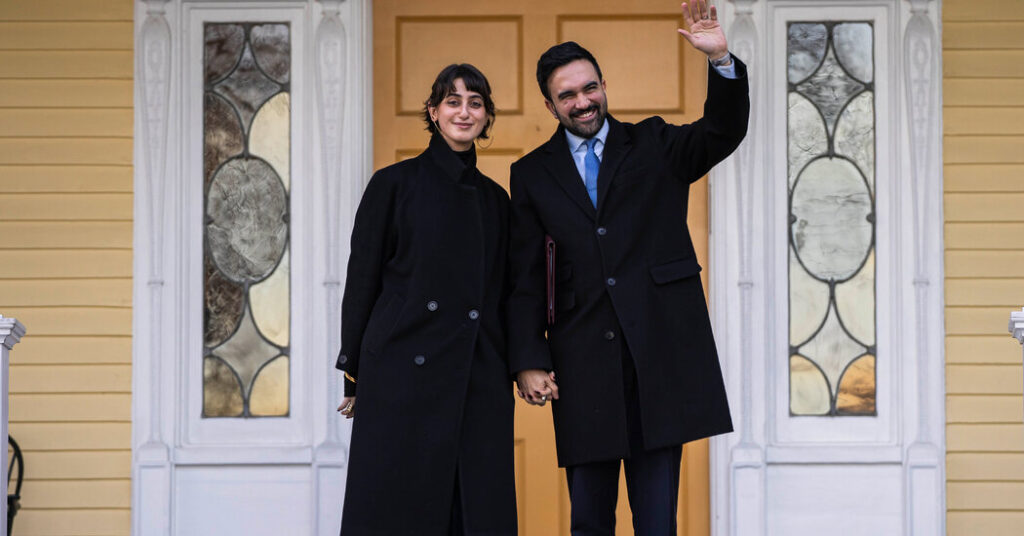
When New York City’s new mayor, Zohran Mamdani, moved into Gracie Mansion with his wife, Rama Duwaji, last week, he mentioned that he had an “aspirational hope” for the “people’s house”: to install bidets in the bathrooms.
“We’ll see if we can actually get it done,” he said.
In a sit-down interview with ABC 7 New York that aired on Sunday, the mayor mentioned a few more details, noting that all he’s envisioning is adding a handheld $25 water gun “that you hook on the side of the toilet.” A spokesperson for the mayor confirmed in an email that installation had already begun at Gracie Mansion.
Almost every mayor of New York has left a mark on the centuries-old residence — giving it a full makeover, as Michael Bloomberg did, or installing tuneups, like Ed Koch’s indoor barbecue pit and David Dinkins’s handmade headboard. But for Mr. Mamdani to bring the bum-cleaning tool into the mansion is, at the very least, a nod to Americans’ growing embrace of a device that is common in many parts of the world but that has long been seen in the United States as somewhat unusual.
There is some evidence of this shift. In a 2026 survey of 700 industry experts by the National Kitchen and Bath Association, 76 percent of interior designers noted that homeowners were looking for toilets with more features, and 48 percent predicted that bidet seats would be popular in the next three years. Tushy, a Brooklyn-based bidet maker, has shipped over two million units across the United States since it was founded in 2015, according to Justin Allen, the company’s chief executive.
“When we started Tushy, bidets in the U.S. were either seen as an inaccessible luxury or, honestly, just kind of weird,” Mr. Allen said. But “once you use one, it’s hard to forget how much cleaner it feels.”
On social media, many users reacted to Mr. Mamdani’s bidet announcement with enthusiasm, describing his redecorating goal as a “priority” and “a must,” while others expressed confusion over his focus on toilets rather than policies.
In a comment responding to a video of the mayor’s announcement, the daughter of former Mayor Rudolph W. Giuliani, Caroline Rose, said she “would’ve done it myself if I had known about bidets when I lived there!!”
Others said that the city should install bidets everywhere and that Mr. Mamdani’s hopes were an authentic reflection of his Indian heritage, as bidets are commonplace there.
In fact, the United States is more or less a global outlier in terms of its stance toward the bidet, which is a term that encompasses several forms of water-based cleaning systems. More modern iterations are attached to toilet seats and have retractable spray wands. The most well-known style is made by the Japanese company Toto, which first released a bidet seat in 1980 and has since developed something of a cult following. Newer upstarts, like Tushy, have their own bidet seats, offering designs from the basic to the luxurious, with the ability to heat toilet seats, control water temperature and neutralize odors.
Across Europe, bidets are often separate, stand-alone basins. The term bidet comes from the French word for “pony,” a reference to the straddling position needed to use these versions of the device. In other parts of the world, like Southeast Asia, homes and public bathrooms will often feature hand-held bidets, such as jugs of water or small shower heads that are colloquially known as bum guns. In some religions, like Islam, which Mr. Mamdani and Ms. Duwaji follow, hygiene and cleanliness are tantamount to faithful worship, making easily available cleaning modes culturally essential, too.
While the bidet offers its users a thorough cleaning, it also has environmental benefits, Mr. Allen said, by cutting down on the amount of toilet paper used and the number of wet wipes that end up in landfills. In fact, the New York Department of Environmental Protection posted a video on Instagram of the mayor’s bidet announcement with a caption that read, “More bidets = fewer wet wipes.”
At one point, Gracie Mansion was public property, serving as a public restroom for visitors of the surrounding Carl Schurz Park, before becoming the official mayoral residence in 1942. In 1981, when Mayor Koch was considering a refurbishment of the mansion, The Times described its bathrooms as hardly rising “above the one-star category.” Mayor Bloomberg’s renovation upgraded all five of the mansion’s bathrooms.
The most basic water-jet-only bidet seat attachments can cost as little as $35, and installation would require only access to fresh water pipes, said Mr. Jacq de Beer, founder of Bidet New York, which performs bidet installations across New York. Other bidet seats, with more bells and whistles, cost upward of roughly $300, and many would also need to be plugged into an electrical outlet, he added. The shape of the existing toilet seat also affects which bidet would be the best fit.
But “I’ve never found a case where I couldn’t do it,” he said.
A mix of infrastructure shifts and a lack of familiarity has, until recently, kept the bidet out of most American homes, said Bryant Simon, a professor at Temple University who is currently writing a book about the history of public restrooms. Most households began to have three-fixture bathrooms, with a sink, a shower and a flushing toilet, starting in the 1880s, thanks to the widespread development of sewage systems, Mr. Simon said. Toilet paper also became mainstream around the same time.
“And, you know, that just becomes people’s experience for excretion” for centuries, he said. “I can only speak for myself — I’m 64, and the first time I went abroad in 1983 and saw a bidet, I didn’t know what it was.”
But social acceptance shifted, out of necessity, during the pandemic, when toilet paper became scarce, Mr. Simon added. It’s a change he has noticed in his own circle, too. In a recent class, he asked his 13 students about bidets — they all knew what they were, and four students had used one. And over the holiday break, Mr. Simon went to two parties. Both homes had bidets.
“Obviously I took note of it,” he said.
Alisha Haridasani Gupta is a Times reporter covering women’s health and health inequities.
The post Mamdani’s Aspiration for Gracie Mansion: Bidets appeared first on New York Times.