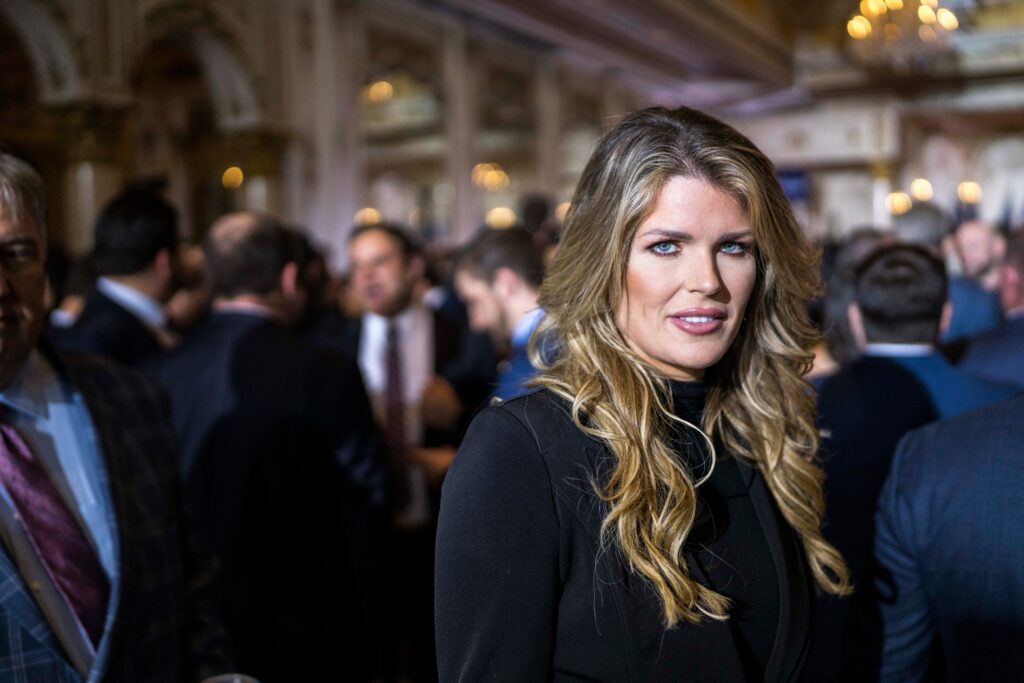
Lindsey Halligan, a Trump administration lawyer who was named head of a key U.S. attorney’s office in Virginia last year with instructions to seek criminal charges against President Donald Trump’s political adversaries, left her post at the Justice Department on Tuesday, Attorney General Pam Bondi said.
Halligan’s departure followed a pair of extraordinary moves by two federal judges who issued court orders Tuesday saying that they intended to replace Halligan at the helm of the U.S. attorney’s office for the Eastern District of Virginia and threatening disciplinary sanctions for any government lawyer who continues to refer to her as U.S. attorney in legal filings.
The separate actions by Chief Judge M. Hannah Lauck and Judge David J. Novak, who were nominated by Presidents Barack Obama and Trump, respectively, signaled a breaking point for the federal bench in the Eastern District of Virginia months after Halligan was disqualified from serving as U.S. attorney in the high-profile office.
The orders intensified a battle playing out nationwide between the executive and judicial branches over how the nation’s 93 U.S. attorneys can be appointed for temporary terms without Senate confirmation. And they present new obstacles for Halligan — who had no prosecutorial experience before she was installed in the job — as she attempts to carry out Trump’s directions to levy criminal charges against two of his perceived political foes: former FBI director James B. Comey and New York Attorney General Letitia James.
Lauck directed the court’s clerk to publish the U.S. attorney job posting in local newspapers, asking anyone interested to apply by Feb. 10. “The position of United States Attorney for the Eastern District of Virginia is vacant,” reads a public notice posted on the court’s website Tuesday.
Typically, U.S. attorneys are appointed by the president and confirmed by the Senate. But federal law empowers the attorney general to name interim appointees when there is no Senate-confirmed pick. Those interim appointments are limited to 120 days, after which the law empowers a district’s federal judges to name a replacement until the Senate confirms a presidential nominee.
Several judges had suggested for weeks that Halligan should resign and sharply questioned her continued use of the U.S. attorney title after an out-of-district judge, Cameron McGowan Currie, ruled in late November that the Trump administration had used an unlawful maneuver to install Halligan.
The orders issued Tuesday marked an escalation, signaling active efforts by the judges to appoint the district’s top federal prosecutor under a federal law that gives them the power to do so after an interim U.S. attorney has been in office for 120 days. That order by Lauck was followed hours later with another one from Novak, who raised the threat of disciplinary action for anyone who describes Halligan as the U.S. attorney in legal filings.
“No matter all of her machinations, Ms. Halligan has no legal basis to represent to this Court that she holds the position. And any such representation going forward can only be described as a false statement made in direct defiance of valid court orders,” Novak wrote. “In short, this charade of Ms. Halligan masquerading as the United States Attorney for this District in direct defiance of binding court orders must come to an end.”
The Justice Department, Halligan and a spokesman for the U.S. attorney’s office in Alexandria, Virginia, did not immediately respond to requests for comment Tuesday.
The Trump administration has appealed Currie’s ruling, but it never requested a stay, meaning that the ruling disqualifying Halligan remains in effect for now. Nonetheless, she has continued to represent herself as the U.S. attorney in court filings.
This month, Novak ordered Halligan to explain why she continues to use the title, suggesting she may be making false or misleading statements. The Justice Department responded defiantly to that order last week, arguing that Currie’s ruling was not binding and that Novak had no authority to strike Halligan’s name from the signature block of Justice Department court filings.
The response, which accused Novak of making “rudimentary” legal errors and missing “elementary” legal principles, was written in a derisive tone unusual for a government lawyer addressing a federal judge.
Novak said in response that Halligan’s rhetoric was beneath the court’s dignity and more suitable for cable news. He said Halligan’s continued use of the U.S. attorney title after Currie’s ruling was an affront to the legal system.
“The Court cannot tolerate such obstinance, because doing so would undermine the very essence of the Rule of Law,” he wrote in Tuesday’s order. “If the Court were to allow Ms. Halligan and the Department of Justice to pick and choose which orders that they will follow, the same would have to be true for other litigants and our system of justice would crumble.”
Halligan’s nomination for a full term as U.S. attorney is pending in the Senate, but it is unlikely to move forward because it lacks support from Virginia’s two senators — Mark R. Warner and Tim Kaine, both Democrats — who have emphasized that the Eastern District of Virginia handles a complex portfolio of cases dealing with national security, leaks of classified information and international terrorism. Halligan is a former insurance lawyer and White House aide; she was a personal lawyer for Trump in the case that special counsel Jack Smith brought against him over alleged mishandling of classified documents that was dismissed. She had no prior experience as a prosecutor.
In disqualifying Halligan last fall, Currie ruled that Halligan was never legally appointed to the position of interim U.S. attorney because the Trump administration had already named someone to that role — Halligan’s predecessor, Erik S. Siebert, who served a full 120-day term, from January to May 2025. The district judges then unanimously extended Siebert in the role at the Justice Department’s request, Novak wrote in his order.
But Siebert was forced out in September after declining to seek charges against Comey and James. Career prosecutors had recommended against pursuing the two cases because of insufficient evidence of wrongdoing. Trump then named Halligan, who promptly secured indictments against Comey, on allegations that he made false statements to Congress, and James, who was accused of mortgage fraud. Currie tossed both indictments after finding that Halligan was unlawfully appointed.
Halligan’s 120-day appointment concluded Tuesday, Lauck wrote.
Justice Department lawyers maintain that the statute allows for back-to-back interim appointments. But in addition to Currie, at least five other federal judges have rejected that argument while ruling on challenges to other Trump U.S. attorney appointees. In each case, the judges have said that if the attorney general could legally name a string of interim appointees, there would be no need for an administration to put a nominee up for a Senate vote.
Still, judges across the country have been cautious in exercising their authority to name replacements for the president’s picks. When New Jersey’s federal judges named a veteran federal prosecutor to replace then-interim U.S. attorney Alina Habba last summer, the Justice Department fired their pick within hours and undertook a series of legal maneuvers aimed at keeping Habba in the role.
Delaware’s chief federal judge began soliciting applications this fall to replace Trump’s interim pick there, former state GOP chair Julianne Murray. But Murray resigned her post in December before a potential standoff with the administration could come to a head.
Judges in other districts have refused to reappoint Trump’s interim U.S. attorney picks but declined to choose replacements. The chief federal judge in Seattle issued an order last week soliciting applications to potentially appoint a new acting U.S. attorney there, when the interim appointment of Trump’s current pick expires next month.
Finding a qualified candidate who is willing to lead the U.S. attorney’s office could be a tall order while the Trump administration insists on keeping Halligan in the role, according to two former managers in the Alexandria office who spoke on the condition of anonymity because they did not want to damage relationships with judges and prosecutors. Although the position is prestigious, any assistant U.S. attorneys in the district would be risking blowback if they applied for the top job while Halligan remains in the office, the two people said. Few attorneys in private practice would want to risk their livelihoods under those circumstances, they said.
Justice Department leaders signaled Tuesday that the Trump administration would probably attempt to fire any replacement for Halligan named by the court. “It’s not likely, it’s guaranteed that the President gets to pick his U.S. attorneys,” Deputy Attorney General Todd Blanche said in a social media post.
The post Lindsey Halligan out as U.S. attorney following pressure from judges appeared first on Washington Post.