In Argentina, dormant high school group chats roared to life with news of Nicolás Maduro’s capture. Colombians debated exit plans if they were next on Washington’s list, Ecuadorean schoolteachers paused lessons to discuss the U.S. raid, and a Peruvian beauty queen even weighed in.
Yet this regional frenzy did not translate into a significant wave of organized protests across a continent that has long harbored resentment over the United States’ Cold War-era meddling in Latin America.
While some Latin Americans denounced what they decried as American imperialism in Venezuela, a more supportive response to President Trump’s action prevailed, with several polls showing that a majority of Latin Americans endorsed the intervention.
“I am happy because I saw the fall of a dictator and I am happy because my Venezuelan friends are happy,” said Carlos Segura, 36, a professor in Buenos Aires.
Seventy-four percent of Peruvians, sixty-three percent of Chileans, a majority of Colombians, Brazilians, Argentines, and even Panamanians, whose country was itself invaded by the United States to remove an authoritarian leader nearly three decades ago, approved of the capture, according to several polls.
In Mexico, the response was more evenly split, reflecting a significant leftist base and widespread opposition to Mr. Trump’s policies. The country’s leftist leader, Claudia Sheinbaum, issued a carefully worded rejection of the attack.
Overall, disagreements among regional leaders over the U.S. removal of Mr. Maduro were tempered by a desire to avoid direct friction with Mr. Trump. And at the ground level, divisions among Latin Americans were softened by the left’s struggle to mobilize against the capture of a reviled authoritarian.
Whatever unhappiness exists toward Mr. Trump and his desire to project dominance over Latin America, a shift toward pragmatism is eclipsing old ideological loyalties, at least for now, experts said. That could certainly change if Mr. Trump follows through on threats to launch land strikes, perhaps in Mexico or in South America, targeting what he says are drug cartels.
But in the case of Venezuela, many Latin Americans opposed Mr. Maduro’s rule and felt the impact of its fallout — including millions of Venezuelans who migrated throughout the region fleeing poverty and repression.
“International law, imperialism, this is the discourse of the elite,” said Marta Lagos, the founder of Latinobarómetro, an annual public opinion survey across Latin America. Popular support for the U.S. intervention, “has nothing to do with ideology,” she said. “They choose whatever is possible to fix things.”
Much of Venezuela’s political future is in flux, with the interim government run by those who ruled alongside Mr. Maduro, and their repressive behavior has continued targeting people engaged in public displays of celebration over the U.S. intervention.
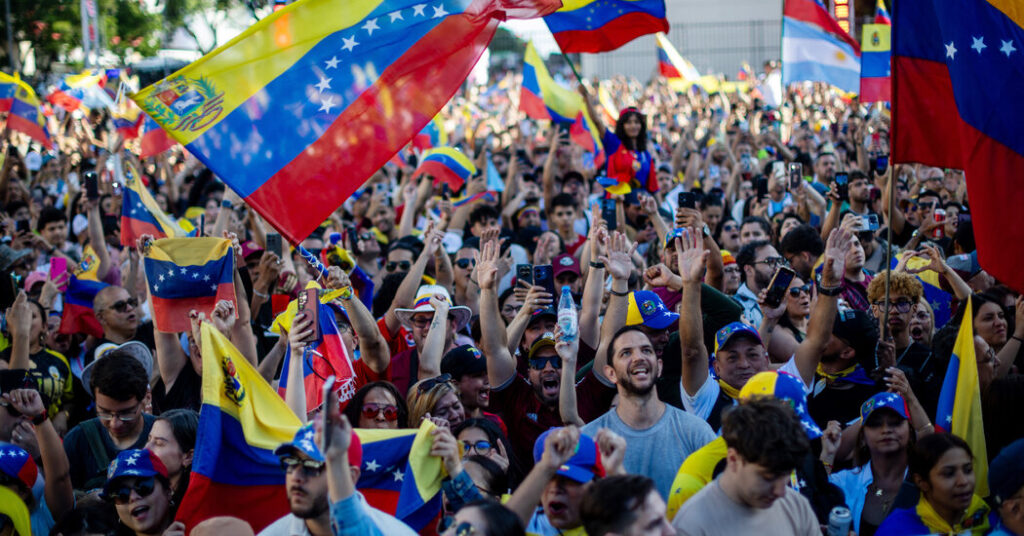
But outside the country, a resounding wave of euphoria rang out, louder than the traditional “Yankees go home” cries, as many Latin Americans joined the Venezuelan diaspora in welcoming Mr. Maduro’s toppling.
“It was the only way Venezuelans could get rid of this guy,” said Lorena Plaza, 37, a schoolteacher in Quito, Ecuador. “Maybe it wasn’t the right way, but there really wasn’t another way.”
In Argentina, where the Venezuelan crisis has been a fixture of domestic political friction for more than a decade as a cautionary lesson of socialist misrule, car horns erupted at dawn on Jan. 3 after news of Mr. Maduro’s capture spread.
An A.I. generated song by a Venezuelanliving in Argentina that mocks how China and Russia failed to defend their Venezuelan ally — “where are the communists?” — became a major sensation, gathering more than 11 million views on TikTok.
“Panamanians and Venezuelans celebrating from now on every Jan. 3,” read a post from El Gallinazo, a popular Panamanian Instagram account that featured a video of two men dancing.
Some regional reactions to Mr. Maduro’s extraction still fell along familiar left-right divides. Many supporters of Brazil’s president, Luiz Inácio Lula da Silva, a leftist, and Mexico’s Ms. Sheinbaum, opposed the U.S. attack. In Chile, President Gabriel Boric — who has tried to stake out a new brand of leftist politics by distancing himself from the region’s socialist dictatorships — nonetheless issued a sharply worded condemnation of the American action.
Still, Mr. Roman said, “you don’t really see the left rallying behind this as a major crying call.” Mr. Maduro’s rule proved so plainly calamitous, he added “it’s not an easy topic for the left.”
On Jan. 3, while celebrations erupted in the heart of Buenos Aires, Argentina’s capital, leftist parties called for a protest outside the city’s U.S. Embassy — but the demonstration ended up being relatively modest in size. A survey by the polling firm Altica showed that 31 percent of Argentines opposed the U.S. intervention, while 61 percent supported it.
The sentiment was largely different in Europe, where a majority of Spaniards, Germans and Britons condemned the attack, according to recent polls.
Following the U.S. invasion of Iraq in 2003, Argentina, a Gallup International survey found, registered the highest level of opposition of any country surveyed — 83 percent — with many Latin American nations also strongly criticizing the military action.
But Iraq was much closer in time to the Cold War, as well as a faraway geographical conflict, experts noted, while Venezuela was an immediate, nearby, destabilizing threat.
“Maduro turned out to be the neighbor who is noisy and disruptive, so when the police came to pick him up they were like: ‘finally,’” said Patricio Navia, a Chilean political scientist at New York University.
Steven Levitsky, a political scientist at Harvard University, noted that three decades have passed since the Cold War helped contribute to U.S. meddling in Central America and a support for brutal dictatorships that entrenched anti-American sentiments across the region.
“There has been a pretty big generational change,” he said. “Many Latin Americans don’t remember that period.”
Many Latin Americans now are worried about more pressing and urgent concerns, experts said, including crime waves fueled in large part by the power and spread of drug trafficking groups that have plagued countries like Ecuador or Costa Rica, nations that had been considered relatively safe.
Many Latin Americans are willing to embrace virtually any solution to end the violence, regardless of the methods employed. That “by all means necessary” logic can take the form of endorsing the illiberal methods of El Salvador’s president, Nayib Bukele, who has suspended key civil liberties while cracking down on crime — but also of condoning outside intervention.
“Latin Americans don’t like a U.S. invasion,” Mr. Navia said, “but they dislike economic crises and humanitarian crises even more.”
Venezuela has been in crisis since 2014, when oil prices plunged, with food and medicine becoming scarcer and more expensive and the Maduro government becoming increasingly repressive, propelling one of the largest migration crises in the world.
Of the eight million Venezuelans who fled the country in recent years, nearly seven million migrated to Latin American countries, most to Colombia and Perú, according to the Migration Policy institute, a research center.
In some nations, the influx has stretched budgets and angered locals who view the newcomers as competition for jobs and other services. And even though people who have committed crimes are a tiny fraction of the many Venezuelans who have fled, the infiltration of criminal gangs among the migrants have brought new crimes and fears among local populations.
Many Colombians saw in Mr. Maduro’s government an ally of armed Colombian rebel groups that have long terrorized their country. One of the largest has established a deep footprint along the border between Colombia and Venezuela, fomenting violence and displacing many Colombians.
Any action that could potentially weaken these groups is often welcomed by many Colombians — even if it means the United States raiding a sovereign country.
“People are willing to look at El Salvador,” Ms. Lagos said. “People are willing to pay a price.”
Reporting was contributed by Daniel Politi and Lucía Cholakian Herrera from Buenos Aires, Argentina, Simon Romero and Annie Correal from Bogotá, Colombia, James Wagner from Mexico City, Mitra Taj from Lima, Peru, and José María León Cabrera from Quito, Ecuador.
Emma Bubola is a Times reporter covering Argentina. She is based in Buenos Aires.
The post In Latin America, Loathing of Maduro Smothers Outcry Over U.S. Raid appeared first on New York Times.