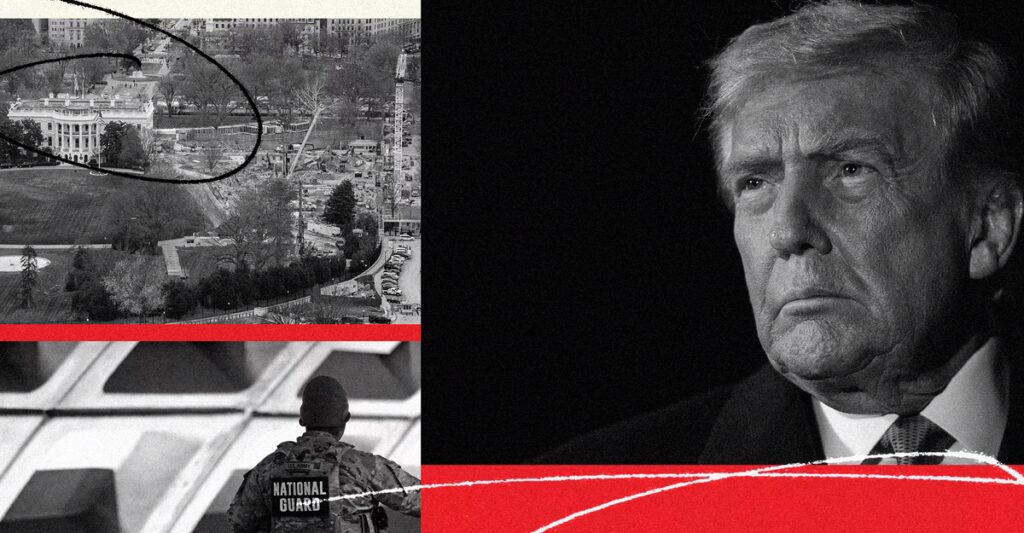
President Trump prosecutes his political opponents; deports immigrants, including some here legally, to foreign prisons without due process; solicits tribute payments from corporations and foreign governments; deploys soldiers to American cities that are not, in fact, in civil-war-level chaos; and puts his name and image on government buildings that quite obviously don’t belong to him.
So, a question: What do you call this form of government? Authoritarian? Kleptocratic? Totalitarian? Fascist?
Above all, Trump attempts to govern by decree, unconstrained by norms, shame, or the Constitution. (The only limits he sees on his powers come from “my own morality,” he recently told The New York Times. “My own mind. It’s the only thing that can stop me.”) But any analysis that attempts to answer the question of whether this makes him a despot must take into account that he is still not terribly successful at despotism. Sometimes he gets his way, but sometimes he does not. The White House on occasion seeks Congress’s approval and is periodically thwarted. Courts block his administration’s moves weekly, even if the small fraction of cases that make it to the Supreme Court mostly go Trump’s way. His enemies continue to walk free, despite his efforts. He is historically unpopular and his term ends in three years.
The easiest way to label America’s new political system might be through the process of elimination. We are not, for example, living under totalitarianism, which, in Mussolini’s words, would entail all aspects of society lying “within the state, none outside the state, none against the state.” Power in America is still decentralized. Local governments operate mostly independently, and business and institutional leaders have power over their domains. What about fascism, then? The historian Robert Paxton came up with several diagnostic criteria in his 2004 book, The Anatomy of Fascism. Fascists, or those adjacent to fascism, are generally obsessed with societal decline. They seek increased militarization, the abandonment of democratic freedoms, and violence in service of internal purity and expansion abroad.
[Quinta Jurecic: Trump’s attack on democracy is faltering]
Paxton himself had once resisted applying the term to Trump. The events of January 6, 2021, changed his mind. No doubt, some of his criteria sounded apt even before the Department of Homeland Security turned its X account into a stream of unsubtle endorsements of white supremacy. Yet the fact that fascistic tendencies are stirring doesn’t mean fascism has taken hold. “There are fascist people,” Samuel Moyn, a law and history professor at Yale, and a critic of using the term, told me. “Those probably exist in the millions, and they always have.” Trump’s own former chief of staff John Kelly has said that Trump “certainly falls into the general definition of fascist.” But a truly fascist form of government? “The United States is nowhere remotely near that,” Steven Levitsky, the Harvard scholar of authoritarianism, told me. Opposition has not been banned; to the contrary, it remains loud. Opponents of Trump are not just spared expropriation, torture, and execution—many even gain money, fame, and power through the very act of opposing him, including writers such as Heather Cox Richardson and politicians such as California Governor Gavin Newsom. “You work for a magazine” Moyn told me, whose existence would have been “unthinkable” during “the Third Reich or under Mussolini.”
If the United States isn’t fascist, have we crossed into kleptocracy, or rule by thieves? Few Americans are doing better in the Trump economy than Trump himself. America has always had politicians who used their power to enrich themselves, but as a rule, they used to try to hide it. In the second Trump era, the graft is largely out in the open. The top purchasers of Trump’s crypto meme coin were invited to dinner with the president. The Securities and Exchange Commission halted its case against one of the biggest investors in Trump’s crypto schemes. The top donors to Trump’s new White House ballroom include the recipients of major government contracts such as Palantir and Lockheed Martin. The government of Qatar gave the White House a $400 million jet. Trump’s Commodity Futures Trading Commission is allowing one company that employs his son Donald Jr. and another that he’s invested in to brazenly evade state-level gambling bans.
But Timothy Frye, a scholar of post-Soviet Russia at Columbia, says kleptocracy isn’t exactly right, either. “There are a lot of countries that have high levels of corruption that I wouldn’t call a traditional kleptocracy,” he told me. Many leaders use the state to direct resources to their own or their friends’ pockets, but there are only a few countries “where the government primarily exists to steal from the populace,” and where the oligarchs “face very few constraints from doing so,” Frye said, adding that in the U.S., “CEOs don’t wake up in the morning thinking that the government’s going to simply expropriate their firms.”
That is a rather low bar to clear. Some executives surely lose sleep over fear of their government contracts being canceled or their merger being rejected on political grounds. The fact that business leaders worry at all about opposing the president is, well, worrying. In Trump’s second term, the powers of the federal government are used to reward allies and punish the opposition, real and perceived. Organizations that Trump deems “left wing” are investigated. States run by Democrats are stripped of their federal funding. Media mergers are steered into Trump-friendly hands. Security clearances are taken from lawyers who worked for Democrats, and government-funded protection is rescinded from ex-officials perceived to be disloyal.
An opposition still exists, in other words, but it’s at a disadvantage. That’s the classic condition of competitive authoritarianism, a term coined by Levitsky and his colleague Lucan Way to describe countries ruled by “hybrid regimes” in the two decades after the Cold War. Before the 1990s, dictatorships usually looked the part. After the fall of the Soviet Union, many authoritarian countries began to hold elections. But the competition wasn’t fair. Opposition media could be shut down. Courts could be packed. Enemies could be harassed or assaulted, and the perpetrators would not be punished.
Because competitive authoritarianism depends on maintaining a plausible degree of democratic participation, it is much easier to pull off when a leader is broadly popular, Levitsky explained to me, like Vladimir Putin or El Salvador’s Nayib Bukele. Trump is not. And it’s more effective when you’re savvy and careful. Trump is neither. His authoritarian moves can be half-baked and primitive, such as the firing of the head of the Bureau of Labor Statistics for releasing economic data that Trump wished were not true. That decision and others like it have led some observers to reach for a different term, one geographically closer to home: banana republic. Because bananas are an unserious fruit, the phrase evokes a certain degree of slapstick mismanagement. But the term’s historical definition is a poor fit for the contemporary United States. Countries that qualify as banana republics, typically Latin American ones, tend to have an economy dependent on a single commodity, a large and exploited working class, and a tiny upper class with a stake in that commodity, which gets to enjoy the fruits of the poor’s labor. Perhaps most important, these countries have a weak government, so weak that foreign leaders and businesspeople can topple it easily to preserve their financial interests. The term is usually reserved for not just any authoritarian state, Levitsky told me, but specifically for “tin-pot dictatorships.”
Although our government does behave as if artificial intelligence is America’s banana, the country is anything but “tin-pot.” Our populace is broadly wealthy. Our state is powerful, with a military so skilled and well funded that it recently kidnapped the leader of Venezuela, a country that bears much more resemblance to a banana republic (its “banana” is oil), without incurring a single American casualty. Indeed, it’s not our state that is weak, but our leaders and their apparatchiks. Lindsey Halligan is a former model and insurance lawyer who had never prosecuted a single case before being illegally appointed as the U.S. attorney for the Eastern District of Virginia. The first prosecution of her life was against Trump’s enemy James Comey, the former FBI director. This was at once a chilling act of retribution and a reassuringly stupid one. Even the country’s most panicked partisans wouldn’t put money on Comey serving a day in prison for the serious crimes he’s charged with. Trump’s attack against him is just too fanciful.
[George Packer: America’s zombie democracy]
Perhaps kakistocracy—rule by the worst—is the most apt word for our current form of government. Prosecutors don’t know how to prosecute. The health secretary believes vaccines cause autism. The FBI director uses government resources to hang out with his country-singer girlfriend, 18 years his junior. The president’s national-security brain trust accidentally texted their war plans and a bunch of emoji to my boss. “There’s always a trade-off that rulers have to make between getting somebody who’s loyal and somebody who’s competent because there’s just not an infinite number of people who have both of these qualities,” Frye, the Russia scholar, told me. Trump appears unbothered by that trade-off. Putin has a brilliant central banker whom he respects and allows to dictate monetary policy. Trump is criminally investigating his own central banker in order to replace him with someone who can be persuaded to lower interest rates, even though the likely consequence would be to push inflation up and tank what little support Trump has left.
Elements of any number of these nondemocratic governing philosophies have arrived in the United States. Pardoning the January 6 rioters was fascistic. The crypto dinner was kleptocratic. Investigating Democrats for reminding members of the military of their oath fits with competitive authoritarianism. Exempting AI companies from tariffs is banana-republic chic.
The common thread uniting these examples is that they are the embodiment of the president’s will. In late 2023, asked by Sean Hannity to assure the American people that he wouldn’t abuse his power if reelected, Trump infamously quipped, “Except for day one.” He would immediately close the border and ramp up oil drilling. But, he said, “after that, I’m not a dictator.”
This was an underpromise. Just today, in Davos, Trump said, “Sometimes you need a dictator.” Every day of his second term, his approach to governance has been literally dictatorial: He says he wants something, and the loyalists surrounding him make sure it happens, no matter if it is illegal or irrational—whether tariffs, National Guard deployments, or the demolition of the East Wing of the White House. Except, of course, when it doesn’t happen. Over and over, the people, and the legal system, fail to give Trump the support and deference that he demands, keeping the aspiring dictator from getting his dictatorship. If Trump, or someone equally indifferent to democracy, could rule more effectively for long enough, he could ensure the death of the world’s oldest democracy. But for him to achieve that, we would have to let him.
The post How to Tell If Your President Is a Dictator appeared first on The Atlantic.