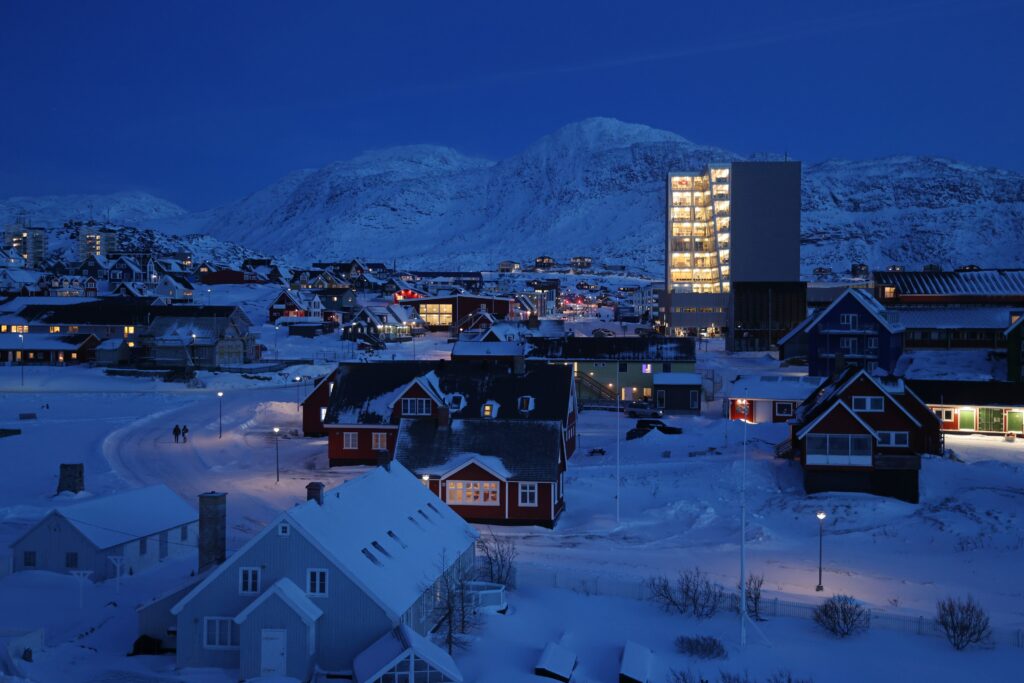
President Donald Trump is right: The United States needs Greenland for its national security. But it doesn’t need to actually own Greenland; Trump can easily address U.S. security concerns without taking full control of the island. Indeed, the model lies on another island just 90 miles off our shores — at the U.S. Naval base in Guantánamo Bay, Cuba.
In February 1903, President Theodore Roosevelt signed a lease agreement with Cuban President Tomás Estrada Palma giving the U.S. the right to “coaling and naval stations” at Guantánamo. Under the agreement, the U.S. recognized “the continuance of the ultimate sovereignty of the Republic of Cuba” over Guantánamo while Cuba agreed that “the United States shall exercise complete jurisdiction and control” over the base. In 1934, as part of a new “Cuban-American Treaty of Relations,” the two countries locked in the lease, which they agreed would continue in perpetuity “so long as the United States of America shall not abandon the said naval station of Guantánamo or the two Governments shall not agree to a modification of its present limits.” To this day, despite the rise of a hostile communist dictatorship on the island that would love to kick America out, the U.S. remains in full operational control of Guantánamo.
Gitmo offers the perfect model for solving the dispute over Greenland. The U.S. does not need to own all of Greenland; it can just lease the parts it needs. After all, less than 1 percent of Greenland is inhabited, and approximately 80 percent is covered by an impenetrable ice sheet more than a mile thick. All that’s needed is enough land to establish a series of military bases along Greenland’s narrow coastlands to allow the U.S. to control the new sea routes being created by receding Arctic ice, project force into the Arctic to counter Russia and China, and establish ballistic missile defense stations as part of Trump’s Golden Dome. (Today there is one U.S. military base in Greenland.)
Trump should task the Pentagon to identify the military bases it needs to build in Greenland, and then renegotiate the 1951 defense treaty with Denmark to lease them. Using the Cuba arrangement as a precedent, Denmark would maintain jurisdiction over more than 99 percent of Greenland’s territory and “ultimate sovereignty” over 100 percent — while the U.S. would have exclusive jurisdiction and control over the territory and waters where it establishes bases. The treaty should also permanently enshrine the U.S.’s existing right to free navigation and overflight over the entirety of Greenland, and create the option to lease additional bases in the future as needed.
In addition to bases, the treaty should bar any Chinese or Russian migration or investment on the island. And it should include an agreement — like the ones Trump has reached with Australia, Ukraine, Japan and other friendly nations — to jointly develop Greenland’s enormous unexplored stores of minerals and rare earth elements. As an incentive, the U.S. could share the profits with the people of Greenland through annual dividend checks, much as the state of Alaska gives its residents a share of state oil revenue.
A leasing arrangement would solve another political problem for Trump. As Sen. Bernie Sanders (I-Vermont) recently pointed out, Greenland’s population benefits from Denmark’s generous Scandinavian social welfare system — including free universal health care, free college tuition, 52 weeks of paid parental leave and five weeks of paid vacation. If Greenland became part of the U.S., Sanders asks, does that mean that all Americans will be entitled to the same benefits? What would justify providing them to new U.S. citizens but not the rest of America? Under a lease option, however, Denmark would retain sovereignty over Greenland’s populated areas — and thus responsibility for subsidizing social welfare spending for its citizens. Problem solved.
Right now, the U.S. pays Cuba $4,085 a month in rent for Guantánamo — but since the 1959 Cuban Revolution, the communist regime in Havana has refused to cash the checks. The U.S. could make a more generous deal in Greenland, but it would still be much cheaper than buying the island outright. Why pay billions for useless ice-covered tracts of land, when all that’s really needed are some strategic coastal tracts?
A lease agreement would give the U.S. all the control it needs. If it can maintain “complete jurisdiction and control” of a Naval station in Cuba over the objections of the hostile communist regime, then it can certainly maintain it over any bases established with the cooperation of a friendly NATO ally.
Another possibility: Incentives could be created for the people of Greenland to one day choose to join the U.S., as is their right under their agreement with Denmark — much as the people of Puerto Rico have repeatedly voted for affiliation with the U.S.. As part of the 1998 Good Friday peace agreement, Britain maintained sovereignty over Northern Ireland, but all residents were given the right to have Irish passports. Greenland’s populace could similarly be allowed to apply for U.S. passports. The agreement might even stipulate that if a majority of Greenlanders claimed U.S. citizenship, a referendum on whether to formally join the U.S. would be triggered. Measures like a right of U.S. residency for Greenland citizens could enhance the free flow of people and goods, just as would exist if Greenland were a part of the U.S.. All this would create a state of de facto shared sovereignty, even as Denmark maintained “ultimate sovereignty” — unless and until the people of Greenland chose otherwise.
This is the path to a win-win-win for the U.S., Greenland and Denmark. As a real estate guy, Trump believes in the importance of ownership. But the experience of Cuba has shown that possession is nine-tenths of ownership. If it leases military bases in Greenland in perpetuity, the U.S. will have what it needs to protect its national security — and a path to de-escalate the current tensions.
The post How to resolve the Greenland standoff appeared first on Washington Post.