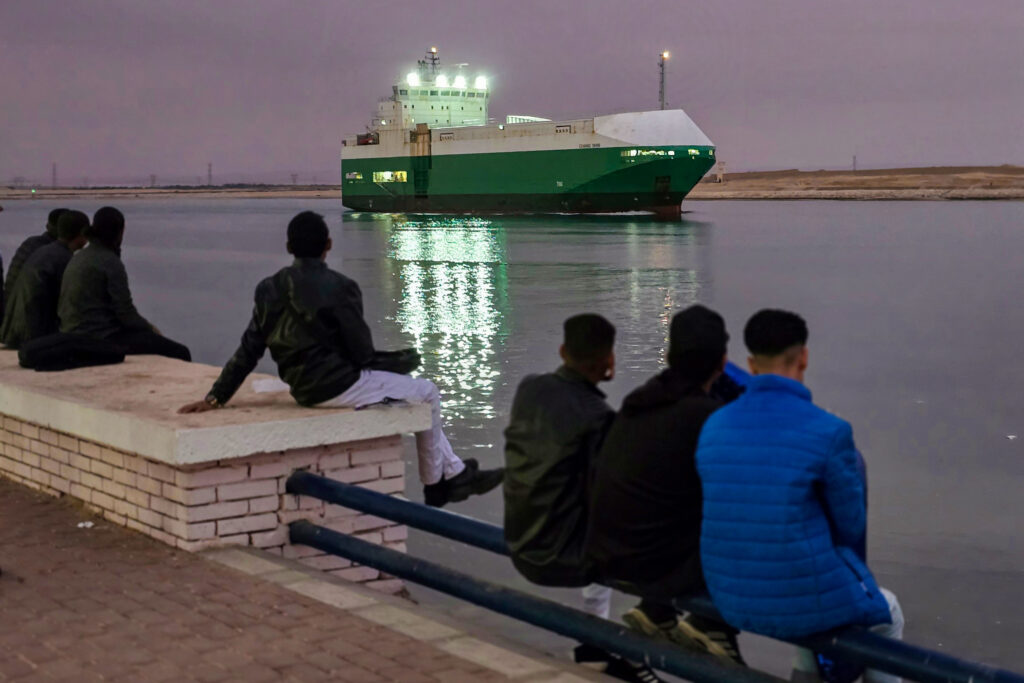
ISMAILIA, Egypt — The men in the canal’s control room had their eyes glued to radar screens, monitoring the progress of the precious yellow icons. Down below, on the bank of the Suez Canal, the Amalthea, stacked high with shipping containers, soon came into view, gliding through the placid water on its journey from the Mediterranean toward the Red Sea.
The vessel’s tranquil passage belied the geopolitical turmoil that has rocked this vital artery for global trade for more than two years and dealt a serious economic blow to Egypt.
The crisis began in the fall of 2023, when Houthi rebels in Yemen began attacking commercial ships in the Red Sea in retaliation for Israel’s war in Gaza. The danger prompted major shipping companies to reroute around southern Africa, adding time and cost to their voyages and depriving Egypt of some $13 billion worth of canal fees over two years in badly needed foreign currency, according to estimates from Egyptian officials.
In wreaking havoc on global supply chains, the Iranian-backed Houthis, once bit players on the world stage, demonstrated how susceptible the economy of the most populous Arab country is to external shocks.
This economic pain fueled Egypt’s diplomatic drive to broker a resolution to the war in Gaza. In recent months, after Israel and Hamas reached a ceasefire deal in an Egyptian resort town in October, Egypt has been trying, with mixed success, to woo shipping companies to return — touting financial incentives, new services and the calm that has prevailed in the Red Sea since the truce.
Those efforts are paying some dividends. The Portuguese-flagged Amalthea was one of 48 vessels passing through the canal on one day last month, according to Hazem Youssef, chief traffic controller for the Suez Canal Authority. Since the Gaza ceasefire took hold, about 45 ships are transiting the canal each day on average, he said — up from the daily average of about 35 before the truce.
But the number is still far below the average of 70 per day before the Gaza war. While some major shipping companies have begun to return to the route, others remain reluctant, given how tenuous the Gaza ceasefire remains.
A ‘lifeline’ for dollars
Built by Egyptians, many of them forced laborers, the Suez Canal was inaugurated in 1869 as an imperial project that primarily benefited the British and French. But ever since Gamal Abdel Nasser, the father of Arab nationalism and Egypt’s second president, nationalized the canal in 1956, the waterway has been a key source of pride and revenue for Egypt.
The Suez Canal is a “lifeline” for attracting dollars needed to pay for the import of essential goods and pay down government debt, said Timothy Kaldas, deputy director of the D.C.-based Tahrir Institute for Middle East Policy. A large container ship can pay Egyptian authorities about $1 million to pass through the canal.
President Abdel Fatah El-Sisi launched an $8.6 billion project to expand the canal more than a decade ago to increase the size of ships it can accommodate. When the coronavirus pandemic disrupted global shipping — and after a massive container ship briefly got wedged in the canal in 2021, jamming international supply chains — Egyptian authorities rolled out discounts to shippers and further enlarged the canal, Adm. Osama Rabie, head of the Suez Canal Authority, said in an interview from the official body’s headquarters in Ismailia last month.
The canal rebounded and produced record revenue of $10.2 billion in 2023, when about 12 to 15 percent of maritime trade passed through the waterway, according to the United Nations’ trade and development body.
Then came the Houthi attacks, centered in the Red Sea well south of the canal. In November 2023, Houthi rebels seized the Galaxy Leader, a cargo ship with links to an Israeli businessman, a BBC report found, and detained 25 sailors. “As soon as the events with the Galaxy Leader occurred, we felt there was going to be trouble in the Red Sea,” Rabie said. “It was like a spreading fire.”
He was right. The Houthis carried out 178 attacks on commercial ships in the Red Sea over the ensuing two years, according to data from Armed Conflict Location & Event Data (ACLED), a global monitoring group. The attacks sank at least four ships and killed at least nine sailors.
Shipping insurance rates skyrocketed, and many major shippers decided to reroute around the Cape of Good Hope. Bypassing the Suez Canal shortcut from Asia to Europe added about a month of transit time on average, according to Peter Sand, chief analyst at Xeneta, a freight market analysis firm.
Military operations by the United States and the European Union did little to deter the Houthis, though a major U.S. bombing campaignagainst the Houthis in the spring produced a momentary calm. In July, the Houthis sank two more ships, killing four and detaining 11 sailors for months.
The revenue shortfall caused by the Houthi attacks led to intensified Egyptian diplomacy to end the war in Gaza, said Hesham Youssef, a former Egyptian diplomat.
In October, when Egypt successfully helped broker the Gaza ceasefire, a former Egyptian official close to the country’s leadership breathed a sigh of relief. “We will get full revenues from the Suez Canal,” he told a Washington Post reporter at the time, speaking on the condition of anonymity to describe sensitive talks. “Peace will be implemented and we will be able to look after our country.”
Wooing business
That may be easier said than done, given the volatility of the Houthis and the fragility of the ceasefire in Gaza, shipping analysts said.
The Suez Canal Authority is courting shipping companies by offering a 15 percent discount for large container ships, Rabie said, and by advertising new services including medical evacuation options for crews and repairs for vessels that sustain attacks, as well as a service that allows companies to change crews in Egypt. The authority hopes that planned bunkering stations will also increase the Suez Canal’s attractiveness.
Looking ahead, Egypt is developing a new Suez Canal Economic Zone, which has already seen some success in attracting foreign manufacturing.
Traffic has been increasing and revenue is picking up, Rabie said, adding that he thought the discounts played a role.
The French company CMA CGM sent a few container ships through the canal late last year and announced a return to the Suez Canal on three of its shipping routes starting this month. The move is significant, Sand said, though CMA CGM isn’t an industry trendsetter.
More promising, the Danish giant Maersk announced last week that it would restart regular transits through Suez on one of its routes, which connects the Middle East and India with the East Coast of the U.S. The move came after Maersk sent initial container ships to test the waters in December and earlier this month.
Still, major companies, including Mediterranean Shipping Company and Hapag-Lloyd, have yet to announce a return, citing the uncertain security situation in the Red Sea.
“A discount doesn’t help explain to grieving widows why the crew are dead,” said Neil Roberts, head of marine and aviation at Lloyd’s Market Association, which provides information to shipping underwriters.
If the Gaza ceasefire holds, Rabie said he expects a gradual return of global shipping to begin this month and continue through August. “Then starting from next August, if things still are as they are, then maybe everyone will resume and things will go back to normal,” he said.
And if the ceasefire falls apart? He chucked wryly, and replied: “I don’t need to think about that.”
The Houthis have signaled that they intend to resume their Red Sea attacks if Israel restarts the war in Gaza. And unfortunately for Egypt, the Gaza war isn’t the only wild card. The Houthis have also attacked commercial ships when their patron, Iran, has come under threat over the past two years, according to Luca Nevola, a senior Yemen analyst at ACLED.
“I expect is if the U.S. or Israel should attack Iran, then we would see a Houthi response in the Red Sea,” Nevola said.
Rerouting supply chains is cumbersome and takes months, Sand said. “No carrier wants to return to the Red Sea, only to get out of there again,” he said. “So once they return, they would like to return to stay.”
Razzan Nakhlawi in Washington contributed to this report.
The post How Egypt is reviving the Suez Canal after maritime attacks sank traffic appeared first on Washington Post.