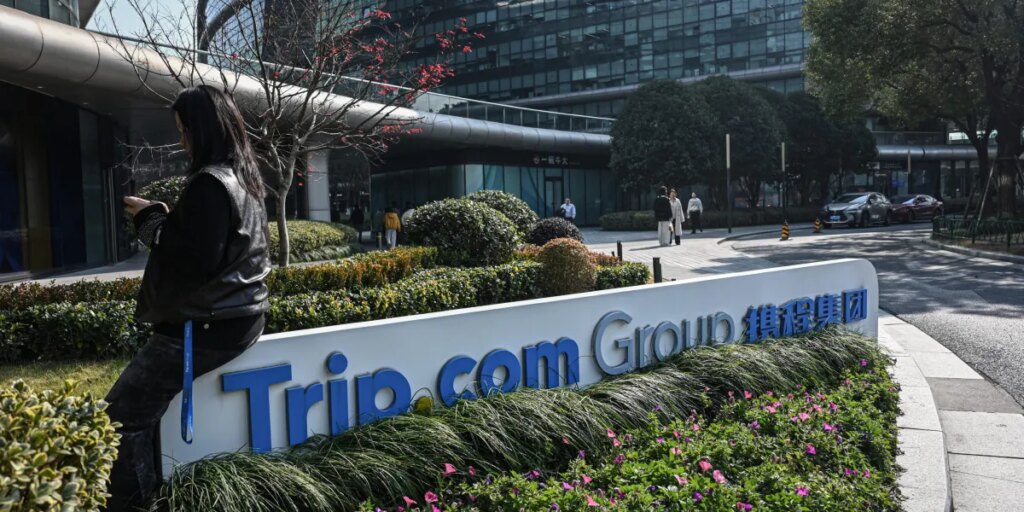
China’s hotels are welcoming record numbers of travelers, yet room rates are sinking—a paradox many operators blame on Trip.com Group Ltd.
For Gary Huang, running a five-room homestay in the scenic Huzhou hills near Shanghai was supposed to secure his family’s financial future. Instead, he and other hoteliers in China’s southeastern Zhejiang province say nightly rates have fallen to levels last seen more than a decade ago, as Trip.com’s frequent discount campaigns force them to cut prices simply to remain visible on China’s dominant booking platform.
“The promotion campaigns now are almost a daily routine,” said Huang, who asked to use his self-given English name out of concern of speaking out against Trip.com. “We have to constantly cut prices at least 15% to attract travelers. We have no choice but to go along with the price cuts.”
Trip.com has been central to China’s post-pandemic travel rebound, connecting millions of travelers with small operators like Huang. But for many hotels, visibility—and sometimes survival—comes at the expense of profits.
That dynamic is now at the heart of Beijing’s antitrust probe. Regulators allege Trip.com is abusing its market position, with analysts citing deflation across the sector as the government’s main concern. Interviews with lodging operators, industry groups and travel consultants describe a system where constant price-cutting and opaque policies are eroding profitability, even as demand rebounds.
Trip.com has said it’s cooperating with the government’s investigation. The company’s stock dove more 16% since the probe was announced a week ago.
Revenue per room—a key hotel metric—was flat across China in 2025, even as other Asian markets saw gains, according to Bloomberg Intelligence. Marriott International Inc.’s revenue per room in China fell 1% most of last year, while Hilton’s China room revenue trailed its regional peers.
The company controls about 56% of China’s online travel market, according to China Trading Desk, and has grown into the world’s largest booking site. Its dominance has helped fuel domestic tourism’s recovery—nearly 5 billion trips were logged in the first three quarters of 2025—but operators say the benefits are being offset by falling room yields.
“The market has developed unevenly and innovation is lacking due to monopolistic practices,” said He Shuangquan, head of the Yunnan Provincial Tourism Homestay Industry Association that represents some 7,000 operators. “The entire online travel agency sector is stagnating in a pool of dead water.”
‘Pick-one-of-two’
The broader challenge is oversupply and cautious consumer spending. In regions like Yunnan, hotel capacity has tripled since the pandemic, just as travelers tightened budgets. Consultants note that while people are traveling more, they’re spending less—leaving hotels slashing rates to fill empty beds and posting billions in losses.
For operators like Huang, the paradox is stark: the platform that delivers customers is also accelerating the race to the bottom. The complaints center around Trip.com’s “er xuan yi,” Mandarin for pick-one-of-two exclusivity arrangements—a practice that Chinese regulators have repeatedly vowed to stamp out.
Trip.com categorizes merchants into tiers with “Special Merchants” enjoying the most visibility and traffic, Yunnan Provincial Tourism’s He said. However, these top-tier merchants are typically prohibited from listing on rival platforms like Alibaba’s Fliggy, ByteDance’s Douyin or Meituan. Merchants who aren’t bound by these exclusive arrangements report being effectively compelled to offer the lowest prices on Trip.com’s online booking platform Ctrip, or risk facing a raft of measures like lowered search rankings.
The post Hotels allege predatory pricing, forced exclusivity in Trip.com antitrust probe appeared first on Fortune.