Until recently, Hollywood was the site of a proxy culture war. Its choices — to make a Ruth Bader Ginsburg biopic or an Eddie Gallagher hagiography, “Barbie 2” or a purity-ring-era Jonas Brothers movie — seemed, at times, to draw more public attention than anything happening in the Labor or Interior Departments. William F. Buckley once said he would rather be governed by the first 2,000 names in the Boston phone book than by 2,000 Harvard faculty members; there was a time when many Americans, especially those dispirited by Donald Trump, seemed to feel something similar about the animators at Disney or the executives at Netflix, whom they charged with putting forth whatever values the actual government couldn’t be made to embrace.
For anyone fantasizing about Hollywood as some liberal bulwark, though, the 2024 election brought that idea to an abrupt halt. The industry’s era of progressive sincerity, and much of its wariness toward conservative-coded content, has evaporated.
And yet instead of a hard pivot from progressive to conservative, something stranger has followed. Suddenly both sides of the culture war are appearing onscreen — only in deeply artificial Grand Guignol fashion, their messages issuing from characters who feel like gauche parodies. The culture war, in other words, has gone camp. Hollywood now makes frothy, delirious shows, for bipartisan audiences, in which political causes that once seemed life-or-death are taken up as easy targets. Ideas that once felt incendiary become punchlines or dizzy memes. In many cases, it is hard to tell whether the left-wing talking point issuing from the character onscreen is actually the product of an irony-poisoned right-wing writer — or, inversely, whether right-wing dialogue comes from a meanspirited member of the Democratic Socialists of America. These are camp aesthetics in the old sense: They take the exterior trappings of once-serious beliefs and produce chintzy knockoffs with deadpan solemnity.
Ideological debates have been flattened into cosplay and puppetry.
The careerist girlboss, for instance, certainly feels like an expired ideal, supplanted by the tradwife and booming youth groups that sell merchandise proclaiming “My favorite season is the fall of feminism.” Yet the girlboss archetype is the centerpiece of “All’s Fair,” fall’s most sensationalist streamer, which one British critic deemed “the worst TV drama ever.” It’s about divorce lawyers who extract exorbitant settlements from wronged women’s despicable partners. They live, inexplicably, like billionaires, in a gilded splendor that’s framed as liberatory. The most eyebrow-raising elements tend to include Kim Kardashian, who wears a thong-baring power suit to a legal proceeding and comforts herself, after revelations of her partner’s infidelity, with a Patrick Bateman-level beauty routine that includes “filler formulated from salmon sperm.” The firm’s office, with its flesh-colored modernist touches and bouclé conference chairs, even brings to mind the Wing, the women-only co-working space that defined a certain strain of 2010s feminism.
How to interpret all this is up to you. True to its neoliberal roots, “All’s Fair” seems to expect that viewers will mindlessly cheer every dollar fed into the central characters’ structures of affluence. But it’s equally easy to watch the characters’ relentless acquisition as though this was satire, a deluded brand of pink-washed Nietzscheanism.
The red-state soap opera “The Hunting Wives,” one of Netflix’s most successful shows, draws from worn-out stereotypes on both sides of the political spectrum. Brittany Snow plays Sophie O’Neil, a former Democratic consultant immersed in the world of glamorous MAGA housewives. She is tightly wound and moralizing, reflexively afraid of guns and taken aback by proud references to closing the state’s abortion clinics. But her outsider status is quickly shed when she leaps into a forbidden affair with the housewives’ leader. There was a time when Democrats debated boycotting Thanksgiving dinners with Trump-supporting family members; now conservatism serves as a camo-heavy costume for the exotic and forbidden.
Even in shows more explicitly framed as conservative, like “Landman,” ideology tends to be rendered with detachment, as if MAGA trappings are being added in the same obligatory way a noir film adds fedoras and pinstriped suits. Billy Bob Thornton plays the title character, wrangling fossil-fuel leases on behalf of an independent counterpart to big oil. But he is no jaunty, imperialist oil baron; instead, he traverses the nicotine-stained badlands of Texas like a Southwestern Willy Loman. One viral, supposedly lib-owning clip has him dismissing renewable energy and fatalistically defending oil extraction: “We don’t do it ’cause we like it. We do it ’cause we run outta options.” The oil workers are, at various points, gassed, poisoned, maimed and killed. Conservative hand-wringing over birthrates is given a bizarre manifestation in the lead character’s daffy cheerleader daughter, who airs a quasi-eugenic theory about how cheerleaders mating with jocks will produce the human equivalent of “super retrievers.” All of this feels less like a roughneck “Triumph of the Will” and more like some kind of burlesque of the right wing.
And “Eddington,” a potential Oscar contender, frames its Covid culture-war tropes as, essentially, a smoke screen disguising more material concerns. Pedro Pascal is a caricature of a C.D.C.-complying liberal mayor, complete with a Katy Perry-scored fund-raiser and an ever-present N95 mask. Joaquin Phoenix plays a mask-averse sheriff waging a populist campaign for mayor, with slogans like “Your being manipulated” [sic] and complaints about the meddling of faraway elites and bureaucrats. There is even an astroturfed antifa militia. But after tensions escalate, leaving one man dead and another immobilized, it is outside industries that enrich themselves at the town’s expense.
Many of entertainment’s culture-war tropes function as period costumes from a not-so-distant past. The girlboss, the MAHA mom, the fossil-fuel impresario: These archetypes are deployed the way TV once deployed the 1980s yuppie, the ’90s hacker or the ’60s hippie. They are broad, central-casting types, strawmen representing movements or subcultures understood from a distance. The beliefs they express are often undermined by exaggeration and double entendres, as if they’re hostages winking in Morse code that nothing they say is in earnest. In other cases, the shows’ creators seem like true believers who are overcompensating for their diminished cultural power, repeating tired talking points with such extravagance that they seem like morticians putting too much blush on a corpse.
Either way, you find very little nonpartisan depiction of reality, in all its morally ambiguous verity. Instead you get camp: Ideologies plucked from their original formats — internet videos, fringe blogs, cabinet meetings — and flattened into cosplay and puppetry. For Hollywood, this is a useful way to flatter viewers, who get to feel above the fray. What’s lost, of course, is any kind of enlightenment or ethical confrontation, as opposed to mere voyeurism — any dream of seeing real murkiness, conflict or shades of gray existing within the narrative universe, or within a given character. In the current paradigm, a reboot of “The Sopranos” would probably involve Tony’s crew experiencing a series of political awakenings. Christopher goes anarcho-capitalist and loses his collections in a crypto scam. Paulie goes on a MAHA-approved diet. Tony has a change of heart and turns the Bing into a worker-owned co-op; he picks up the morning paper wearing a Zohran Mamdani pin. He’s finally at the beginning of something. He smiles. He’s happy.
Casey Michael Henry is a writer based in New York City. He publishes the cultural newsletter Slim Jim.
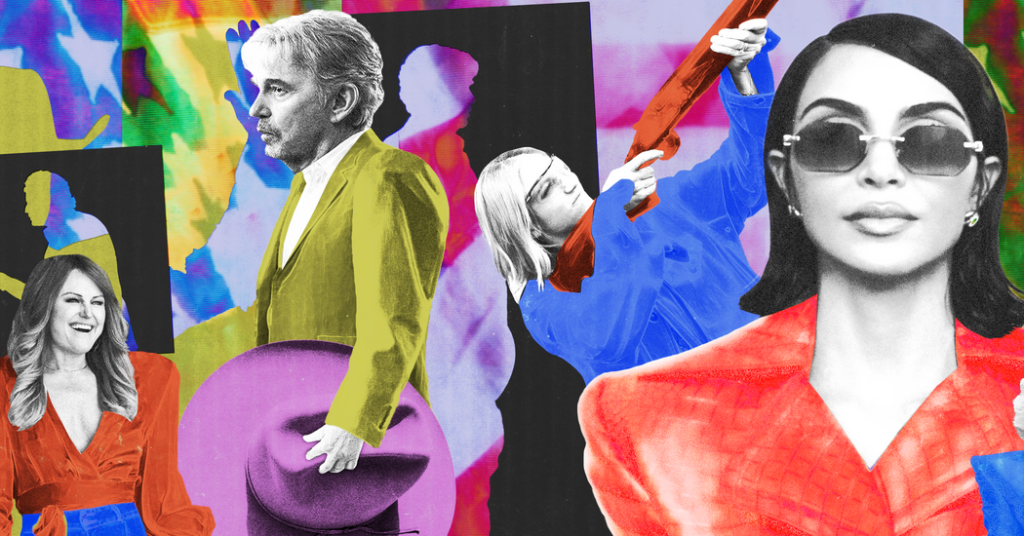
Source photographs for illustration above: Ser Baffo/Disney; Richard Foreman/A24; Emerson Miller/Paramount+; Kent Smith/Lionsgate.
The post Hollywood’s Woke Era Is Over. Now It’s Turning the Culture War Into Camp. appeared first on New York Times.