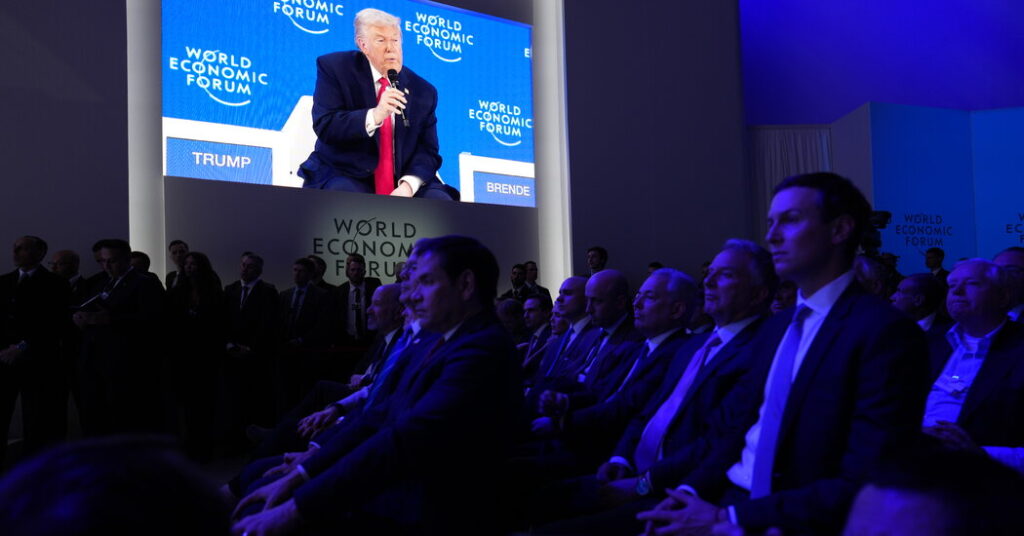
President Trump took aim at many familiar targets, and some new ones, in a lengthy speech at the World Economic Forum on Wednesday in which he alternately praised and threatened European allies and repeated his demands for ownership of Greenland.
He pledged not to use force to seize the semiautonomous Danish territory, giving some measure of relief. But that slight comfort was likely undercut by the often mocking tone of a speech that underlined European leaders’ worries about the health of NATO and their relations with the United States.
In remarks that stretched for over an hour, Mr. Trump lashed out at NATO in front of fellow members of the military alliance and lobbed criticism at the leaders of several nations, Somali immigrants in the United States, wind power and more. Here were his targets:
Denmark and Greenland
Mr. Trump referred to Greenland, which he has insisted the United States must control for reasons of national and international security, as “cold and poorly located.” He has argued that China and Russia could seek to exploit it, and said on Wednesdaythat granting U.S. control of it was “a very small ask.”
He said that he was seeking “immediate negotiations” to discuss its acquisition, while also seeming to rule out using military force to take it.
“I don’t have to use force” he said. “I don’t want to use force. I won’t use force.”
Still, later in the speech he appeared to threaten European leaders, telling them they can say yes to Washington acquiring Greenland, and America will be grateful, or they can say no, and “We will remember.”
He argued that only the United States can defend Greenland, and you can’t defend something you don’t own as well as something you do. European leaders see Greenland differently. They have sent troops there to demonstrate NATO’s ability to secure it, and they have warned against American efforts to pry it from Denmark, which has boosted its military presence on the island in recent days.
Mr. Trump invoked the German invasion of Denmark during World War II, when the United States defended Greenland. He called America “stupid” when it “gave it back” and called Denmark “ungrateful.”
In fact, the United States was never given sovereignty over Greenland. Denmark signed a deal in 1941 for the United States to defend the island, but never to take it over.
Europe
Mr. Trump’s pursuit of Greenland has pushed the decades-old trans-Atlantic alliance, already strained by a year of criticism and combativeness from the Trump administration, to the brink. On Wednesday, some of his harshest criticism was of European nations.
In a broadside suggesting that only the United States could guarantee global security and prosperity, he said: “Without us, most of the countries don’t even work.”
Speaking about his own European heritage, Mr. Trump insisted, “The United States cares about the people of Europe.” But then he invoked a hoary joke about how the United States came to Europe’s defense against Nazism in World War II.
If not for that, he said to the audience filled with European business and political leaders, “You’d all be speaking German and little Japanese.”
He told the gathering that his “friends,” whom he didn’t name, no longer recognized many European cities when they visit — a less-than-subtle reference to migration.
“I love Europe and I want to see Europe go good, but it’s not heading in the right direction,” he said.
Renewable Energy
Many of the political and business leaders Mr. Trump was addressing have spent years focusing on the growth prospects of the clean energy transition.
He spent several minutes arguing that European nations have hurt themselves by trying to reduce greenhouse gas emissions, while reveling in his efforts to block and dismantle renewable electricity plants in the United States.
“Here in Europe, we’ve seen the fate that the radical left tried to impose on America,” he said, criticizing energy policies in Germany and Britain. He drew some laughter when he assailed one of his favorite targets, windmills, saying that China sells turbines “to the stupid people that buy them, but they don’t use them themselves.”
Many of Mr. Trump’s comments about energy were not grounded in reality. China and the United States get a similar share of their electricity from wind turbines — about 10 percent as of 2024, according to data from the research firm Ember Energy and the U.S. Energy Information Administration.
Iceland
After referring to Greenland, a territory with a population of nearly 60,000 people, as a “piece of ice,” he appeared to confuse it with Iceland, a Nordic island nation, when talking about a dip in the stock market this week.
U.S. markets posted their biggest losses in months on Tuesday, which many analysts attributed to investor concerns over Mr. Trump’s pursuit of Greenland and his threat to impose higher tariffs on allies if they don’t relent to his desire to control it.
“Our stock market took the first dip yesterday because of Iceland,” Mr. Trump said, adding: “So Iceland’s already cost us a lot of money.”
Switzerland
The historically neutral Alpine nation that is the host of the annual forum in Davos was not spared, either. “They’re only good because of us,” Mr. Trump said of Switzerland.
Last August, Mr. Trump raised tariffs on Switzerland to 39 percent, significantly higher than rates he levied against its neighbors. In his speech, he seemed to confirm what European officials had long suspected: The decision was personal.
He said he had received a call from Switzerland’s president, Karin Keller-Sutter, pushing back on an initial 30 percent tariff. “And she was very repetitive,” he said, adding: “She just rubbed me the wrong way.”
After that call, Mr. Trump said, “I made it 39 percent.”
Somali immigrants
Mentioning a fraud scandal that law enforcement officials say took root in pockets of Minnesota’s Somali diaspora, Mr. Trump directly questioned the intelligence of members of that community.
“Can you believe that? Somalia,” he said. “They turned out to be higher I.Q. than we thought.”
Some near the front of the audience groaned loudly. The president has long fixated on the Somali community and subjected it to insults. Many Somali Americans in Minnesota say the fraud scandal has tarnished the reputation of their entire community of about 80,000 people.
The Federal Reserve
Mr. Trump expressed dismay that officials with the U.S. central bank “change once they get the job,” making decisions about interest rates without consulting him. The Federal Reserve was designed to be independent of the White House so that officials can set rates to control inflation, away from political pressure.
His criticism of the Fed chairman, Jerome H. Powell, prompted some giggles from an audience that included many financial officials.
While he was speaking, back in Washington, the Supreme Court was hearing arguments in a case over whether Mr. Trump had exceeded his authority when he sought to fire a member of the Fed’s board of governors, Lisa Cook, last year.
Canada
Mr. Trump drew some gasps when he directly criticized Prime Minister Mark Carney of Canada. Canada is historically one of the United States’ staunchest allies.
Mr. Carney said in a speech at Davos on Tuesday that the era of U.S. hegemony could be over, calling the current moment “a rupture.” Though he didn’t mention Mr. Trump’s name, there was no mistaking his meaning.
“Canada lives because of the United States,” Mr. Trump said. “Remember that, Mark, the next time you make your statements.”
Zelensky and Putin
After his hourlong speech, Mr. Trump sat down onstage with Borge Brende, the World Economic Forum president. Some leaders at Davos have worried that Mr. Trump’s focus on Greenland would distract from European efforts to end Russia’s war against Ukraine. A peace proposal pushed by Mr. Trump has appeared to gain little traction with Moscow.
Asked whether President Volodymyr Zelensky of Ukraine and President Vladimir V. Putin of Russia would make a deal, Mr. Trump said: “If they don’t get this done, they are stupid.”
He then added the caveat, “I don’t want to insult anyone,” prompting one person in the crowd to cackle.
Zolan Kanno-Youngs, Jim Tankersley, Jeffrey Gettleman and Rebecca Elliott contributed reporting.
Erin Mendell is a Times editor in Seoul, covering breaking and live news. She has been based in Asia since 2016.
The post Here’s a Look at Everything (and Everyone) Trump Assailed at Davos appeared first on New York Times.