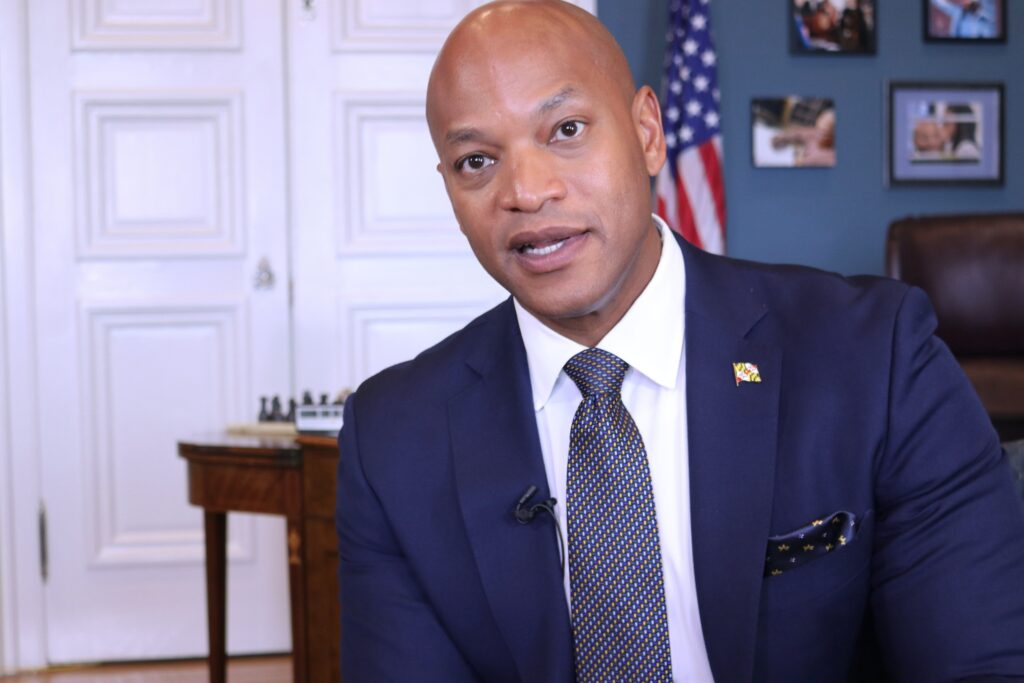
Maryland Gov. Wes Moore and his fellow Democratic allies are barreling toward an ugly intraparty fight over redistricting, as his advisory commission voted late Tuesday to advance a conceptual map that could oust the state’s lone Republican member of Congress.
Designed in response to Republican gerrymandering done in other states at President Donald Trump’s behest, the proposed map distributes deep-blue Maryland’s Democratic voters among more districts, creating some less-safe Democratic seats but making it more likely for Democrats to win longtime Republican strongholds.
The chief target of Maryland’s redistricting is Rep. Andy Harris (R-Maryland), the House Freedom Caucus chairman, who represents the state’s Eastern Shore.
“See you in court, Wes!” Harris said in a statement after the map was released.
The proposed map, which would give Democrats all of Maryland’s eight congressional seats, has support from national Democrats eager to net as many seats as possible to gain control of the U.S. House. But it faces an uphill battle in Maryland’s Democratic-controlled General Assembly.
Maryland Senate President Bill Ferguson (D-Baltimore City) refuses to support midcycle redistricting ahead of the 2026 midterm elections, saying it will backfire. Ferguson, a lawyer, is on the commission that approved the conceptual map over his objections during a closed-door session on Tuesday. He called it “objectively unconstitutional.”
“Ultimately, a flawed process has delivered a flawed product,” he said.
The Governor’s Redistricting Advisory Commission has no power to enact new districts. But the map it approved in concept will be taken up by the legislature within a week or so, making Maryland among the last states to redraw its congressional boundaries in a political arms race that began over the summer when Texas redrew its boundaries to gain five seats for the GOP.
(Virginia Democrats voted last week to send voters a referendum asking to circumvent an anti-gerrymandering law and draw a new map this year. A vote is expected in April.)
“Arrogant and corrupt Republicans started this battle. Democrats will end it,” House Minority Leader Hakeem Jeffries (D-New York) said Tuesday.
Maryland Del. C.T. Wilson (D-Charles), a commission member, said he will introduce the map after bill drafters finalize the district boundaries and convert the concept into legislation for the General Assembly to consider.
He will be its lead defender, he said.
“We’re in a unique time, and history is watching us,” Wilson said. “If our Founding Fathers did not want this to be political, they wouldn’t have put it in the hands of politicians.”
Wilson said watching Republican policies unfold under the Trump administration should provoke a response from Democrats. “At some point, there needs to be a line in the sand. They’ve already crossed it,” he said, offering a long list of examples that included Republicans redrawing maps out-of-cycle elsewhere, warrantless immigration raids, and the rollback of diversity, equity and inclusion programs.
Del. Kathy Szeliga (R-Baltimore County), who successfully challenged the last Democratic-gerrymandered map in court, called Moore’s commission “anything but transparent government” and said the recommended map was created “in the cloak of darkness.”
“It is shameful, is what it is,” Szeliga said. “And if they pass it, yes, there will be a lawsuit.”
Brian E. Frosh, a Democrat and Maryland’s former attorney general who is on the commission and voted for the proposed map, said legal concerns are overblown.
“What I explicitly voted for was a concept,” Frosh said in an interview. Frosh oversaw the state’s last mapmaking effort after the 2020 Census and said the current sketch will be turned into a constitutionally valid proposal before lawmakers vote on it.
Frosh said that netting just one more seat for Democrats helps the party counteract Republicans.
“We know they’re trying to tip the playing field to their advantage, and I don’t think we should sit back and play by a different set of rules,” Frosh said. “Those are the rules that we need to play by, and we need to play as hard as we can. It’s the old saying: You can’t bring a knife to a gunfight.”
The conceptual map redistributes much of the state’s high-density population in the Interstate 95 corridor, spreading out Democrats who live in the suburbs of Washington into different districts and dividing Baltimore’s Democrats roughly in half.
Frosh and Wilson both said that reducing Democrats’ representation in several districts could ultimately make them more competitive. About half of Maryland voters are registered Democrats. One-quarter are registered as Republicans, and another quarter are not affiliated with a party.
Jared DeMarinis, Maryland’s state administrator of elections, said in an interview that it was too soon to predict how enacting new districts would affect the upcoming election, but that he would review any legislation once introduced.
Maryland House Majority Leader David Moon (D-Montgomery) was an early advocate for redistricting in Maryland, proposing a bill during the summer that would have triggered a redrawing of the congressional maps in the state if other legislatures across the country made the first move.
He said lawmakers in his chamber have been “ready and willing” for this moment. “If there’s a will to act, there’s a will to do it as soon as possible,” Moon said.
Michael Brice-Saddler contributed to this report.
The post Democrats’ redistricting proposal could oust House Freedom Caucus chairman appeared first on Washington Post.