Peering from under a cap emblazoned with Venezuela’s flag, Miguel Alejandro Herrera smiled at the camera, and then started swaying his hips to a catchy Latin rhythm.
“Where is China? Where is Russia? Why didn’t they act? What’s the excuse?” Mr. Herrera lip-synced in Spanish, bouncing his shoulders to the beat. “Maduro is in a federal prison, and now I ask myself: Where are the communists who were going to help him?”
The video, which he said he made with artificial intelligence, is a celebration of Nicolás Maduro’s ouster as Venezuela’s leader and a jab at some of his closest alliances, said Mr. Herrera, a music producer and social media commentator known online as Kilómetro.
Since it was posted on Jan. 8, the video has drawn more than 11 million views on TikTok and 5 million on Instagram. And it has racked up thousands of comments, most of them cheering Mr. Herrera and Mr. Maduro’s capture.
“I knew the theme was going to catch on,” Mr. Herrera, 28, said in an interview from Argentina, where he has been living in exile since 2024. “But I didn’t know it was going to be this big.”
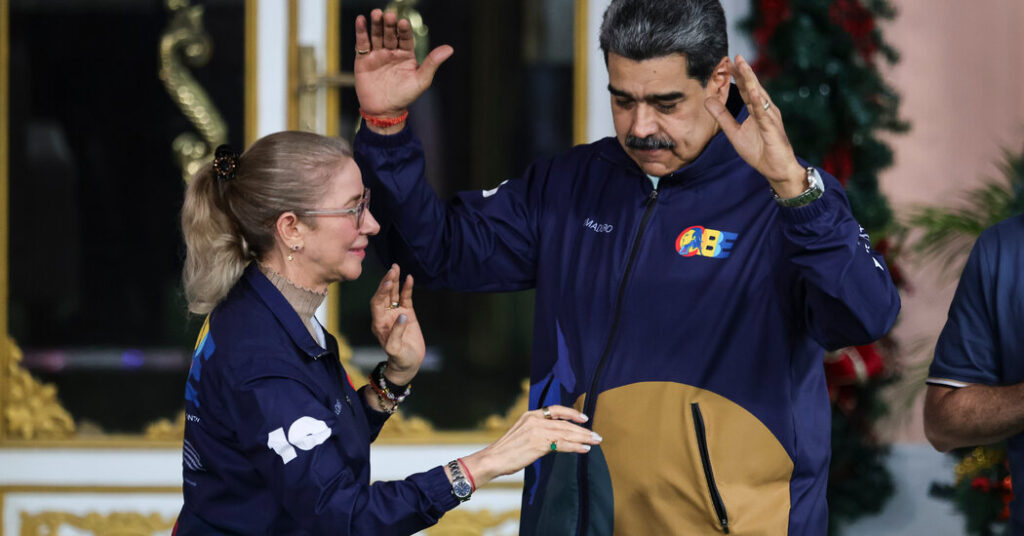
Mr. Herrera’s song plays on a trope familiar to most Venezuelans: the jingles long deployed by Mr. Maduro and his political movement. In the lead-up to his capture, Mr. Maduro had taken to breaking into musical routines, including dancing to techno beats remixed with the slogan “No War, Yes Peace.” (His dancing may have ultimately contributed to his downfall.)
The video, and the enormous response it has set off, stand in sharp contrast with the narrative offered by Venezuela’s government, which has leaned on the state-controlled broadcaster to show what appear to be large crowds of protesters, insisting that Venezuelans are overwhelmingly upset about Mr. Maduro’s ouster.
Few in Venezuela have dared to disagree, as a new wave of repression has taken hold. Since the U.S. operation that led to Mr. Maduro’s capture, Venezuelan security forces have boarded buses, searched phones and questioned people, seeking evidence of support for his removal. Fearing reprisal, many Venezuelans are sidestepping the subject at workplaces, coffee shops and other public settings.
Yet online, at home and abroad, Mr. Herrera’s catchy tune appears to be resonating. “I say what people inside Venezuela cannot say,” Mr. Herrera said. “Many people write to me saying they have the song saved for when they can play it loud on the streets.”
His video plays on the familiar use of sentimental, upbeat or triumphant melodies by Chavismo, the socialist-inspired movement first embodied by Hugo Chávez and, later, by his successor, Mr. Maduro. Those tunes were once so catchy, Mr. Herrera said, that they would even move Venezuelans who opposed Mr. Maduro. “Now that has changed,” he said. “Now, the opposition’s music is better.”
At the same time, Mr. Herrera sought to create a summer hit, not unlike the ones that typically hit airwaves around this time of year in the Southern Hemisphere. “The rhythm is, like, tropical,” he added. “It’s perfect for listening in the car, for going to the beach, for celebrating.”
Mr. Herrera’s post has also set off a wave of memes, including an A.I.-generated video of President Trump spinning the tune on a D.J. turntable as Mr. Maduro, in a prison cell and clad in an orange jumpsuit, swings his hips to the rhythm.
The spread of Mr. Herrera’s video has been fueled in part by Venezuela’s vast and vocal diaspora. Fleeing repression and economic woes, about eight million people have left the country since 2015, many settling in Spain, the United States or countries in South America.
Mr. Herrera began making videos ahead of the presidential election in 2024. Many of them explained electoral rules, urged Venezuelans to register to vote and supported the candidate challenging Mr. Maduro. Mr. Herrera eventually amassed several million followers, and his posts garnered hundreds of thousands of views.
But when Mr. Maduro claimed victory despite evidence that the opposition had won by a large margin, Mr. Herrera decided to leave Venezuela. “We packed our bags that night,” Mr. Herrera said. “I left for my safety.”
Like many Venezuelans abroad, Mr. Herrera isn’t quite ready to go back yet.
Even with Mr. Maduro out of the picture, Venezuela is still being run by his inner circle of loyalists. The United States has endorsed the nation’s interim leader, Delcy Rodríguez, warning that more strikes could come if she failed to follow America’s interests when it came to oil, but making almost no mention of human rights or democracy.
In one post, Mr. Herrera depicts Ms. Rodríguez as a string puppet manipulated by Mr. Trump. Mr. Herrera said he believed that, with the United States exerting so much control, Venezuela was on course for substantive change. “The United States is there, and she has to do what Trump wants.”
In the meantime, Mr. Herrera said he would keep making videos. “It’s a fight for the freedom of my country,” he said. “More than a job, it’s a hope of returning to a free country.”
Maria Ramírez contributed research.
Ana Ionova is a contributor to The Times based in Rio de Janeiro, covering Brazil and neighboring countries.
The post After Maduro’s Last Dance, a New Rhythm Goes Viral in Venezuela appeared first on New York Times.