The sweet spot of the auto market isn’t hard to find. Millions of American drivers only want one thing: a small- to medium-sized SUV, with a small- to medium-sized price tag.
It’s a huge, lucrative market — comprising around half of new-car sales in the U.S. — but one that few electric vehicles have managed to enter. In 2026, however, that will change. Carmakers are planning to roll out at least six new electric SUVs in the U.S. this year with price tags at or below $35,000, products that could help ease a slowdown in EV sales.
“EVs have to move more into the mass market and there are launches that are now squarely hitting that,” said Nathan Niese, Boston Consulting Group’s global lead for electric vehicles. “It’s what’s going to prop up what otherwise would be a down year.”
EV sales have surged in recent years, as carmakers improved range and charging speed, while federal incentives helped entice buyers. Relatively high costs, however, remained the last speed bump to mass adoption. Of the roughly 60 electric cars and trucks for sale in the U.S. last year, only three could be had for less than $35,000; the median starting sticker price was $59,100, nearly $10,000 higher than the average price for all vehicles.
When federal subsidies disappeared in September, EV sales swooned. The message for the c-suites of Detroit was clear: Price is at least as important as powertrain preference, if not more. Many auto executives have since slowed their EV plans and shifted some production back to gas-powered models that they can build (and price) more affordably.
“Anything you can do to make a customer feel you’ve given them a more affordable product is an advantage to them right now,” said Nick Nigro, founder of Atlas Public Policy.
The good news for auto executives: A steady drop in battery prices has improved the economics of EVs, opening a lane for small new models.
“The end of the EV subsidies does not necessarily spell bad news across the board,” BloombergNEF analyst Huiling Zhou wrote in a recent report. “Carmakers that can cut costs and offer affordable models in the most desirable vehicle segments are likely to see sustained sales growth.”
Here’s a look at the EVs that will probably find plenty of interest in 2026.
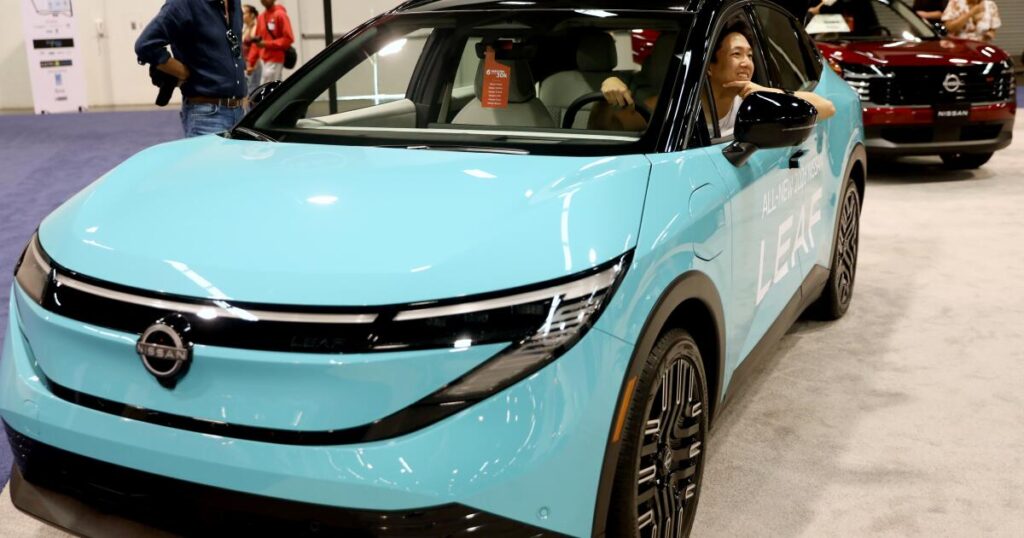
Nissan Leaf
Nissan has long known the sales magic of an affordable EV. Since its debut 15 years ago, the Leaf has parked itself in nearly 1 million households’ driveways and garages, despite its modest range and quirky, hatchback design. For the 2026 iteration, Nissan overhauled the car for the first time in nearly eight years, upsizing it to the SUV category. The end result seems to have shed many of the model’s quirks and compromises.
For one, the new Leaf no longer looks “cartoonish,” according to reviewers. Gone is the near-obsolete CHAdeMo charging port that’s akin to a Betamax videotape, replaced by a traditional CCS charging receptacle on the driver’s side and a NACS port (better known as the Tesla plug) on the passenger’s side. It does retain one important feature of past Leafs: The new model still slips under the $30,000 threshold.
Chevrolet Bolt
General Motors has a similar overhaul in the works for its Chevrolet Bolt, another affordable machine that won a crowd of buyers right up until the company pulled the plug on the model in 2023. Chevy revealed the resurrected iteration of the small SUV in October and it’s set to go on sale early this year. The car looks pretty much the same and the driving range is similar, but the reborn Bolt is powered by a new battery that will cost far less and charge far more quickly than the previous version. The Bolt also has GM’s hands-free driving system — dubbed Super Cruise — and is now capable of bidirectional charging, which means it can provide power in a blackout or whenever else you need it.
Toyota C-HR BEV
The company calls the coming C-HR a “coupe-like SUV.” While the description reads like an oxymoron, it’s one that plays well with U.S. tastes in car design. The machine is big enough for a hefty Costco run, but small enough to park in a compact space. And the new Toyota ride offers nearly 300 miles of range while coming with standard all-wheel drive, which typically compromises efficiency. Toyota teamed up with Subaru to develop the platform for this new small electric SUV, a bit of cost-sharing that will help keep the sticker price around $35,000.
Subaru Uncharted
The Subaru side of the Toyota partnership is the Uncharted, an SUV that will be a little smaller than the brand’s other electric offering, the Solterra. With the base model — starting around $35,000 — buyers can forgo all-wheel drive for about 15 more miles between charges. Among SUV owners, Subaru ranks second in brand loyalty, meaning Crosstrek and Outback drivers waiting to go electric will finally have more than one option.
Kia EV3
Kia has already checked the “medium” and “large” boxes in its EV product line; now, it’s steering for small. The EV3, which is expected to sell for about $35,000, will slide just behind the brand’s EV6 size-wise even as its boxy design echoes the EV9, a bulky, three-row SUV. Kia is also planning to give buyers some unique color choices, from “shale grey” to “frost clue.”
Slate
Cheap EVs aren’t just the realm of incumbents. Startup Slate is swooping in with plans to deliver its first machine by year-end. The company’s first vehicle, which can be converted from pickup to SUV, is to a Ford F-150 what an Ikea futon is to a Pottery Barn sectional. The base version — the company calls it “the blank Slate” — is best described by what it isn’t. It lacks a touchscreen, cooled seats, all-wheel drive and a stereo. What Slate promises in return is a sticker price in the mid-$20,000s.
At the company’s launch event last year, Chief Executive Chris Barman delivered what has since become a bit of a stump speech for cheap EVs. “The definition of what’s affordable is broken,” she said.
Stock writes for Bloomberg.
The post Affordable fleet of electric SUVs hit the roads this year, hoping to entice buyers without subsidies appeared first on Los Angeles Times.