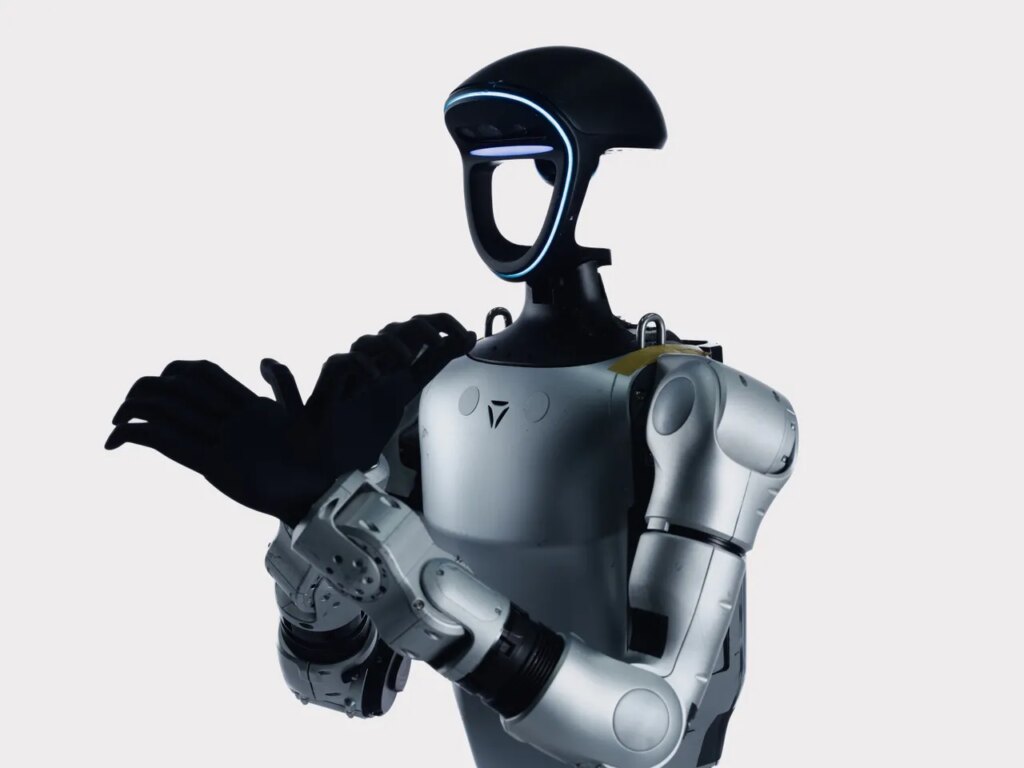
The 4-foot-tall humanoid robot that’s in front of me seems, quite honestly, a bit drunk. It leaps from one leg to the other, waving its arms. After 30 seconds or so it abruptly stops, then strides toward me with an arm outstretched.
The little robot is at the World Artificial Intelligence Conference, on the banks of the Huangpu river in Shanghai. The convention center is teeming with humanoids—dancing ones, box-toting ones, robot dog-walking ones doing circuits around trade show booths. A few lie slumped in a corner as their batteries recharge.
It’s a balmy day in July, and I’ve come to Shanghai to learn how China’s AI world differs from the Western one I usually cover. I’d immediately noticed the sleek electric cars from BYD, Xiaomi, and Huawei that fill the streets of the city’s fashionable old French Concession. At Manner, a high-end coffee chain, I sampled an avant-garde beverage called a “sparkling citrus iced Americano.” Now that I’m at the convention, I can’t help but picture these dancing robots strolling Shanghai’s streets and perhaps carrying their owner’s shopping bags.
A group crowds around a small boxing ring, where two humanoids throw punches at each other. One falls down, then gets back on its haunches and straightens up. A young woman offers to let me punch a humanoid. I feel certain that this would make me feel bad, so I decline.
The activity in this convention center is a bit of a mirage, of course. Amid the throngs, you can spot people holding game controllers. They’re giving the robots high-level instructions. The humanoids can control their balance and execute short routines, but it’s humans who tell them which way to walk, whom to shake hands with, or when to backflip. Another limitation: Many humanoids don’t have fingers. Their arms usually end in stumps, meaning that while they can hold and lift boxes (or wear boxing gloves, they can’t grasp anything.
Here are 23 ways China is rewiring the future.
Even so, experts predict that robots will have profound effects on the workforce and the economy. Amazon is testing humanoids from an American startup called Agility and, according to leaked memos, expects to replace a significant number of workers with robots in the next few years. Bank of America analysts predict that by 2035, robot makers will ship 10 million humanoids a year. Morgan Stanley forecasts that by 2050 a billion will be in use, with almost a third of them—302.3 million—in China, compared with 77.7 million in the US.
Perhaps no humanoid maker has a bigger lead than a Hangzhou-based company called Unitree. While Elon Musk’s Optimus staggers through its demos, Unitree’s robots are doing sprints, kung-fu kicks, and acrobatic backflips. (The conference’s dancing door greeter was a Unitree.) Unitree’s legged robots are also incredibly cheap, costing tens of thousands of dollars or less, a tenth of what a typical humanoid in the US costs. Unitree is China’s most prominent robotics startup, a national champion for its tech industry, and is reportedly targeting a $7 billion IPO listing in Shanghai. And if Unitree fails? A staggering 200-plus other Chinese companies are also developing humanoids, which recently prompted the Chinese government to warn of overcapacity and unnecessary replication. The US has about 16 prominent firms building humanoids.
With stats like that, one can’t help but suspect that the first country to have a million humanoids will be China.
HANGZHOU
Unitree’s home city of Hangzhou is about 110 miles from Shanghai. The place is famous for its vast and photogenic West Lake, but it’s also home to Alibaba, the ecommerce giant, Ant Group (one of Alibaba’s affiliates), and several fast-growing AI startups. Besides Unitree, this includes DeepSeek, whose open source AI models enjoy global popularity.
I’m hoping to visit Unitree along with a few other companies. Unlike many of its rivals, Unitree sells a wide range of legged robots and is profitable. Unfortunately, I find the company largely off-limits to visitors as it prepares for the IPO. I later hear that the headquarters is battleworn: A set of stairs inside the entrance is battered from legged robots practicing carrying heavy payloads. “It is one of the most run-down places you can imagine,” says Mike Cho, a robotics entrepreneur based in Singapore who has spent time there. “Everywhere there are broken robots, broken parts, and broken concrete.”
Later I connect with Wang Xingxing, Unitree’s CEO, who, citing his poor English, agreed to talk via the messaging app WeChat. Wang is something of a celebrity in China. In February 2025, he was invited to an event hosted by the Chinese premier, Xi Jinping, along with several members of China’s tech royalty (Alibaba’s Jack Ma; Huawei’s founder and CEO, Ren Zhengfei; BYD’s chairman and CEO, Wang Chuanfu; and the CEO of Xiaomi, Lei Jun). At the conference in Shanghai, I’d seen Wang deliver a keynote speech in rapid-fire Mandarin. He told the crowd that he planned to build robots adept at “serving tea, working in factories, or even performing arts.”
On WeChat, he tells me that he’s been fascinated by robots since he was a kid. During his first year at university, he cobbled together a small, two-legged robot on a budget of 200 RMB ($28). “The moment I saw the robot I designed come to life,” Wang writes, “the sense of achievement from combining technology and creativity made me determined to devote myself to robotics research.”
As a master’s student at Shanghai University in 2015, he built a small, four-legged robot for less than 20,000 RMB (about $2,800). It became a social media hit; people marveled that a student could build such a sure-footed, low-cost machine. He worked briefly for the drone company DJI before receiving a small amount of seed funding and establishing Unitree in 2016. The company released its first product, a robot dog called Laikago, in 2017.
Wang admits that, early on, Boston Dynamics and its fourlegged robot Spot were an inspiration. Gavin Kenneally, CEO of Ghost Robotics, recalls seeing Laikago at trade shows and conferences. “Their robot really wasn’t very capable,” he tells me. But while Spot sold for $75,000, Laikago cost only $25,000.
In 2019, a team at MIT developed an electric motor that would allow its quadruped, Mini Cheetah, to run at record speeds. Less than a year later, Unitree unveiled a new fourlegged robot, A-1. “It was basically an exact copy of the MIT Mini Cheetah,” Kenneally says. “It was leaps and bounds ahead of their previous platform.”
Unitree’s business took off. In 2023 its sales of quadrupeds were 10 times higher than Boston Dynamics’, according to the consulting firm SemiAnalysis. Nearly 24,000 Unitree quadrupeds were sold for use, among other places, on construction sites and oil rigs and in factories. The robots can climb stairs and traverse rubble to conduct inspections or security patrols.
Disassemble a Unitree robot and you’ll see the incredible advantages of China’s tightly integrated manufacturing, where strong relationships with suppliers can make or break a company. SemiAnalysis looked at one configuration of Unitree’s newest quadrupeds, Go2, priced at about $8,000. All of its core components—the sensors, motors, gearbox, battery, computer—cost only $3,272, the consulting firm found. (Unitree prices other Go2 configurations as low as $1,600.) “What they’ve done is to iterate extremely quickly, using Chinese manufacturing and supply chains,” Kenneally tells me.
Wang wasn’t only interested in robot dogs. Boston Dynamics had been working on a humanoid called Atlas for years. By 2023 Wang was watching Musk whip up enthusiasm for humanoids with his Optimus demos, and Wang started to develop a humanoid of his own. In August of that year, Unitree released its first model, H1. Less than a year after that, Unitree started selling the more capable G1, which costs a little over $13,500 for academic users. This past summer, the company unveiled an even cheaper but less advanced humanoid called R1, which sells for just 39,999 RMB ($5,700).
During his WAIC speech, Wang had hinted that a revolution in robotic intelligence is on the horizon. “The ‘ChatGPT moment’ for robots will come when a robot can enter an unfamiliar room, take a bottle of water to someone, or tidy up autonomously after a simple command,” he told attendees. “This could happen in one to three years if fast, or three to five years at most.”
Plenty of roboticists believe they’ll get their “ChatGPT moment” soon enough, though the question, of course, is how that’s defined. I had reason to suspect, though, that Wang leans optimistic. At a recent major robotics conference in Hangzhou, a panel of experts surveyed the room on whether humanoids would take over most human jobs by 2050. Wang was one of the few who thought they would.
BEIJING
I hurry to catch a flight to Beijing to visit another outfit eyeing robots’ ChatGPT moment. The Beijing Academy of Artificial Intelligence is a nonprofit founded in 2018 by the city government to coordinate AI research. From a window in the BAAI’s robotics lab, on an upper floor of a squat office building, I can see the sprawling campuses of Tsinghua University and Peking University, two of China’s most prestigious schools. Despite its academic outlook, the BAAI has attracted the US government’s attention. In May 2025, the US Commerce Department added the institute to its Entity List, barring it from acquiring American technology. The US government accuses the BAAI of “attempting to acquire U.S.-origin items in support of China’s military modernization,” although staff at the BAAI insist it is simply a research lab.
At the academy I meet another dancing Unitree robot. This one assumes a wide stance, then stomps its legs and pumps its fists to a beat. I hadn’t seen these moves before, and for good reason. The humanoid is using an experimental approach, in which an AI model learns by observing human movement—in this case, dance routines from Douyin, China’s version of TikTok.
Zhongyuan Wang, president of the BAAI and head of its robotics work, tells me about the institute’s new open-source robotics model, Robobrain 2.0, which its engineers built to merge a language model’s abilities with spatial reasoning. Robots have yet to take full advantage of language models’ broad capabilities, and the hope is that LLMs will help robots operate in unfamiliar situations and communicate better. In one experiment, BAAI researchers used Robobrain 2.0 to control a pair of robot arms. When the model heard someone say “I’m hungry, make me a burger,” it translated the statement into actions that commanded the robot arms to place lettuce and meat in a bun.
But language models can only do so much, and what robots need most urgently is a new kind of model that understands the physical world the way an LLM understands the written word. And to build that model, engineers need way more data. While walking around BAAI, I see scores of workers behind desks. They’re teleoperating various robot arms and grippers to teach algorithms simple manipulation tasks such as sweeping up beans on a table, pouring liquids from a jug into different cups, and picking items from shelves. A young man wearing a virtual reality headset appears to be making tea as a camera records his every move. The idea is that with enough training data, robots will intuit how to do all sorts of things without specific training.
The trouble is, nobody quite knows what data is most useful to the robots, let alone how much they need or how best to collect it. And for humanoids to become ubiquitous, people need to invent hardware that better mimics a human hand. For a robot, doing a backflip is a lot easier than flipping a coin.
Still, Tony Zhao, cofounder and CEO of Sunday Robotics, a California-based startup, tells me he worries that companies like his don’t stand much of a chance against Chinese firms, which can bring on more workers, like BAAI’s teleoperators, to train robot models and rapidly roll out new hardware. “The iteration speed, the US is losing there,” he says. “And honestly I don’t know how we can win.”
To try to keep up, Zhao recently recruited an executive from a Chinese robotics company with deep connections and experience tapping into China’s vast and complex supply chain. “The only way we can beat Chinese companies is to build a China team,” he says.
Some US CEOs, including Demis Hassabis of Google DeepMind and Lachy Groom of Physical Intelligence, both of whom are chasing the robo-ChatGPT moment, have told me they imagine robotics development roughly mirroring that of smartphones, where China makes the hardware and the US makes the brains. (Except that Huawei is now making both.)
The answer might be that the US government needs to get involved, suggests Jonathan Hurst, cofounder and chief robot officer of Agility, which makes humanoids. He’s imagining, among other things, heavy investment in advanced domestic manufacturing, such as tax incentives for firms that use robots in their warehouses and factories, as a way to prop up domestic robotics firms. Such a strategy might start to mimic the Chinese government’s patient capital investment in its industries. “We have to be very smart about automation,” he says. “It is the only way.”
My hotel in Beijing, in the high-tech hub of Zhongguancun, didn’t have any of the wheeled robots that routinely deliver items to guests’ rooms at some big-city hotels. Instead, mine had an unfailingly polite human called Stephen. When I needed to get a shirt cleaned, Stephen got the job done in just a few hours. As I flew home at the end of my trip, I reflected on how many hands had washed, pressed, packaged, and transported the garment back at such speed. Even in China, the robots have not yet won.
What Say You? Let us know what you think about this article in the comments below. Alternatively, you can submit a letter to the editor at [email protected].
The post Your First Humanoid Robot Coworker Will Probably Be Chinese appeared first on Wired.