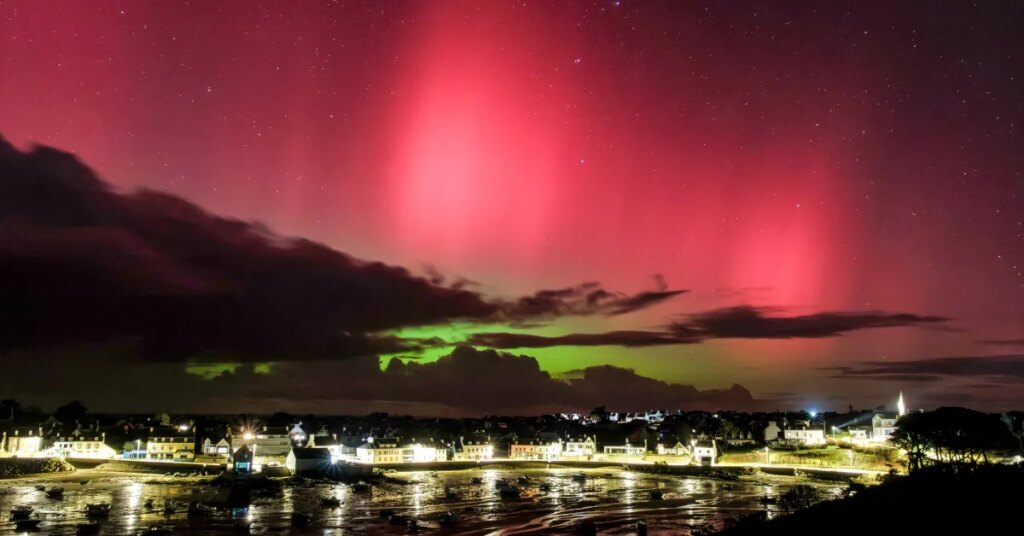
Solar storms can knock a wired planet sideways, disrupting communication and navigation satellites, power grids, defense systems, data centers, weather forecasting, and more. On Monday afternoon, the sun slugged the Earth with a massive flare, landing its most powerful energetic punch since the Great Halloween Storm of 2003. For the most part, we got off easy, with little infrastructure disruption reported. The biggest impact was actually a lovely impact: the northern lights, usually confined to the polar regions, have been visible across Canada, much of the U.S., and Europe.
[time-brightcove not-tgx=”true”]
The event began at 1:09 p.m. ET on Jan. 18, with observatories around the world detecting what is known as a coronal mass ejection (CME)—an explosive burst of superheated plasma and magnetism from the solar surface. From the jump, the astronomers knew they had spotted a big one. Solar flares are divided into four categories according to their strength: B-class, C-class, M-class, and X-class, with B being the least powerful and X the most. As with earthquakes, the scale is logarithmic, so X is 10 times more powerful than M, which is 10 times more powerful than C, which is 10 times more powerful than B. This one was an X. It was headed our way and there was nothing to do but brace for the blow.
Earth has suffered worse. Within the M, C, B, and X categories is a more precise 1 to 9 scale, with 1 being the weakest and 9 the most powerful—so a B7, for example, will be stronger than a B3. The current storm is an X1.9. The Oct., 2003 flare was so powerful it blew out the detectors, exceeding the 1 to 9 scale and registering a whopping X17 before the instruments failed.
Whatever a storm’s score, when it’s spotted, the National Oceanic and Atmospheric Administration leaps into action—specifically its wonderfully named Space Weather Prediction Center (SWPC). The SWPC has a scale too, with solar storms ranked on a 1 to 5 scale from minor to moderate to strong to severe to extreme. Minor storms have a minimal impact on power grids, satellites, and other infrastructure. The most pronounced effect of a minor storm is on migratory animals, which use the Earth’s magnetic fields as an internal GPS and can be thrown off track when the solar magnetism hits. Northern lights may be visible as far south as Michigan. An extreme storm, category 5, can cause voltage control problems in power grids—if it doesn’t cause the grid to collapse completely. Satellites can lose their orientation, suffer uplink and downlink problems, and experience electrical charging across their surface. Aurorae can be seen as far south as Texas and Florida.
This week’s flare was not quite as powerful, weighing in as category 4, or severe, potentially causing power grid and satellite disruption, but less than a category 5 causes. Aurorae were seen in northern California and the Alabama and Mississippi region.
The first humans touched by any solar storm are those not living on the surface of the Earth. Since 2000, the International Space Station has been continuously occupied by rotating crews of astronauts and cosmonauts. In the event of a coming solar storm, they train to take shelter in the two most heavily shielded of the station’s 16 habitable components—the American Destiny module and Russia’s Zvezda—and with good reason. Cosmic radiation may increase the risk of a range of ill-effects including cancer, cataracts, and neurodegenerative disease. The astronauts followed those precautions this week.
Other earthly assets are protected in other ways. Satellites are put into safe mode, with only power, navigation, and communications systems left operating, and everything else shut down till the storm passes; airlines avoid polar routes, which are exposed to more incoming radiation; grid operators reduce load, and rely on protective systems that block so-called geomagnetically induced currents (GIC). When the gale from the sun reached the Earth at 2:20 p.m. ET on Jan. 19—or 25 hours after the CME erupted—all of these systems held and only minor disruptions were reported. The wave-front from the sun is still washing over the Earth, but is expected to dissipate over the next day, dropping to a scale 1 event by Jan. 21.
The aurorae, meantime, will linger. NOAA has yet another scale, the K index, which measures how far from the poles the lights will be visible following a solar storm. The scale runs from 1 to 9; this storm scores an 8, meaning that fully 27 states across the U.S. will experience a light show. The moon, meantime, is cooperating, with only the tiniest sliver visible, providing a very dark sky, which enhances the aurora. If you’re in the lucky tier of states, enjoy the show.
The post What to Know About the Biggest Solar Storm to Blast Earth in Over 20 Years appeared first on TIME.