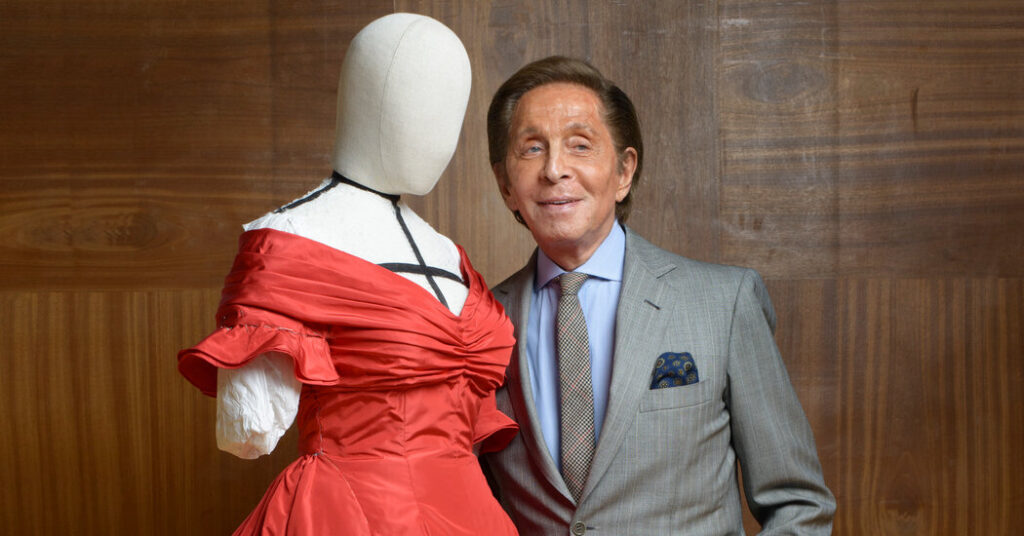
The Italian designer Valentino Garavani led a momentous life. Professionally, he was defined by his glamorous fashion creations worn by jet-setters, socialites, actresses, singers and the wives of very wealthy men. His success was such that he got to live as well as those he dressed, and sometimes better, with villas, a yacht and pugs. The 2008 documentary “Valentino: The Last Emperor” made his skill at living the good life plain to all, along with what it meant to build an enduring career in fashion. Staying on top in that world isn’t a pursuit for the weak-willed, even if one has a devoted partner — both business and, for a time, romantic — as he had with Giancarlo Giammetti.
Valentino, as he was known to the world, dealt in beauty. He didn’t aim to incite political change; his work didn’t tantalize the intellect; he was not out to upset the social order. “I know what women want,” he once proclaimed. “They want to be beautiful.”
Mr. Garavani, 93, died on Monday at his home in Rome, the city where he founded his brand in 1959. He was a bridge between different ways of thinking about female beauty: between beauty as a rigorous standard to uphold and beauty as personal power. He began his career when a woman needed a preordained form of attractiveness to move up in the world, and he was the last of a generation of designers for whom transforming a woman into a great beauty was a wondrously lucrative, admirable and uncomplicated pursuit. His death comes at a time when beauty is political, debatable and consequential. The spirit of diversity, gender inclusivity and generosity of recent years is getting pushback from a rise in neotraditionalism and hyperfemininity in Washington and elsewhere.
Mr. Garavani didn’t measure his success in the fashion industry by the affections of critics and editors but by the enthusiasm of his customers and their willingness to spend generously for his clothes. He trained in Paris in the techniques of haute couture and became famous for his graceful gowns in a shade of attention-grabbing tomato that became known in the fashion world as Valentino red. His garments regularly appeared at award galas worn by actresses such as Julia Roberts and Jennifer Lopez. A Valentino gown was always pretty and polished and inevitably evoked old Hollywood glamour.
Over the years, Mr. Garavani crafted an image of a suave, perpetually tanned gentleman with an eternally auburn bouffant blow-dried to an eerie stillness. He was not a man who took his runway bows in a T-shirt and jeans. His uniform was a finely tailored suit.
Mr. Garavani represented a particular period in fashion, one in which beauty was not so much an antidote to the trials and stresses of life but something akin to a value system. People dressed. They dressed up. They did so not simply because there were codes and arbitrary rules about when one could wear white and whether one’s belt needed to match one’s shoes but because such formalities were taken seriously as signs of class, prestige and belonging. Women, in particular, were rooted in that powerful aesthetic system. Valentino didn’t create it, but as a professional, he came of age in it. He was the last of the boldface designer names who were part of it and lived to see its demise.
He began his career at a time when, without a hint of sarcasm, a particularly attractive woman might be referred to by a society wag as a great beauty. To be so called was an accomplishment, and whether beauty came at great pains or was God’s blessing, it was a valuable kind of currency. In formal situations, a married woman — a great beauty, a swan or otherwise — was listed under her husband’s name. That’s how her credit card was issued, too. At best, her first name was “Mrs.” A great beauty had a good chance of marrying significant wealth, and with that union came comfort and security. A great beauty was less likely to be an old maid, which might have been the worst fate of all.
These attractive women were, of course, far more than a pretty face. They were intelligent and savvy, but a great deal of their social and cultural clout was tied up in their appearance, and they worked hard to wear just the right clothes because the right clothes mattered.
When Mr. Garavani founded his brand, beauty was uncomplicated by a demand for diversity. The culture wasn’t attempting to be respectful of various body types, ethnic backgrounds, races, ages and gender identities. Beauty was beauty, and most people understood that the standard was set by a willowy blonde or perhaps a sporty brunette or a long-limbed redhead with a hint of aristocracy in her blood. Everyone else worked with what they had.
Over the years, he dressed a multitude of women of different shapes and persuasions, from Elizabeth Taylor and Aretha Franklin to Cate Blanchett. A woman wanted to be beautiful. Mr. Garavani was certain of this. And to accomplish that, the designer worked in silk and organza. He made use of a well-placed ruffle or a dusting of glitter. He highlighted a shoulder, a long neck, the décolletage. This was his definition of beauty. It was not inside-out seams and cockeyed hems and jackets cut to Brobdingnagian proportions. Beautiful wasn’t a perfect T-shirt or a pair of chunky sneakers.
Mr. Garavani left the stage in 2008. Beauty by then had become a lot more complicated and much more diverse. The male gaze and the ways in which it shaped and distorted fashion were no longer unchallenged. Other systems of chicness arose. Miuccia Prada had introduced a kind of intellectualism. The Italian brand Marni, with its lopsided collars and awkward silhouettes, was promoted as thinking woman’s fashion. It wasn’t meant to be beautiful — or at least not in the traditional way. Phoebe Philo became the creative director of Céline in 2008, and the fashion industry was agog over her minimalist celebration of female power and the glory of a plain white shirt. Soon enough, the Man Repeller blog, inspired by the idea that certain clothes left men confused and repulsed, captured the mood of the times.
Eventually, the creative reins of Valentino landed in the confident hands of Pierpaolo Piccioli. He continued a legacy of gorgeous clothes. But they were presented with more overt messages about how stereotypes and prejudices sometimes limit our understanding of who and what is beautiful, as well as who has access to fashion’s most moving poetry. In 2024 the baton was passed to Alessandro Michele. At his spring 2026 show Mr. Giammetti sat in the front row, along with the actor Colman Domingo. For the occasion, Mr. Michele referred to the Italian filmmaker and writer Pier Paolo Pasolini, using a motif of fireflies to evoke the fight against fascism.
Mr. Garavani’s version of beauty didn’t make demands on the imagination. He didn’t strive to be woke or to weave elaborate tales about identity. He didn’t tell the full story of a woman; he simply celebrated the glossy surface. And that alone was an extraordinary feat.
It is also reassuring to know that beauty is now defined with more nuance and breadth. Our definition of beauty is more interesting. It’s something to discuss and argue over. Beauty can be weaponized and celebrated. All that change is invigorating. Still, at least one thing Mr. Garavani knew to be true decades ago remains so, with an important postscript. Yes, women want to be beautiful. But in their own way.
Robin Givhan is a Pulitzer Prize-winning fashion critic and a former senior critic at large for The Washington Post.
The Times is committed to publishing a diversity of letters to the editor. We’d like to hear what you think about this or any of our articles. Here are some tips. And here’s our email: [email protected].
Follow the New York Times Opinion section on Facebook, Instagram, TikTok, Bluesky, WhatsApp and Threads.
The post Valentino Was the Last of Fashion’s Old Guard appeared first on New York Times.