At the start of President Donald Trump’s second term, a Wall Street Journal poll found that voters said they liked his ideas to get tough on immigration and crime and make the federal government more efficient — but they were concerned he’d go too far.
As he wraps up his first year in office, an emboldened Trump has worked to remake much of American government to be loyal to him; weakened federal agencies’ ability to respond to natural disasters and disease outbreaks; reshaped vaccine childhood policy to suit vaccine-skeptics; is using the Justice Department to prosecute his perceived political opponents and try to silence his critics; arrested hundreds of thousands of migrants; leveraged the military to clamp down on protesters and potentially seize more territory; and instituted tariffs on goods imported from nearly every country.
But most Americans don’t like what he’s done.
Trump has always been a uniquely unpopular president, and he’s as unpopular as ever. Two major polls out last week show 40 percent approve of how he’s doing as president. A Washington Post average of polls in January finds 57 percent of Americans disapprove of how he’s handling the country.
“His support has been low by historical standards,” said Lou Jacobson chief author of the Almanac of American Politics, “and it hasn’t really gotten any better.”
Trump asserts that much of what he’s doing will become popular when voters see the end game. “A lot of times, you can’t convince a voter,” he told Reuters recently. “You have to just do what’s right. And then a lot of the things I did were not really politically popular. They turned out to be when it worked out so well.”
But it’s hard to find a bright side for Trump in polling today. Here’s more about how voters feel about Trump one year in.
His military actions are particularly unpopular right now
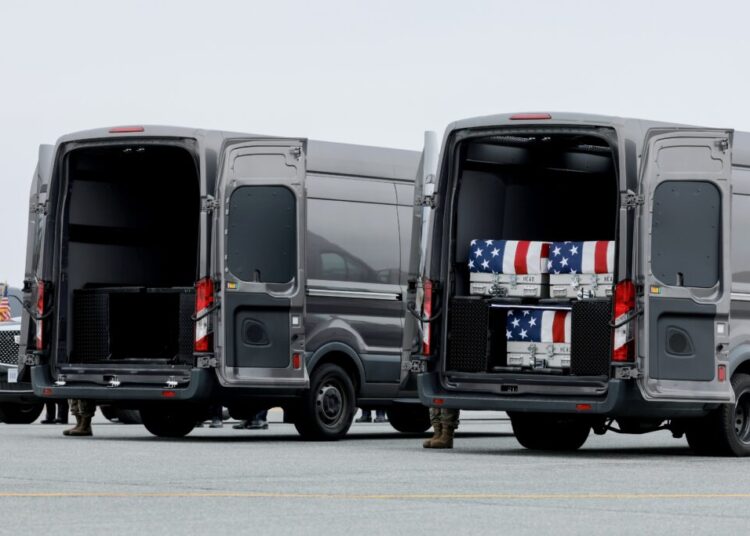
Trump is redefining himself as an aggressively expansionist president. He ousted Venezuela’s leader and asserted the U.S. is running the country. He is considering military strikes against Iran and is threatening Europe’s economy as he tries to take control of Greenland, a Danish territory.
An AP-NORC poll from earlier this month finds more than half believe he’s “gone too far” in using the U.S. military to intervene in other countries. Trump’s use of the military at home is also controversial. An October Washington Post-ABC News-Ipsos poll found that 58 percent didn’t think Trump should be able to send the National Guard into cities over a governor’s objections.
The White House asserts these are matters of national security and thus the authority to act resides solely with the president. Unless Congress or the courts step in to assert otherwise, analysts say he will probably continue to use the U.S. military for his expansionism goals.
His signature issue — immigration — is getting more unpopular
Trump’s administration set out a goal of deporting 1 million migrants in the first year. He hasn’t reached that, but his deportations have been “dizzying in scope and speed,” a new report from the nonpartisan Migration Policy Institute finds. He has also stopped a historic number of immigrants from coming into the country.
The White House touts record low border crossings and says it’s deporting both criminals and people who are working in the country illegally.
But the more people he deports, it seems, the more unpopular his signature issue becomes.
The Associated Press finds that just 38 percent approve of how Trump is handling immigration. His deportations are also seeping into the U.S. economy by raising prices on groceries as farms lose their workers. The vast majority arrested by Immigration and Customs Enforcement also have no criminal records, according to the Migration Policy Institute.
ICE’s tactics are also increasingly dominating the national conversation. They have deployed in cities across the nation and recently killed an observer in Minneapolis. Trump defended ICE’s tactics: “They’re going to make a mistake sometimes,” he said Tuesday.
“It’s worth questioning whether we can exercise our rights safely now that there is this level of impunity,” said David Bier, director of immigration at the libertarian-leaning Cato Institute.
Voters don’t think he’s making the economy better
Last week Trump called affordability “a fake word.” But the economy is often the most important issue to voters.
A new CNN-SSRS poll finds that just 3 in 10 Americans rate the economy positively, while 55 percent say that Trump’s policies have worsened economic conditions in the country.
“Voters have been clear that their main priority is the economy and prices, and Trump seems focused on anything but,” said Doug Heye, a former Republican National Committee official who has been critical of Trump. “On any given day, he may go on a bizarre, meme-filled tirade on Greenland, Minneapolis, Venezuela, awards, Gaza — all ignoring what voters want Trump to fix.”
The last time voters felt mostly positive about Trump’s handling of the economy was one month into his administration. Then Trump instituted his widespread tariffs.
Prices continue to go up. Manufacturing in America has continued to go down. And overall job growth virtually stalled when tariffs went into effect, said Diane Swonk, chief economist with the tax and consulting firm KPMG.
Add to all of this rising health insurance costs.
“It’s a really difficult economy right now,” Swonk said.
The post Trump’s deeply unpopular presidency so far appeared first on Washington Post.