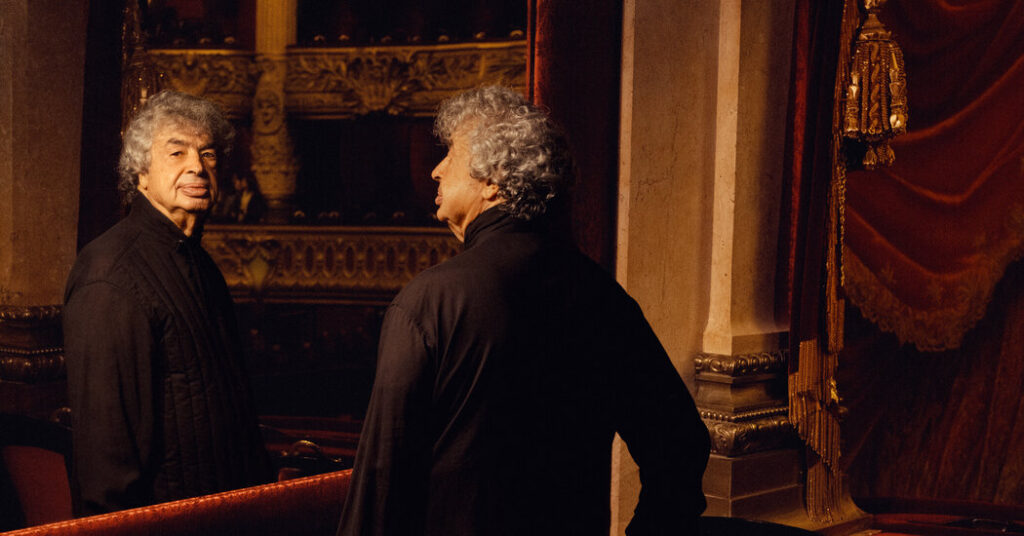
The conductor Semyon Bychkov opened the score of Tchaikovsky’s opera “Eugene Onegin,” and settled back in his chair in his 17th-century Paris pied à terre. “The music of the language of Pushkin is so startling,” he said animatedly, reading out a line in Russian, his finger tracing the musical staves.
“It’s not just the choice of words, but the constellation that make the words mean different things,” he said. “And the way Tchaikovsky has found that meaning.”
The Russian-born Bychkov, 73, is both voluble and passionate about his work. He has conducted “Onegin,” countless times, first as a 20-year-old student at the Leningrad Conservatory. And when he takes the podium on Monday for a Paris Opera production of the work, directed by Ralph Fiennes,” he will do it in a new role: as the company’s next music director.
Bychkov has had a long and varied career; since leaving Russia at 22, he has been the chief conductor of prestigious American and European orchestras and conducted both orchestral and opera works at major houses worldwide.
But the recently announced Paris Opera position — he becomes music director designate in August and takes on the job full time in August 2028 — is his most high-profile appointment yet.
“Every orchestra is a child of its country,” he said. “They are French, with their way of thinking, their body language, their culture, with enormous imagination, spontaneity, reaction to beauty. In a world that is so homogenized, this identity needs to be cared for and protected.”
Bychkov, a charming and vivid raconteur, described the moment last summer that the possibility of taking the job crystallized for him. Attending a dinner — “worthy of Louis XIV!” he said — after a Paris Opera concert, he was “assaulted” by orchestra members.
“The music director position is open,” they told Bychkov, who has lived in France with his wife, the pianist Marielle Labèque, for about 35 years. “‘Come to us! We want you, we need you!” Poor Alexander” — Bychkov was referring to Alexander Neef, the director general of the Paris Opera — “was standing right there, and I told them, ‘You need to speak to him.’ But it woke something in my heart.”
The Paris Opera has been without a music director since Gustavo Dudamel’s surprise resignation in 2023, after just two seasons in the job, and four years ahead of schedule. When Dudamel left, Bychkov said, he felt “vibrations” from the Paris Opera, where he had conducted over the years. But he was about to begin his second term as the music director at the Czech Philharmonic, and felt committed to his goal of bringing that orchestra “back to the small group of the elite.”
By last year, he said, he had decided that mission was accomplished, and he would return to the life of a freelance conductor when his term in Prague ended in 2028. “I thought, ‘I’ll be free again,’ and it was an attractive idea.”
Nonetheless, he began to look at the Paris Opera repertory. “They have done everything,” he said. “Except a symphonic repertoire.” And starting in summer 2027, he said, there is “a historic opportunity to develop that repertory” since sequential renovations to both the Palais Garnier and the Opera Bastille will mean reduced programming of operas and ballets.
Neef, who has known Bychkov for 20 years, agreed about the opportunity to expand the orchestra’s symphonic repertoire. They began to have “more serious conversations” about the position in the fall, Neef said. “It was important to find the right person, the right match, and Semyon hadn’t been available earlier. But suddenly the timeline was possible.”
BYCHKOV WAS CONDUCTING “Elektra” at the Opera in 2022 when he suggested a new production of “Onegin” to Neef, and proposed Fiennes, whom he had known for many years, as its director.
“I wanted to come back to this opera one more time in my life, and Ralph just popped into my head,” Bychkov said. “I had seen him play Onegin in a film directed by his sister, and I saw a sensitivity to the culture he was interpreting which stayed with me.”
He called Fiennes, who had directed film and theater but not opera. “I said, ‘How about this?’” Bychkov recounted. “Silence!” But Fiennes, who speaks some Russian and directed a film about Rudolf Nureyev, soon said yes, and they began to spend time together at Bychkov and Labèque’s house on the Basque coast, discussing Pushkin’s text, the characters and the music.
Fiennes approaches the singers very much like actors, said the Russian baritone Boris Pinkhasovich, who is playing Onegin. “There’s a huge focus on facial expression, eye contact, and very small, precise gestures,” Pinkhasovich said. “He’s incredibly meticulous, very patient and deeply involved.”
Even before rehearsals began on Dec. 1, Bychkov and Fiennes worked with the Armenian soprano Ruzan Mantashyan, who is singing the role of Tatiana. “It is very rare for a conductor to be so involved from the start,” she said. “I can’t praise his musicianship enough; in every rehearsal he finds a new color, something to help you as a singer.”
The two men have continued to collaborate closely, said the Ukrainian tenor Bogdan Volkov, the production’s Lensky: “Semyon shapes time through music, Ralph through dramatic rhythm, and their ideas naturally meet.”
“‘ONEGIN’ WAS THE FIRST OPERA I ever conducted,” Bychkov said, “almost an obsession with me when I was growing up.” The elder of two boys, he was born and raised in St. Petersburg, then known as Leningrad; his father was a research scientist, his mother a teacher of French and English. They were a music-loving family; his mother’s father was an amateur composer, and her grandfather had been a conductor at the Odessa opera house at the turn of the century. Bychkov’s younger brother, Yakov Kreizberg, would also go on to a successful international conducting career.
“So it’s somewhere in the genes,” Bychkov said.
Bychkov started piano lessons at 5; two years later he was accepted into the state-run Glinka Choir School. For the next 10 years, he sang and studied harmony, ear training, music history and choral conducting.
Early on, he said, “I looked at our conductor, and it was obvious to me that’s what I wanted to do.” At 14, he began to observe classes held by Ilya Musin, the country’s foremost conducting teacher, at the Leningrad Conservatory. He auditioned for Musin’s conducting course, “unheard-of for a 17-year-old boy,” he said.
Seventy-eight candidates auditioned for one spot. Bychkov conducted Brahms’s First Symphony, and as the orchestra played, he said, “I knew this was where I belonged.” He was accepted.
In 1973, three years into his degree, Bychkov won the prestigious Rachmaninoff conducting competition, and was invited to make his debut with the Leningrad Philharmonic. But by then, he knew he wanted to leave Russia, a decision that was seeded in his teens when his father could not get a job or obtain the right to permanently reside in Moscow because he was Jewish.
“Our passports said ‘Jewish,’ not ‘Russian,’” Bychkov said. “And my parents told me to be proud of it although like most Russians, we were completely nonreligious.” His father’s despondency about finding work made its mark on the teenager. “I knew I wanted to be free,” he said, “not just politically, but to take life into my own hands.
He applied for an exit visa. Despite K.G.B. harassment and threats — and the retraction of the invitation to perform with the Leningrad Philharmonic — he finally obtained permission to leave with his first wife, Tatiana Rozina.
In March 1975, Bychkov and Rozina boarded a plane for Vienna with $100 in their pockets. Their goal was the United States, which he saw as a country founded on immigration, with a wealth of classical music opportunities.
THEY ARRIVED IN NEW YORK on Aug. 6, 1975. “You can imagine the humidity, the dirt, the dust,” he said. “But it was fantastic.”
He was accepted into a conducting course on full scholarship at Mannes College, where he soon became conductor of the student orchestra. In 1980, he became the music director of the Grand Rapids Symphony in Michigan, remaining there for five years and acquiring U.S. citizenship (and a congratulatory letter from Ronald Reagan) in 1983.
By 1986, as the Buffalo Symphony’s chief conductor, he had already established an international reputation, receiving a 20-minute ovation after a 1984 appearance with the Berlin Philharmonic, and being discussed as Herbert van Karajan’s successor there.
But Bychkov’s career remained steady rather than stratospheric. In 1989 he moved to France to become the music director of the Orchestre de Paris. By then he and Rozina had separated, and he had met Labèque, one half of the Labèque sisters piano duo.
The move to Paris brought Bychkov into contact with contemporary composers like Henri Dutilleux and Luciano Berio, who was a friend of the Labèque family, and allowed him to approach “the huge missing block of French music I had hardly conducted.” He added, “I realized that the greatest challenge of an interpreter is to immerse into the culture of a work. There is no such a thing as absolute interpretation, but a score is born in a particular era and moment that you have to understand to perform it well.”
Bychkov went on to music director appointments in Cologne and Dresden, in Germany, and in Prague, the Czech capital, each, he said allowing the one thing that has been most important to him since Mannes College: “Complete freedom to choose and conduct the music that is important to me.”
THE PROSPECT OF FREEDOM at the Opera — “the idea of being able to combine opera and symphonic work that is existentially important to me,” he said — is clearly thrilling to Bychkov, who seemed in his element after the announcement of his new position.
Does he have any trepidation about working at the Opera, with its powerful labor unions and labyrinthine politics?
“I am familiar with the mentality, but also the sheer talent,” he said. “There are frustrations, but also great rewards. There is an American expression: To know your streets. I know my streets here.”
When his appointment was announced, in confidence, to the orchestra at the first rehearsal of Onegin, Bychkov told them just one thing.
“You will be the center of my life.”
This, he added simply “is what they want.”
The post This Charming Raconteur Is Paris Opera’s Next Music Director appeared first on New York Times.