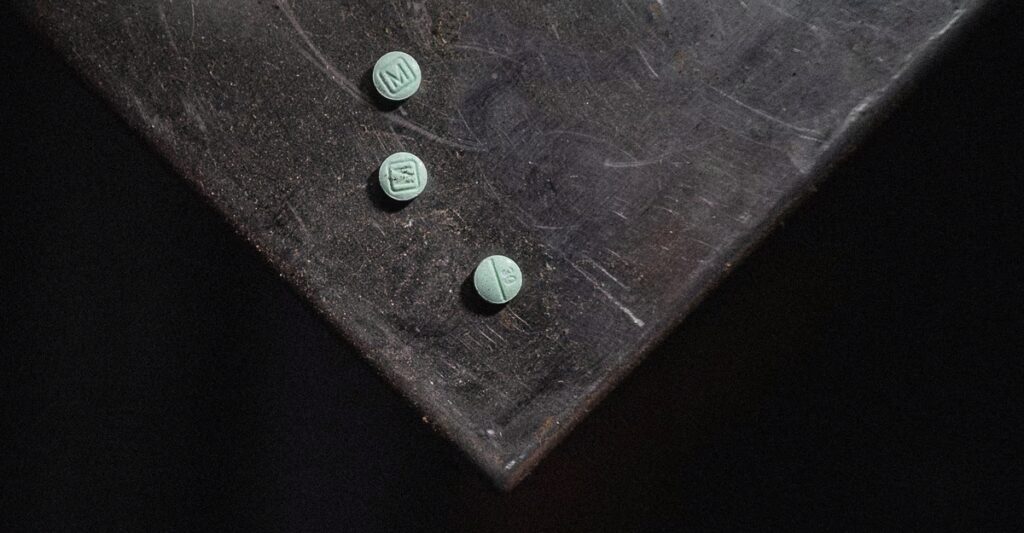
For two decades, the United States and Canada have struggled with a drug epidemic. From 2003 to 2022, annual overdose deaths in the United States rose from less than 26,000 to nearly 108,000—becoming the leading nonmedical cause of death, surpassing car accidents and gun violence combined. In Canada, overdose deaths increased almost tenfold in the same period. In both countries, the surge in deaths was supercharged by “synthetic” opioids such as fentanyl, the ultra-potent, lab-made narcotic that has come to dominate the supply of hard drugs.
Then, sometime in 2023, something miraculous happened: Death rates started dropping. In Canada, opioid-overdose deaths declined 17 percent in 2024, then continued falling sharply in the first six months of 2025 (the most recent months for which data are available). In America, preliminary data indicate that total drug deaths fell from their peak of just shy of 113,000 in the year ending August 2023 to about 73,000 in the year ending August 2025.
Although the numbers are still too high, the public-health community has responded to the decrease with jubilation—and confusion. Overdoses had been rising inexorably for 20 years. What changed?
A new paper, published earlier this month by a group of drug-policy scholars in the journal Science, presents a novel theory. The paper’s authors attribute the reversal not to any American or Canadian policy, but to a sudden fentanyl “drought,” which they say may have its causes not in North America, but in China.
[Nick Miroff: Fentanyl doesn’t come through the Caribbean]
If right, their conclusion implies a disheartening lesson amid the otherwise-welcome news. Nothing American or Canadian policy makers did—no amount of law enforcement, harm reduction, or opioid-settlement funds—made deaths start falling, the paper implies. America and Canada’s drug problem might be in China’s hands.
The paper’s authors draw on a variety of data—drug potency, law-enforcement actions, and, cleverly, social-media posts—to study the supply of fentanyl over time. Most of what drug dealers sell on the street isn’t 100 percent pure fentanyl. Instead, dealers usually adulterate their drugs, combining fentanyl with inert powders such as sugar and baby powder, or mixing in other drugs to stretch the active ingredient. Recent years, for example, have seen a major increase in adulteration with the horse tranquilizer xylazine, which knocks users out but doesn’t satisfy the opioid craving. Such adulteration happens because users expect to pay the same amount for their drugs every time; dealers vary how much fentanyl they get for their dollar depending on how available the drug is. When purity goes down, it means the availability of fentanyl has, too.
Using data from the Drug Enforcement Administration, the paper’s authors observe that when overdose deaths began falling in mid-2023, the measured purity of fentanyl sold on the street began falling roughly in tandem. By the end of 2024, the data show, both overdose deaths and powder purity had fallen by about 50 percent—a dramatic concurrence.
The authors also look at DEA data on law-enforcement seizures of fentanyl, finding that these also slowed in the third quarter of 2023. This, they argue, is less attributable to any sort of strategy or personnel change and more to the fact that there appears to have been less fentanyl for law enforcement to seize. The authors also say that Canadian data, to the extent they are available, are consistent with this trend.
To further explore the possibility that fentanyl supply was plummeting, the authors also decided to look to an unusual source of data: Reddit forums dedicated to drugs‚ such as r/fentanyl. From 2021 to early 2023, “droughts” were rarely mentioned at all. But beginning in late 2023, the term drought starts showing up in dozens of posts a month, an increase of as much as 1,900 percent. In other words: Users were noticing a supply crash, too.
Droughts have been known to reduce overdose deaths. For example, Australia experienced a significant “heroin drought” in 2001. According to a 2024 study, the drought cut opioid-overdose deaths by somewhere from 36 to 56 percent among a cohort of people using illicit opioids.
But if a fentanyl drought had come to North America, what was causing it? The paper’s authors suggest that the answer may be related to a 2023 China crackdown on fentanyl-precursor chemicals and the online platforms that sold them, itself following a summit between President Biden and Xi Jinping. That crackdown in turn may have made it harder for Mexican producers, who usually source their precursors from the Chinese gray market, to manufacture the drug. But that’s more of a speculation than a definitive answer, Jonathan Caulkins, a professor of public policy at Carnegie Mellon University and co-author of the paper, told me.
“I’m much more comfortable with the idea that supply has become less abundant,” Caulkins said, adding that he’s fundamentally “puzzled what it was that could have produced such a long-lasting reduction.”
Clearer than what caused the drought is what didn’t cause it. As deaths fell, many pointed to their preferred policies. Nora Volkow, the longtime director of the National Institute on Drug Abuse, attributed the decline to the increased availability of the overdose-reversing drug naloxone, as well as steps taken by Congress and the Biden administration to make opioid-addiction medication more available. The Biden DEA administrator Anne Milgram claimed law enforcement’s share of the credit, saying her agency had successfully put “pressure” on the cartels.
These explanations were never that convincing. Reducing drug deaths through enforcement is notoriously hard. Naloxone seems to have had no discernible effect on fentanyl deaths, though it has reduced deaths caused by other, less potent opioids. And a massive study that deployed both harm-reduction and treatment interventions across 67 communities from 2021 to 2022 yielded no statistically significant reduction in overdose deaths. These approaches all might make small differences, but they can’t explain the big drop.
Nor, the paper’s authors note, can they explain the glaring fact that overdose deaths went down in both the United States and Canada, which have very different drug-control-policy approaches. “Both countries, despite very different policies, seem to be riding the same wave of broad trends in supply and use,” Caulkins said. Which leaves American and Canadian policy makers with something of a disappointing victory: Deaths are down, but they may yet come back, and preventing that turn may be far beyond American and Canadian control.
[Listen: A radical answer to the fentanyl crisis]
Though we don’t know why the drought happened, it still offers opportunity. In 2019, a multiagency operation shut down a handful of drug gangs in Philadelphia’s Kensington drug market at once, effectively imposing a drought through policy. A rigorous study later concluded that overdose deaths fell as a result, and the use of addiction-treatment medication in the surrounding Delaware Valley—an area covering parts of three states—increased. When their supply dries up, some people get off drugs; now is a great time to help them.
But there are risks, too. An uncertain drug supply can drive some users to substitute other substances—xylazine, or the latest illicit tranquilizer, medetomidine—that are dangerous in their own right. And sudden drops in the availability of opioids can reduce chronic users’ tolerance, leading them to take too much and overdose when the drugs come back.
If we want to lock in the unexpected windfall from the drought, now is the time to focus on getting people clean. That’s a big lift, but the right combination of medication, therapy, and voluntary and involuntary treatment can make a difference. If we do nothing, though, then one day fentanyl will come back—and there will be little anyone can do.
The post The Real Reason for the Drop in Fentanyl Overdoses appeared first on The Atlantic.