The Golden Gate Bridge, the iconic span that hangs between San Francisco Bay and the Pacific Ocean, has been the site of more than 2,000 confirmed suicide leaps since its completion in 1937. The true death toll is certainly higher, since not all jumps are witnessed and not all bodies are recovered.
In 2006, at least 34 people jumped to their deaths by crossing the four-foot rail and plunging more than 200 feet into the strait below. It was also the year that Paul Muller and two others with family members who had jumped from the bridge decided to do something.
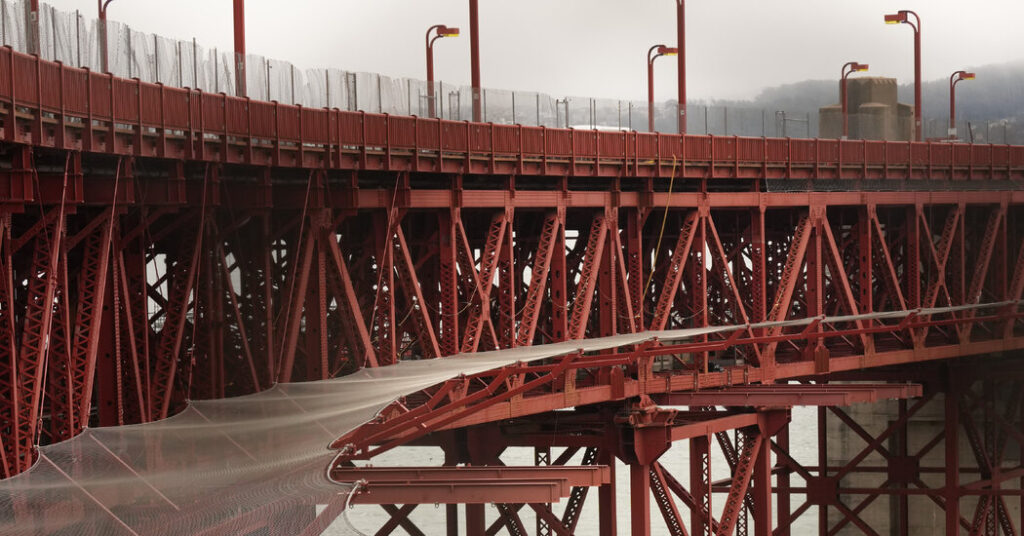
That something slowly evolved into a complicated, miles-long series of stainless-steel nets — a “suicide deterrent system” — now strung on both sides of the bridge. It is out of sight to the millions of people who cross the bridge every year, but plainly visible to anyone standing at the rail, looking down.
For decades, there had been an average of 30 suicides at the bridge each year. In 2024, as the final pieces of the net were installed and tweaks were made, there were eight.
In 2025, the first full year with the nets in place, there were four, and none between June and December.
That annual total is surely among the fewest ever recorded at the bridge, and seven months might be the longest stretch without a suicide at the bridge, though early records are sparse.
“The last seven months there were zero, so the results couldn’t be better,” Mr. Muller said.
Mr. Muller was disheartened to learn that there has been one suicide early in 2026. But the goal all along was to save lives, and to eventually undo the dark magnetism of the bridge as a place to die.
Denis Mulligan oversees the bridge operations as general manager of the Golden Gate Bridge, Highway and Transportation District. His office at the south end of the bridge overlooks the steady flow of cars, pedestrians and bikes that cross between San Francisco and Marin County.
In late 2023, as the installation of the nets was nearing completion, Mr. Mulligan said it would take a year or two of data collection to assess the impact of the nets on the death toll outside his window.
Early in 2026, Mr. Mulligan considered the results.
“The assessment is that the net is working as intended,” Mr. Mulligan said. “We’re trying to reduce the number of deaths. That’s what government should do, is protect the public. We were candid up front that nothing’s 100 percent, but that we think this is a worthwhile endeavor and good for the community. And we think a lot of people are alive today because of the project.”
Mr. Mulligan also oversees a vast electronic surveillance system and a team of on-bridge officers whose responsibilities include identifying and stopping those who are considering a leap. Last year, there were 94 successful interventions, about half as many as the average before the nets.
“Nets” is a misnomer; they are taut, marine-grade stainless steel cables about 20 feet below the public walkways on both sides of the bridge. The idea is that anyone who jumps into the net will be injured enough, or at least shaken enough, to keep them from crawling out and intentionally falling the rest of the way to the water.
Mr. Mulligan, wary of attracting copycat attempts, declined to explain how those who have died by suicide the past two years have circumvented the nets. He also declined to say how many people have jumped into them and been rescued.
But the immeasurable number might be those who came to the bridge, spotted the nets and decided that suicide there was no longer possible.
In 1937, 10 weeks after the bridge opened, a 47-year-old World War I veteran reportedly said, “This is as far as I go,” and jumped.
His was the first known suicide. Others followed. In 1939, the California Highway Patrol recommended that the four-foot rails be raised. For decades, decision makers ducked behind aesthetic concerns, costs and effectiveness. The death toll, loosely tracked, reached 500, then 1,000, and kept growing every week or two, on average.
Frustrated by the inertia, Mr. Muller, Dave Hull and Patrick Hines founded the nonprofit Bridge Rail Foundation in 2006, with the hope of raising, finally, the height of the rails.
“The overriding concept to the Golden Gate Bridge story is restricting easy access to lethal means,” Muller said. “It’s a way to reduce suicides that John and Jane Q. Public can do. You don’t need a lot of complex psychiatric training to, say, simply lock up the guns.”
Or to make leaping into the ocean more difficult.
Support grew slowly. Growing numbers of grieving families, mental health professionals, even coroners pleaded for something to be done. Eventually, the idea that took hold was borrowed from a solution used in Bern, Switzerland: nets.
Debates raged, approvals came, construction bids opened and costs rose. There were legal squabbles with contractors. Construction began in 2018, meaning it took longer to install the nets than the four-plus years it took to build the bridge itself. What was once estimated to cost $76 million ended up costing $224 million.
Critics have long wondered if steering the suicidal away from the Golden Gate Bridge merely sends them elsewhere to take their own life. Net proponents do not think so.
A 1978 study by Richard Seiden, at the University of California, Berkeley, tracked 515 people who, between 1937 and 1971, went to the Golden Gate Bridge intending to jump but had been persuaded not to. It found that 94 percent were still alive or had died of natural causes.
“Suicidal behavior is crisis-oriented and acute in nature,” Mr. Seiden concluded.
The Golden Gate Bridge has long been a unique draw for the suicidal, some even coming from other states and countries. At the edge of the ocean, on one of the world’s most famous structures, it was a way to die somewhere both beautiful and notable. Death was almost certain. (Most jumpers are killed on impact, but those who survive usually drown.)
And access was simple, with parking lots on both ends and public sidewalks along a short rail.
“The bridge has exerted a siren’s call for so long for some suicidal people that it might be hard for them to believe that it’s no longer the case,” said John Bateson, a longtime director of a suicide prevention center in the Bay Area and author of “The Final Leap: Suicide on the Golden Gate Bridge.” He writes a monthly newsletter for the Bridge Rail Foundation.
That might all explain why, while the number of suicides in 2025 were about one-seventh the pre-net average, interventions only dropped in half. People are still showing up.
“The more people who know that the barrier is in place will be discouraged for even thinking about the Golden Gate Bridge as a suicide destination,” Mr. Bateson said.
The Bridge Rail Foundation remains active, despite the successful completion of its original goal. It fields calls from officials around the world looking to reduce suicides from other bridges or high places.
That might be the incalculable legacy of the work, beyond the raw number of lives saved at the Golden Gate Bridge. If one of the world’s most famous and deadliest bridges can prevent all but a few suicides, other places can probably do the same.
“That’s certainly the hope,” Mr. Bateson said. “From the outset, all of us have recognized that whatever happens on the Golden Gate Bridge is going to serve as a model for others.”
If you are having thoughts of suicide, call or text 988 to reach the 988 Suicide and Crisis Lifeline or go to SpeakingOfSuicide.com/resources for a list of additional resources.
John Branch writes feature stories for The Times on a wide swath of topics, including sports, climate and politics. He is based in California.
The post Suicides Were Frequent at the Golden Gate Bridge. Not Anymore. appeared first on New York Times.