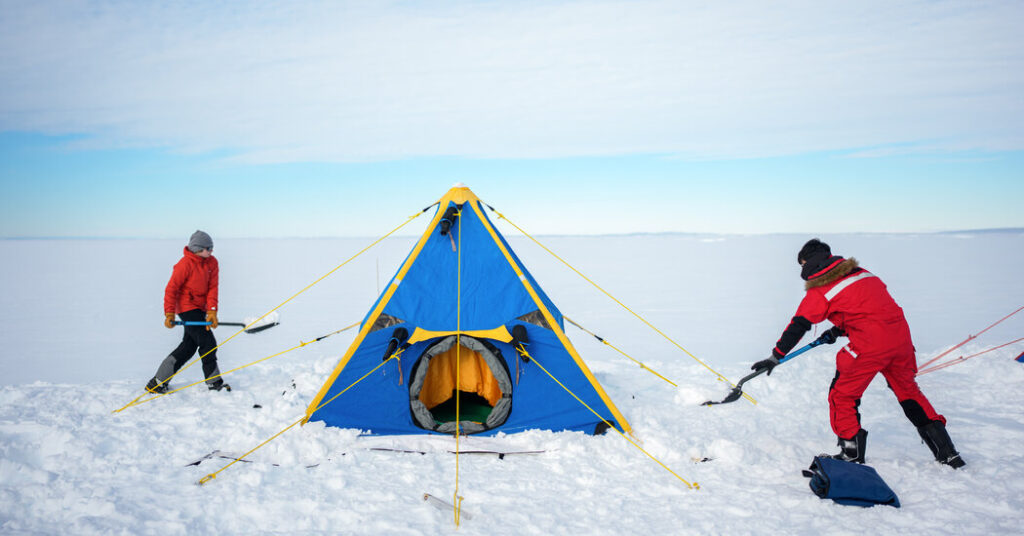
After a series of weather delays threatened to derail their mission, scientists on Monday managed at last to set up camp on Antarctica’s remote and fast-melting Thwaites Glacier. For the next few weeks, they will be attempting a difficult but vital operation.
They aim to bore half a mile through the ice and place instruments in the warming ocean waters below, giving the world a rare, close-up look at how this gargantuan glacier is being corroded by the sea. Researchers fear that Thwaites’s thinning could someday trigger its total collapse, which would raise sea levels around the globe.
The break in the weather couldn’t have come soon enough. After crossing the southern seas and reaching Thwaites early this month, the researchers were unable to travel the last 19 miles to their planned research site because helicopters from their ship, the icebreaker Araon, couldn’t land on the cloud-swathed ice.
Now that the scientists and their roughly 17 tons of gear have been flown safely onto the glacier, they have no time to waste.
Their drilling equipment will take a week to set up. Blizzards could slow their work. Whether or not their scientific goals are achieved, the team’s 10 members need to be off the glacier by Feb. 7, when the Araon must begin its return journey to New Zealand. The ship is scheduled to embark another Antarctic voyage shortly after this one wraps up.
“We’re very lucky to be here; we also work very hard to be here,” said Scott Polfrey, a mechanical engineer at the British Antarctic Survey and member of the drilling team. “It’s important for everybody here that we do things safely and we come home with hopefully some hard-hitting scientific results that speak about our planet.”
When asked, during a break from moving gear at the camp, whether he had any first-night rituals while working on glaciers, Peter Davis, an oceanographer on the team, said: “Probably collapse, because everyone is just always knackered, absolutely knackered, after the first day.”
The big haul started late on Sunday afternoon, when the clouds parted and the Araon’s two helicopters flew a dozen loads of cargo onto the glacier. The helicopters ferried more freight and people on Monday, and by 4 p.m., the scientists and engineers were putting up tents, unpacking supplies and shoveling snow.
On Monday evening, as Chang W. Lee, my photographer colleague, and I were being flown onto Thwaites, the team’s camp first appeared as specks on the colossal white plateau, insignificant next to the enormous crevasses that furrowed its snowy surface.
The camp sits on a flat, 650-foot-long strip of ice, with boundaries that the team marked with flags and willow branches stuck into the hard, icy snow. Its wider end, roughly 160 feet across, is where the drill will be set up. Its narrower end is where 10 single-occupancy sleeping tents have been pitched in a neat row.
The team will eat in a mess tent that has an air fryer, a bread machine and an assortment of low-effort meals, including freeze-dried chicken fajita bowls and quick-cooking Korean beef and radish soup. Two toilet tents are as simple as it gets: a lidded seat propped up over a deep hole in the snow. Power for their drilling and camp equipment comes from several generators.
One important task on Monday was piling snow around the edges of the tents so they didn’t blow away. Another was digging a big hole for burying the team’s coolers of frozen meat and vegetables. “Obviously we’re in the world’s best freezer,” said Taff Raymond, one of the team’s two safety guides.
At around 6:15 p.m., the air at the camp was 24.8 degrees Fahrenheit, or minus-4 degrees Celsius. The snow dampened all sound. Skuas patrolled the area, the seabirds alighting on the wooden crates and steel chests that had so rudely invaded their domain.
The scientists’ camp sits in a modest depression in Thwaites’s surface, giving the landscape more shape and variety than it seemed to have from the sky. To the north, the sun caught the jagged crests of what looked like distant mountains. In fact, they were the tops of the gigantic, fast-deteriorating icebergs that are all that’s left of Thwaites’s western tongue. The glacier had engulfed us in all dimensions; we were mere specks on the giant’s back.
Still, it’s what’s happening thousands of feet below, not at the icy surface, that made the team want to drill at this spot.
Warm ocean currents are constantly flowing into the waters under Thwaites and melting the glacier’s undersides. Large plumes of fresh water are also escaping from gaps between the glacier and the bedrock, where underground heat and friction are melting the ice at its base. All these waters mix and muddle under Thwaites, affecting where and how quickly the glacier thins.
Such complexities help explain why scientists have at times observed Antarctic ice melting at two or three times the rates predicted by mathematical models, said Ji Sung Na, a senior researcher at the Korea Polar Research Institute who is part of the drilling team. Only by collecting sustained measurements in the water under the ice can scientists improve their models and better project future melting, Dr. Na said.
Several members of the drilling team bored a hole through Thwaites’s eastern ice shelf for a similar purpose in 2020. An expedition two years later to drill in another area was foiled by sea ice, which blocked the Araon from sailing close enough to Thwaites for the scientists to travel to their planned research site.
Dr. Davis, the oceanographer, last camped on the glacier in 2020. “We thought that was going to be the most complex terrain we’d ever work on,” he said. “Little did we know.” He was referring to the fractured and fast-moving ice beneath this year’s campsite, which has already caused a scare.
The drilling team’s safety guides, Mr. Raymond and Jinsuk Kim, slept on the glacier Sunday night, before their colleagues were flown in. They were standing at the camp’s wider end, they said, when they heard a terrible loud crunching noise beneath their feet. The ice below the surface was breaking apart.
The guides tightened the camp’s boundaries, probably not for the last time.
“My goal is finishing as fast as we can,” Mr. Kim said, of the drilling operation. “We need to leave as fast as we can.”
Raymond Zhong reports on climate and environmental issues for The Times.
The post Skies Clear, and a New Outpost Springs Up at the Bottom of the World appeared first on New York Times.