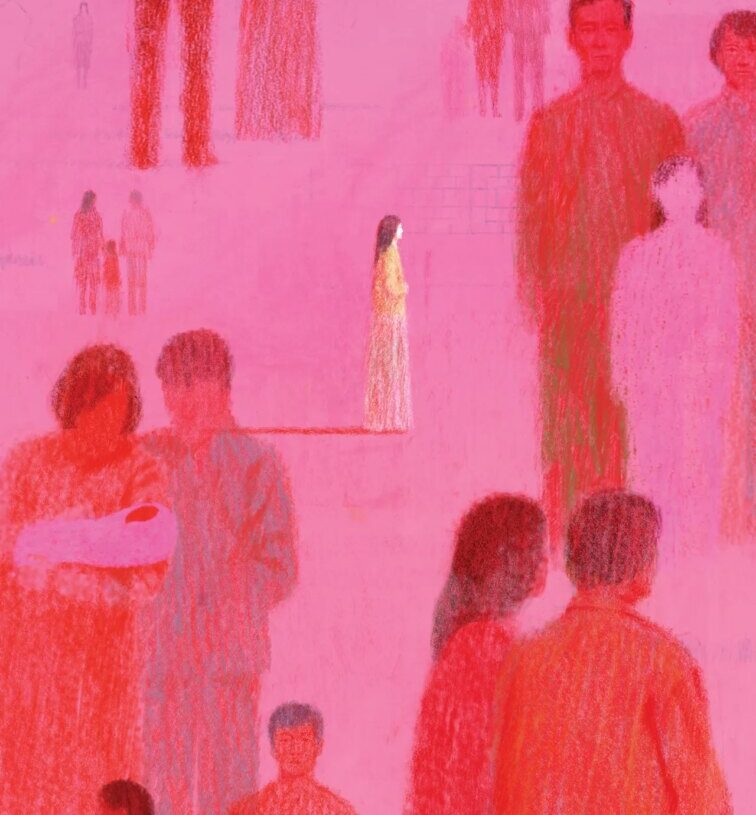
A girl is found on a street in Ma’Anshan, China, in May 1993. Her paternal grandfather, the story goes, set her down and walked away. No explanation. It’s unclear how long she’s been outside when somebody arrives and takes her to the orphanage.
A white woman adopts the girl and brings her to America in August 1994. She gives her an English name.
In spring 2010, when Youxue (her Chinese name) was a high school sophomore in Dallas, Texas, she decided to start searching for her birth parents. She knew it wouldn’t be easy. Given the international nature of her adoption and the under-the-table circumstances in which most Chinese children were relinquished, there was a strong likelihood she would never find them. But her adoptive mother was supportive and found a “searcher” through Yahoo groups, one of the first forums where adoptees connected online. In China, the searcher plastered posters of Youxue and her information in high-traffic areas of Ma’Anshan, in Anhui Province, and went to the police station that was listed in Youxue’s certification of abandonment. There, the searcher was able to access records and find a short note that Youxue had apparently been left with.
In September, several families came forward. One of them seemed like a potential match. They had an older daughter and a younger son. Looking at photographs, Youxue thought she could see a resemblance. For the maternity DNA test, she sent off a cotton swab with buccal cells from the inside of her cheek, along with a few strands of hair.
Here are 23 ways China is rewiring the future.
In November, she received a text from her adoptive mother that the DNA results had come back positive. There was a match! She wanted to tell all her friends and family; she felt whole. She started taking Mandarin lessons and texting with her birth parents. They said they loved each other and couldn’t wait to meet.
But when she was on spring break in 2011, Youxue’s birth father told her that her birthday was September 11, 1994. This was impossible. Youxue had already been adopted by then. Thinking it was a mistake, Youxue replied, but he insisted: Mother knows birth date.
After checking with the DNA company, Youxue found out they had emailed her someone else’s results. This was not her biological family. Devastated, Youxue deleted all of her messages with the family and all of her photographs of them. She knew she would regret it, and that they could even be useful for another adoptee, but she couldn’t bear to hold onto them anymore. To want something is to expose yourself to pain, and choosing to search means opening yourself to heartbreak.
Meanwhile, in a small village in China’s Anhui Province, a mother asked her adult daughter and teenage son to help her search for her two relinquished daughters. She had long wanted to look for them, but she spoke only her local dialect and had little access to technology. With no formal education, she didn’t know where to begin, and nobody was sure how to help.
Decades earlier, the conditions that shaped this family’s life were set in motion by China’s one-child policy. The government’s population control program, enacted in the late 1970s, turned family planning into state-mandated decisions about which children were allowed to exist. In the ’80s, rural parents were allowed to have a second child only if the first was a daughter. Families who violated the policy received large fines and other penalties, sometimes sterilization and physical violence.
Today, there are more than 82,000 Chinese adoptees in the United States, most adopted between 1999 and 2016. More than 60 percent of the children adopted in that period were girls. The majority of adoptive parents are white, wealthy, and well educated. Because child abandonment is illegal in China, very little documentation connects Chinese adoptees with their birth families.
In the summer of 2011, only a few months after the false match, Youxue and her adoptive mother traveled to China to try searching again. Through a friend who had been adopted from the same orphanage and was now reunited with his birth family, they found another searcher who, along with a local radio personality, had helped make a successful reunion in the past. With access to police records and the short note the first searcher found, they finally had more context to move forward.
In Ma’Anshan, Youxue did newspaper interviews, online news interviews, and even a television interview that ran on all the local buses. She was searching for families that had relinquished a daughter between August 1993 and January 3, 1994, because her orphanage documents stated she was likely born around that time. She did blood tests. That summer, one family matched everything. Both parents had her blood type. They even knew what was on the note left with the baby; they said they had written that note years earlier in a moment of desperation.
With a news crew in tow, Youxue and her adoptive mother caravaned to the family’s house in a neighboring township. Nobody could stop crying. But the second Youxue saw the mother step out of her house, she knew something wasn’t right. They looked nothing alike.
Youxue had long suspected her paperwork wasn’t accurate. In 1994, when her mother adopted her, she was tall for her age. The documents listed her as a seven-month-old. She’d had developmental delays, common for children in orphanages who are malnourished, but even accounting for those, she was likely older than her papers showed. She’d also had more teeth than a seven-month-old normally would.
Now she knew: The note, the police records, the photographs—all of it had to be somebody else’s. In 1993, a girl was left on the stoop of a police station in Ma’Anshan, but it wasn’t Youxue. That girl, hopefully still alive, may have Youxue’s papers, because Youxue has hers.
Youxue continued her search. All that she had known about the circumstances of her birth was incorrect. The only thing she could be certain of was the orphanage her mother had adopted her from.
In the fall of 2012, Youxue’s new searcher reached out again and said that somebody had seen her footage and wanted her to be on the Chinese TV show Wait for Me, which tries to connect missing children with family members. Later that year, she appeared on the show, the first non-Chinese citizen to be featured. One family eventually came forward, but they were eliminated based on blood type.
Even though Youxue continued learning Chinese, her hope began to falter. Years passed. By 2020, as Covid-19 outbreaks swept across China, Youxue couldn’t escape the fact that her birth parents were getting older and that perhaps time had run out.
A woman in Anhui Province saw one of Youxue’s online interviews, but she didn’t recognize her. She scrolled past, unaware that the woman on her screen was her niece. Her sister, Youxue’s mother, had been searching for Youxue for a long time.
In recent years, a growing number of Chinese American adoptees have begun looking for their birth families, many for the first time as adults. Empowered by consumer DNA tests like 23andMe and AncestryDNA, they are finding relatives in ways that would have been impossible a decade ago. One woman I talked to located her birth parents within days of uploading her DNA. Another, Alyse, discovered a cousin, also adopted and living in the United States, after finding a 14 percent genetic match. When they first met over FaceTime, the two sat in silence, studying each other’s faces. “Actually seeing each other was really surreal,” Alyse told me. Like many adoptees now rediscovering relatives across continents, their conversation turned from family history to the eerie parallels of their lives. Both were pursuing doctorates; both filled their free time with art: knitting, crocheting, painting. The similarities felt like proof of some phantom thread that had always connected them.
Every year, technology narrows the distance between international adoptees and their biological families. Created in 2009, China’s National Reunion Database allows anybody to go to a police station and submit their DNA to try to find their family members. In 2016, China launched the Reunion System, which includes mapping technology and assistance from Chinese social media giants like Douyin to post information that could help children and families find each other. Similar to Amber Alert, the Reunion System uses nearly 30 mobile apps and media outlets to disseminate information to peoples’ phones. China also set up free blood collection sites across the country. These new efforts reflect the government’s desire to resolve high-profile abduction cases and demonstrate responsiveness to a crisis that has drawn international scrutiny.
In April 2024, Youxue heard about the National Reunion Database during a virtual GED Match Day, an online event that helps people consolidate their DNA files in a single place. The fact that the National Reunion Database was new to Youxue underscores how little-known it remains outside of China. The next month, with instructions from the Nanchang Project, a nonprofit that helps Chinese adoptees find their birth families, Youxue mailed her DNA sample to the database.
Youxue received confirmation that her DNA had arrived in China on July 14. Forty-eight hours later, a remarkable coincidence: A woman in Anhui Province submitted her DNA to the National Reunion Database too.
On August 20, Youxue received a congratulatory email from one of the Nanchang Project volunteers. Youxue had a definitive match with two parents. At first, she couldn’t believe it. The last company had sent her a false match. But matching with both parents offered a new level of certainty.
A volunteer at the Nanchang Project told Youxue the names of the parents. The next morning, she received an Instagram message from an account she didn’t recognize. It was a message from a friend of her first cousin in China.
In April 2025, Youxue and her adoptive mother flew to Shanghai. Her biological older sister met them at the airport with her husband and young child. Earlier, over texts, her sister had asked Youxue to give her child—Youxue’s biological nephew—an English name. Youxue chose Henry. Crying and holding two massive bouquets of flowers, her sister hugged her while her brother-in-law held the sign “Welcome to China.” They spent the next day walking around Shanghai and talking.
Youxue has two older sisters and one younger brother. Her family kept the eldest daughter and relinquished the second and then the third—Youxue. Nobody has been able to track down the second-eldest daughter; her fate remains unknown. Youxue’s family had been pressured by Youxue’s grandparents to have a son, and the family planning office in their region was strict. Her real birth date is eight months off from what the documents said. Youxue has the same skin and lines across her cheeks as her mother, and she looks just like her brother and father. They have the same smile.
After a few days in Shanghai, her sister’s family drove them to her family’s village, where her parents still lived. Youxue hadn’t been from Ma’Anshan after all, but a poorer village in nearby Wuhu. Relinquished children were often left in higher-trafficked cities where they had a better chance of being found. Her parents and her brother met them outside a hotel. Her father, red-faced and sobbing, wore a blue polo and her mother a red velour tracksuit. They held each other. They hugged her adoptive mother. Youxue later told me that her father cries more easily than her mother.
Cousins and aunts and uncles were all waiting. The family hired caterers and shot fireworks when Youxue walked down the street. They laid out a red carpet and gave her and her adoptive mother red cashmere scarves to wear. The entire village was invited to a celebration. An enormous banner said “Welcome home, daughter!” in Chinese and English gold lettering. Ten tables, 22 dishes. Other people in the village didn’t believe that Youxue had been adopted to America until they saw her white, blond adoptive mother. Her family drove them around the village and showed her the fish and crab fields they used to work in, the water reflecting the milky blue of the sky. Looking at her parents laughing, sitting together on a moped, she could see what their young love might have looked like.
One of Youxue’s aunts couldn’t stop crying. She had also relinquished two daughters years ago and desperately wanted to find them.
Youxue’s parents largely spoke the local dialect, although her mother had learned some Mandarin. They worked as farmers for most of their lives and had little opportunity for schooling. Even though Youxue speaks Mandarin, she needed a translator to communicate with them.
Most Chinese families didn’t even have access to clean water until the 2000s, and many lived in abject poverty. “We’re so sorry.” That was what everyone in her biological family told her. Her parents, her aunts and uncles, her siblings. But Youxue told me that “forgive” wasn’t the right word for how she felt about the circumstances of her relinquishment. She doesn’t blame them: “I don’t grieve for just myself. I grieve for them too.”
Every year, more Chinese adoptees send off DNA kits, upload photographs, or submit their DNA to the National Reunion Database. As databases grow and social networks interconnect, the chance of reunion grows. Chinese police now use not only DNA analysis but also face recognition to help families reunite. Some adoptees post their stories on RedNote, a social media platform similar to TikTok. What once felt like an impossible quest now feels like a movement. For Youxue and thousands of others, every reunion proves that the past is not sealed off forever.
After 14 years of searching, three on the ground in China, Youxue is now in regular contact with her birth family. When she talks about her story, her face brightens. She’ll be back in Wuhu in February to spend Chinese New Year with them. “Even before I met my biological family, I loved them,” she says. “I’ve loved them throughout this entire process.” Youxue now runs a nonprofit that creates online groups and in-person meetups for adoptees. In addition to her missing older sister, she is still searching for two female cousins.
What Say You? Let us know what you think about this article in the comments below. Alternatively, you can submit a letter to the editor at [email protected].
The post She Was Given Up by Her Chinese Parents—and Spent 14 Years Trying to Find a Way Back appeared first on Wired.