Scores of dolphins followed our boat, a flotilla of fins and sleek surfacing bodies. Cued by the captain, six of us passengers plunged into the sea to meet them. I looked through my mask to see two of the creatures 10 feet away, one locking eyes with me while another rolled over playfully.
Of the many wildlife encounters I’ve had during three visits to Kangaroo Island, 70 miles off the coast of South Australia, this may have been the most magical. When my husband and I last visited in 2002 with our then-8-year-old twin boys, Kangaroo Island Marine Adventures was only a gleam in the eye of Andrew Neighbour, a fifth-generation islander and former lobsterman. These days, Mr. Neighbour offers opportunities to swim amid the pod of about 80 bottlenose dolphins that gather in what he calls their “lounge room.” In these azure waters off the island’s windy north coast, one might also see seals and soaring raptors like white-bellied sea eagles whose shadows flit across the cliffs.
While the dolphin encounter was a welcome novelty on this voyage to KI, as the 96- by 34.5-mile island is known to locals, I had not been so sure about other alterations to the island that had first enchanted me during a solo trip in 1992. A major concern was damage wreaked by the 2020 wildfires that had scorched much of the western end, killing two people and many thousands of livestock animals, koalas, kangaroos and their smaller wallaby cousins. I worried also that the island’s charms and sustainability had been challenged by an increase in tourism. Since 2001, the number of annual visitors has risen from 150,000 to 274,000 in 2024.
‘A Giant Reset Button for the Bush’
Nevertheless, my husband, Warren, and I planned a four-day stay on KI with our grown sons and their partners, hoping to experience just the right combination of wildlife, adventure, local cuisine and downtime on the island’s immaculate white strands. While my previous visits had been in mid-March, nearly fall in the Southern Hemisphere, and the winter month of July, this visit took place in December, during the Australian summer season.
So I was amazed when, after coming over on a packed ferry from the mainland, we rarely felt crowded during our stay. The only time we jostled for a prime viewing spot was when watching long-nosed fur seals frolicking near Admirals Arch in Flinders Chase National Park at the island’s west end.
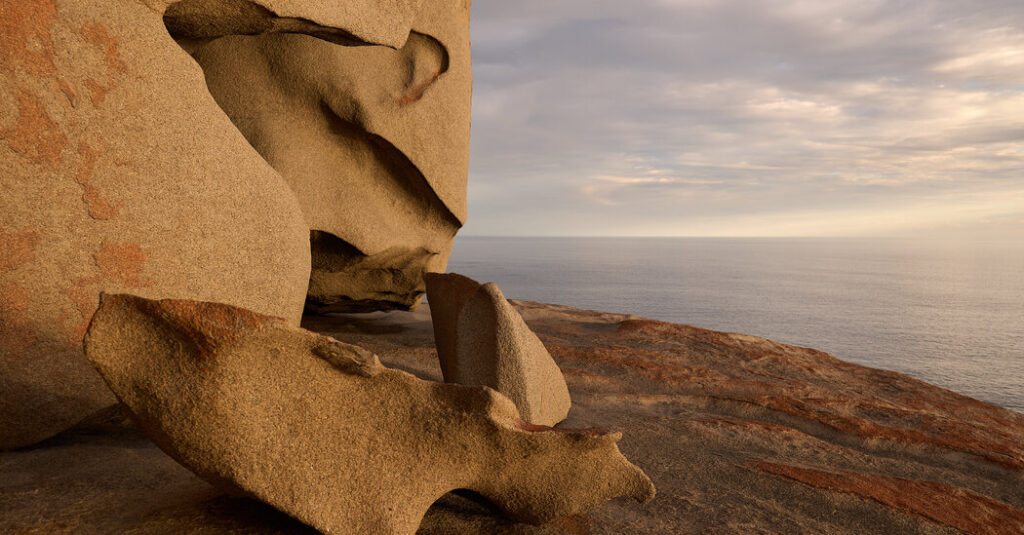
People go to the park to see not only seals but the arch itself, a giant maw in the granite cliffs whose stalactite teeth frame the swells breaking on the rocks beyond. I marveled that the arch’s visual impact does not wane with subsequent viewings. Nearby, the Remarkable Rocks, an assemblage of outsize granite boulders sculpted by winds and water, looks like an alien playground. Indeed, vacationers capered on its lichen-frosted slopes and posed for pictures in cubbyholes.
It was on the path to the Remarkable Rocks where I was most mindful of the recent wildfires, and not in an entirely negative way. A new boardwalk traversed the bush, and, as I paused to contemplate the blackened, skeletal relics of mallee eucalyptus trees, these ghostly reminders were eclipsed by the shrubs that had sprung up amid the devastation.
My attention was distracted by a woman who, crouching to examine one of the young bushes, volunteered that the plant appeared to be evolving, growing in a slightly different way. After she introduced herself as a naturalist tour guide and photographer named Nikki Redman, I expressed surprise that the regrowth was so extensive. “Fire has been a part of the Australian ecosystem for millenniums,” Ms. Redman said, likening it to “a giant reset button for the bush.”
“What people don’t realize,” she added, “is that Kangaroo Island is better than ever.”
Our KI sojourn supported Ms. Redman’s reckoning. Flinders Chase now boasts a spiffy visitors’ center made with fire-retardant timbers, for example, and the 41-mile Kangaroo Island Wilderness Trail has been restored. Accommodations ranging from campgrounds to the upscale Southern Ocean Lodge have been rebuilt.
Animals such as goanna lizards and the quilled anteaters known as echidnas survived the 2020 blaze by staying in their burrows. But the island’s marsupial namesake and its smaller wallaby cousins took a big hit. So did about half of the roughly 50,000 koalas, a loss that could be interpreted as one of nature’s cruel corrections.
Dr. Peggy Rismiller, who runs the Pelican Lagoon Research and Wildlife Center with her husband, Mike McKelvey, told me that koalas, which are not native to KI, had denuded the gum trees on the western end of the island. “If we could contain koalas to one area, it would be fabulous,” she said.
Fairy Penguins and Koalas
Two days earlier, we had met a rescued koala named Larry when we visited the Kangaroo Island Wildlife Park, which had just moved to a new location near Seal Bay on the southeastern coast. Injured in the 2020 fires, Larry had been released from the park’s former mid-island location several times but reportedly kept returning to join fellow survivors of fires and road accidents.
Residents of the park’s roomy enclosures included foot-high fairy penguins frolicking in a pool and many marsupials, which we paused to feed pellets and scratch their soft brown heads. Magpies warbled in the surrounding bush, tawny dingoes in pens perked up at sounds of potential prey nearby, and emus ogled us.
Other encounters with native fauna occurred during guided tours to see Australian sea lions at Seal Bay Conservation Park, where a mother fed her pup under the boardwalk, and fairy penguins at the Penneshaw Penguin Center on the island’s northeast shore.
One does not have to go to parks or on tours to see animals. We had to be very careful on the roads, especially earlier and later in the day when kangaroos and wallabies are wont to jump out from the bush. We also saw roadside snakes soaking up the sun, and, one afternoon near our Airbnb on Island Beach on the island’s southeast end, a five-foot-tall kangaroo got into a tangle with a dog.
Local Spirits and Lunch Under a Fig Tree
While wildlife was once KI’s main attraction, the island’s food, wineries and distilleries have stolen some of the limelight. We made pilgrimages to a few of those places, including the Kangaroo Island Brewery, which makes flavored ales and lagers on the North Coast Road, a five-minute drive from Kingscote, KI’s busiest town. From there it is a short hop to Kangaroo Island Spirits, which distills gin, vodka and liqueurs flavored with local botanicals such as lemon myrtle and coastal daisy. We joined the customers sipping colorful cocktails and flights of sundry spirits at tables in a spacious garden with pear trees, star jasmine, sea lavender and lemon-scented gum trees.
Like Springs Road Wines next door, many businesses had sprung up since our last visit. An exception was Clifford’s Honey Farm, a family business that started with a small store in 1993. Known for its delectable honey ice cream, it has expanded to include products ranging from honeybee-shaped cookies to Drunken Drone Honey Wheat Ale.
Perhaps most symbolic of the evolution of the island’s cuisine was the Fig Tree restaurant, where meals are served on lace tablecloths beneath the branches of an enormous fig tree. When I first visited in 1992, the tree was simply one of the spots where the chef Belinda Hannaford catered to guests at her nearby Cliff House accommodations. Now, under the auspices of the chef John Stamatakis, it serves multi-course meals during the warmer months, with dishes like barramundi with orzo, and galaktoboureko, a custard and phyllo dessert with preserved green figs.
Sated after a late lunch there, we emerged from the tree’s dappled shade and were mesmerized by a mob of kangaroos that had materialized in the surrounding fields. We walked off the meal on nearby Snelling Beach and Stokes Bay, whose white sands, azure waters and craggy cliffs can be reached by following a winding path through towering boulders.
While KI still has no traffic lights, there are changes afoot. A luxury resort with an 18-hole golf course is being built on the southeast coast, and larger Dash-8 aircraft started flying to the island last February. Two new ferries for cars and passengers are due in June.
As the island continues to change, Dr. Rismiller of Pelican Lagoon Research and Wildlife Center believes that the pride taken by generations of KI settlers in how they have coexisted with nature is something visitors can’t ignore. “People return to Kangaroo Island time and again,” she said, “to observe nature naturally and walk through the magnificent island scenery.”
Follow New York Times Travel on Instagram and sign up for our Travel Dispatch newsletter to get expert tips on traveling smarter and inspiration for your next vacation. Dreaming up a future getaway or just armchair traveling? Check out our 52 Places to Go in 2026.
The post ‘Remarkable Rocks’ and a Koala Named Larry: Adventures on an Australian Island appeared first on New York Times.