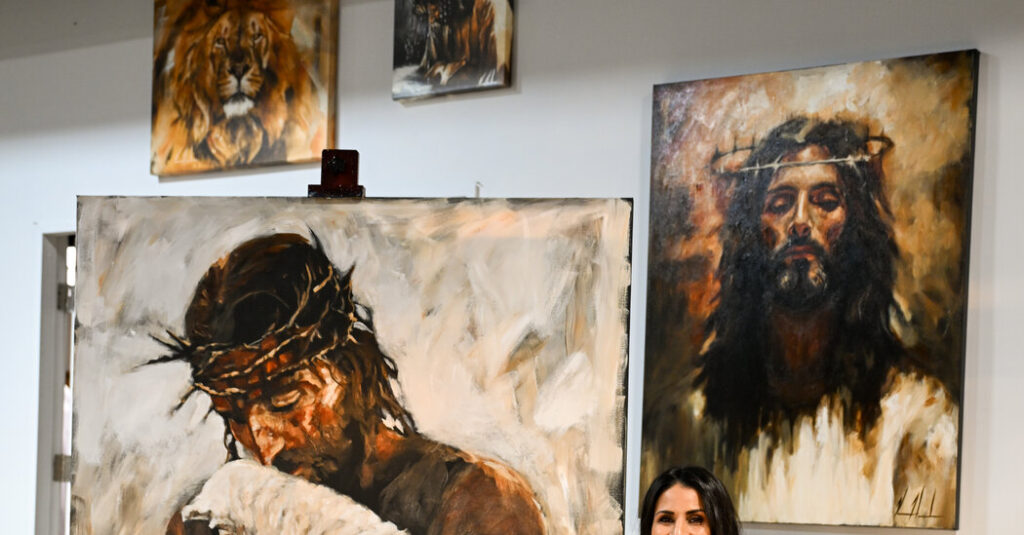
President Trump took the stage during his New Year’s Eve party at Mar-a-Lago and introduced someone he called “one of the greatest artists anywhere in the world.”
“She is a speed painter,” the president says in a recording of the event.
The painter, Vanessa Horabuena, spent the next 10 minutes making an image inspired by the Shroud of Turin, contouring Jesus’s eyebrows and nose from a yellow cross that she initially painted at the center of her black canvas. The president returned to the stage, promised to sign the artwork himself, and the painting was quickly auctioned for $2.75 million to a couple who promised to split their donation between St. Jude Children’s Research Hospital and the local sheriff’s department.
The artwork’s sale easily set a new benchmark for speed painting, a once-obscure competitive art form that has gained popularity over the last decade in Southern beauty pageants, Midwest corporate events, basketball halftime shows and church gatherings. Speed artists typically combine painting and performance to execute large portraits — of celebrities, patriotic symbols or religious figures — within the space of a few minutes.
Like a modern-day vaudeville circuit, artists often use gimmicks to entertain crowds, painting a portrait upside-down before flipping the canvas to reveal an image of Taylor Swift or singing “The Star-Spangled Banner” while quickly re-creating a picture of American soldiers.
Horabuena has described her style as “live worship painting.” In an interview, she recalled visiting the president on the evening of Dec. 30 for an hourlong session in which she painted two religious works. “I created two paintings of Jesus with worship music playing,” she said. “It was very moving and emotional. By the end of the night, President Trump had invited several people into the room. Some of the men were tearing up, saying they could feel God’s presence.”
After the session, the president invited her to the New Year’s Eve party to recreate her version of the Shroud of Turin in front of revelers.
Horabuena said that she started painting for the president in 2023 after meeting him at the Conservative Political Action Conference in Texas in 2022. She was a longtime supporter and said she started giving him paintings of himself, of wildlife and of religious symbols, some of which now decorate his various properties, including Mar-a-Lago and the Trump National Doral Golf Club in Florida. Last year, she also painted an image of the president gazing toward the crucifixion during one of his official inaugural celebrations, the Liberty Ball.
She said that the president had told her that he wished she could paint his official presidential portrait but said there was an artist already under contract for the job. The White House did not respond to questions about the official presidential portrait, however, Karoline Leavitt, the White House press secretary, did express praise for Horabuena.
“Ms. Horabuena is an extremely talented artist whose beautiful paintings of Jesus Christ have earned the admiration of millions of Christians around the world, including President Trump,” Leavitt said Monday in a statement.
Based in Tempe, Ariz., Horabuena said that her art business had struggled through the years, though she grew a following on social media. She said that she was “shadow banned” on Instagram, but she was still making money by selling prints through her online store, for between $15 and $994.50. Online, she also shares her opinions on politics and religion, including posts about the moon landing being staged and a conspiracy theory about the Easter Bunny’s pagan origins.
An Alternate Art World
Speed painting is a small community with less than a couple of dozen full-time professionals in the business, according to talent bookers and agents. Many artists trace the practice back to Danny Dent, who developed a “Two-Fisted Art Attack” routine at venues like Woodstock 1994 and Caesars Palace, where he could finish a portrait in the time of a song or two. Some of his followers gained a foothold by performing on television shows like “America’s Got Talent.” One contestant, Robert Channing, painted an image of Howard Stern in 2014, spreading glue on a black canvas before offering “a little catch at the end” — he splashed the canvas with glitter, revealing Stern’s portrait.
Annika Wooton, 31, said that she first started speed-painting in 2012 with some encouragement from her theater teacher in Virginia. She went on to perform in beauty pageants, where the time limit was close to 90 seconds. Nowadays, she aims to finish paintings in five to seven minutes, the length of a basketball halftime performance. Like many speed painters, she shaves seconds off her time by painting on a black canvas to limit the need for shading and often depicts her subjects in profile to avoid lopsided proportions.
“For a halftime show, are you going to hire a dog who jumps through hoops or a speed painter?” she said, pointing out that she is often competing for jobs against acrobats and circus acts.
Wooton said she learned some tricks of the trade from watching artists like Dent and Jessica Haas, 35, who describes herself as “America’s first female speed painter.” After introducing speed painting into her own beauty pageant routines, Haas attended the Memphis College of Art and earned a degree focusing on sculpture.
“I worked with an engineer to invent this rotating easel that would take 20 seconds off my time,” Haas said. “It would pop off your finger if you put it in the wrong place.” Alongside flipping the canvas, Haas often wears sparkly dresses and five-inch heels, occasionally taking a break from painting to shake a leg with cheerleaders and dance teams.
Trump Administration: Live Updates
Updated
- Trump calls Britain’s Chagos Islands deal an ‘act of great stupidity.’
- Trump doubles down on his Greenland threats.
- Trump threatens 200 percent tariffs on French wine.
“I will make it as big of a show as they want it to be,” she said, adding that she made 16 speed paintings in a recent week, practically lives on an airplane during the college sports season and charges corporate clients anywhere from $10,000 to $80,000.
Kelsey Dulinski, the director of fan experience at Louisiana State University, has hired Haas three times. She said that entertainment is a major draw for sports audiences, where the advent of livestreaming for college and minor league events has added an emphasis to the halftime show.
“Families with little kids are coming for the halftime acts,” Dulinski said. “With Jessica, she paints upside-down so you don’t really know what is going on the whole time.”
That entertainment factor has also resonated among religious and conservative audiences as many speed painters focus on Christian iconography and portraits of political figures like President Trump and the political activist Charlie Kirk.
Approaching the canvas in a letterman jacket and pants splattered with paint, Alejandro Ruiz created a portrait of Kirk after his assassination in September. He also painted an image of Jesus cradling a young girl draped in the American flag.
Ruiz, who paints under the name Revel, has received millions of views on social media. He said in a phone interview that he began speed painting nearly a decade ago as an outlet for depression and anxiety. “The void was filled,” he said, adding that he transitioned from a software engineering job to creating art full-time, with commissions between $3,000 and $5,000. Over the last year, he painted about 30 canvases for clients, often practicing for 40 hours before a performance to perfect just one work.
“I once painted an A/C unit for a company that builds them overseas,” he recalled. “They loved it. I was like … are you kidding?”
“I don’t consider myself that good of an artist,” Mr. Ruiz said. “I just found a way to get my art in front of people’s faces.”
Worshiping at the Speed of Paint
Horabuena emphasized that while her speed paintings were an extension of prayer, her beatific paintings of Mr. Trump were not religious. “I would never worship a man, and I am not worshiping a painting,” she said.
“I started painting when I was 27 years old,” she said, adding that she had a traumatic childhood, which included sexual abuse, and that she struggled with her sexuality. She describes herself as self-taught, inspired by a pastor with whom she started counseling and who encouraged her painting. She began at her dining room table, with a portrait of the musician Bob Marley.
She later discovered speed painting through the work of artists like the renowned performance speed painter David Garibaldi, who also made several portraits of President Barack Obama, including one executed on the White House lawn in 2016.
But Horabuena turned down offers to speed paint at halftime shows and similar events. “That was about commercializing my gift as opposed to allowing my art to represent what is in my heart and soul,” she said.
By the time she appeared onstage at Mar-a-Lago, to judge by the video, Horabuena had honed her performance. Grabbing a paint brush in each hand, she started applying blue and orange hues to the dark canvas. She frequently paused, lifting her hands in worship as music played with the lyrics, “all hail the name of Jesus.” After 10 minutes, she lifted the painting into the sky.
She has not met the couple who bought her painting for $2.75 million but said she was just happy to participate on New Year’s Eve. “I wasn’t nervous about the people, I just wanted to be able to do the painting, rendering it in an excellent way to make sure that my focus was never off God.”
Zachary Small is a Times reporter writing about the art world’s relationship to money, politics and technology.
The post President Trump’s Chosen Artist? A Christian Speed Painter. appeared first on New York Times.