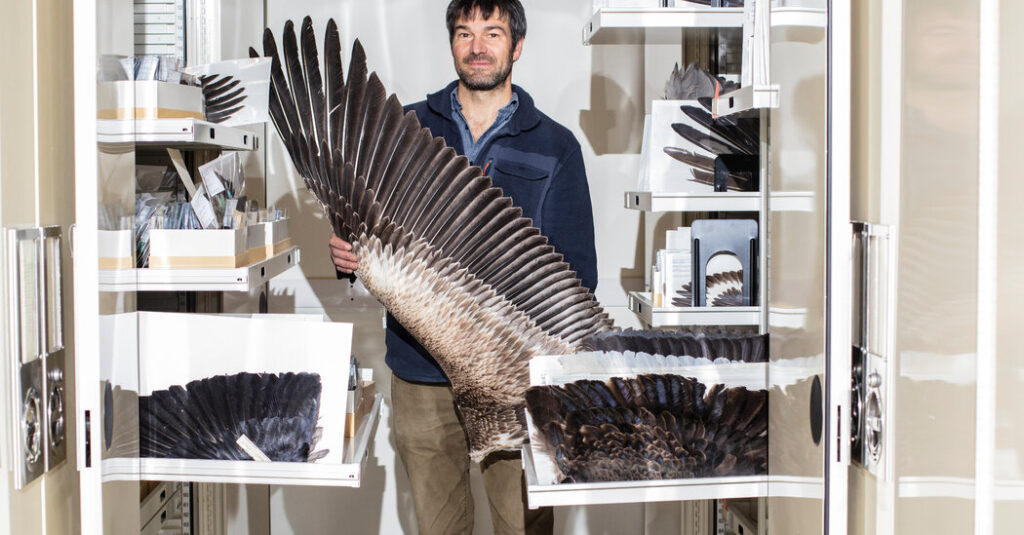
Vanya Gregor Rohwer slid open a drawer to display the rich pink spread wing of a roseate spoonbill, one of thousands of mounted wings at the Cornell University Museum of Vertebrates.
He pulled up a long flight feather to expose, at its base, a palm-tree shaped feather so minuscule it could easily be missed. For a long time, this tiny feature called a filoplume was indeed obscure.
“The history of research on filoplumes is not super robust. They are kind of an overlooked feather,” said Dr. Rohwer, a curator of birds and mammals at the museum. “They were considered a degenerate feather or a useless feather, a relic.”
No longer. Dr. Rohwer and his father, Sievert Rohwer, an influential feather researcher and curator emeritus at the Burke Museum at the University of Washington in Seattle, believe that the tiny filoplume is a key player in the monitoring and maintenance of birds’ feathers, which keep them airborne.
Ever since feathers first appeared on dinosaurs around 150 million years ago, they have been evolving. Now there are six types of feathers on a bird’s body, including filoplumes, and all are made of keratin, a dead substance like human hair.
A paper published last year in the Journal of the Royal Society Interface described a feather as a masterpiece of engineering, one comprising nine orders of magnitude, from the nanoscale to the meter scale. Because the most sophisticated 3-D printers are limited to just four or five orders of magnitude, feathers have yet to be replicated.
“There is no manufacturing technology that can come close to a feather,” said David Lentink, one of the paper’s authors, who studies birds to find ways to improve robots at the University of Groningen in the Netherlands. “They are unusually sophisticated.”
The result is a natural material that is so light that it floats slowly to the ground, yet so strong it can protect a bird flying through wind, rain and cold for days on end. And new ones replace the old ones every few years.
Interest in bird feathers has intensified alongside the rapidly expanding uses of drones and other aircraft, with researchers looking at whether synthetic feathers would make flights more maneuverable, efficient and less noisy.
Filoplumes have inspired micro or hair sensors, for example, that can measure air flow, speed and direction to support a type of self-navigation called “flight by feel.”
Filoplume-like sensors could help drones, which have difficulty dealing with wind gusts, make split-second adjustments.
All birds have filoplumes, even those that cannot fly. There are usually one to three per feather, and they are densest around contour or body feathers and flight feathers.
Filoplumes detect pressure, touch and vibration in adjacent feathers and, through highly sensitive nerve endings, called Herbst corpuscles, in their follicles, translate those mechanical cues into neuronal signals.
These sophisticated feathers provide birds with detailed information about their plumage as they fly. They tell them to adjust their feathers to stay warm, or to release heat. They may also detect the movement of parasites,prompting the birds to preen or emit oil in that area.
(Bristle feathers, short and found on a bird’s head, face and neck, are also sensitive to the environment and alert birds to insects and other prey.)
The birds with the most filoplumes are large, strong flying species like eagles, albatrosses and vultures. Albatrosses, which have been known to fly 6,000 miles or more without stopping, are among those who have the most — more than 9,000 have been counted on some birds. So far, red-tail hawks have the most filoplumes per feather among the birds whose feathers have been counted by researchers.
Filoplumes play other roles. The beard of a wild turkey is actually thin strands of feather called mesofiloplumes. They aren’t sensory, but ornamental, and may grow up to a foot in length. A wild turkey does have filoplumes on its bald head, though, which help it sense the world around it.
Whiskered auklets, a seabird, have large ones atop their heads.
“Those are elaborate filoplumes,” Dr. Vanya Rohwer said. “They use them for navigating down these dark nesting burrows so they are not hitting their heads.”
Studying filoplumes and other plumage alongside his father for more than 20 years, he thought he knew how birds lost and regrew their feathers every few years.
“It was predictable, sequential and orderly,” he said.
In 2015, though, the Rohwers learned about a captive golden eagle whose tail feathers were cut experimentally for research purposes.
“That eagle replaced a cut tail feather way, way faster than an uncut feather,” the younger Dr. Rohwer said, shortening the growth period to about a year. “So birds have some mechanism to detect a feather that is not performing well.”
His father, Dr. Sievert Rohwer, said that the filoplumes, presumably, “are sensitive to vibration the feather would generate if it’s worn or not functioning as well as it should.”
“It makes intuitive sense,” the younger Dr. Rohwer said. “You are crashing through the brush capturing prey or struggling with it on the ground, a process very likely to break a feather.”
Both Rohwers are leading curators of extended bird wings, which they have used to study filoplumes and other feathers. The elder Dr. Rohwer, 83, has amassed the world’s largest collection of bird wings, which have been spread out and mounted at the Burke Museum, with 40,000 pairs pinned open in cellophane.
Dr. Vanya Rohwer, 43, is building a sizable spread wing collection of his own here at Cornell, which so far comprises around 10,000 pairs.
Full bird specimens, meanwhile, are kept in drawers, in a kind of morgue. Dr. Rohwer opened some of them on a recent tour to reveal an array of colorful plumage, including pink-and-peach-colored lilac breasted rollers and green-and-yellow bee eaters. Another drawer was filled with extinct species, including several ivory-billed woodpeckers and a passenger pigeon.
Bird nests are another passion of the younger Dr. Rohwer’s and he studies bird eyelashes as well. In one study, he found that the use of snakeskin to line many birds’ nests significantly reduced predation.
Dr. Rohwer met his wife, Rachel Schlass Rohwer, when, as a budding taxidermist, she attended his class on the preparation of avian specimens. She was smitten both by Dr. Rohwer and the painstaking process of preparing birds for display in museums.
“Knowing these passenger pigeons once eclipsed the sky, and seeing them in these drawers with so much of their color retained, it really moved me,” Ms. Schlass Rohwer said. “Most things when they die lose color and lose so much of their narrative.”
The couple has taken several salvage trips to harvest surplus bird and mammal specimens from freezers at other museums for the Cornell collection. They skin and stuff the birds with cotton or spread their wings in a display, where they are available to researchers.
Ms. Schlass Rowher, who has also studied fashion, has specialized in designing hats with ethically obtained feathers from birds who died naturally and are legal to own. It’s a violation of federal law to possess most types of bird feathers.
With advances in technologies, new information is being extracted from feathers. DNA from a single feather, for instance, allows researchers to trace that bird back to its breeding population. That information is being used to create “genoscape” maps across the world for migratory birds, and to prioritize important habitats for conservation.
The filoplume, though, remains one of the least-understood feathers. “A lot remains to be discovered about their function,” Dr. Lentink said, “because it is almost impossible to study their function in living birds.”
A bird in the lab is very different than a bird in the air, leaving avian flight largely a mystery.
“Sometimes science can’t answer questions because the experiments are too hard, this is such a case,” he said. “It is hard to really prove functions of these feathers in a fully functional happy flying bird doing its normal behavior.”
The post Nature’s Super Feather appeared first on New York Times.