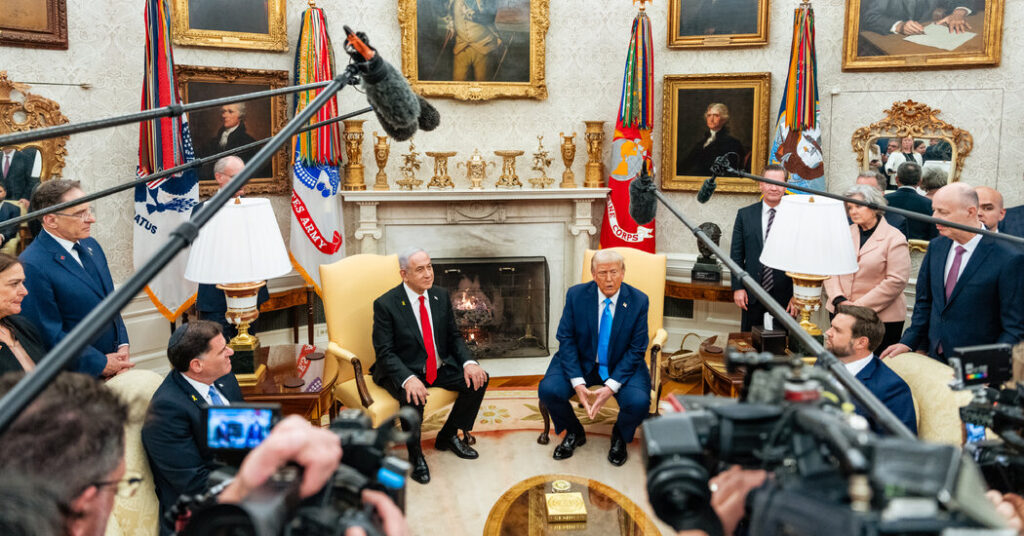
During the first year of his second term, President Trump used the Oval Office in a way his predecessors haven’t, as a veritable reality show with a revolving cast of world leaders.
More than 40 international leaders made the trek to Washington to meet with the American president last year, many with the cameras rolling.
There were ambushes, threats, obsequious displays and the realignment of longstanding American foreign policy. Where previous presidents would have briefly posed for a photo before getting down to business behind closed doors, Mr. Trump relished the spectacle of the lengthy exchanges in front of the press in an Oval Office he has redecorated in gold.
After dressing down President Volodymyr Zelensky of Ukraine in February, Mr. Trump, a former star of “The Apprentice” and professional wrestling productions, notably said: “This is going to be great television.”
But it was more serious than just a show: The fate of wars, prisoners, human rights and crippling economic sanctions all hung in the balance with every exchange. To appease Mr. Trump, world leaders often came bearing gifts, the more flattering, the better — an invitation from the king, a new Air Force One or even a Nobel Prize medal.
For a candidate who campaigned on an “America First” agenda, Mr. Trump’s second term has thus far been defined as much by a focus on international affairs as domestic matters. He brought the world to him and, with the rare exception, on his terms.
In doing so, it was as much a display of power to those at home as it was to those abroad.
“Trump displays a lot of the characteristics of a populist leader that really revels in the politics of spectacle,” said Lisel Hintz, professor at the Johns Hopkins School of Advanced International Studies. “He’s a deal maker, but he’s also a TV producer. TV is so ingrained in how he thinks about the world, how he thinks about politics, and how he thinks about power.”
Here is a look at some of the key ways in which Mr. Trump conducted diplomacy from the Oval Office in his first year back in office.
Forging new relationships with strongmen allies
It didn’t take long for Mr. Trump to shake up longstanding American foreign policy stances, welcoming in strongmen rulers of countries that previous administrations had at times kept at arm’s length.
He partnered with President Nayib Bukele of El Salvador, deporting hundreds of Venezuelan migrants to a notorious Salvadoran prison, including a wrongful deportation that neither president claimed the power to fix.
He welcomed President Recep Tayyip Erdogan of Turkey, even joking that the Turkish leader had manipulated the vote in his country. “He knows about rigged elections, better than anybody,” Mr. Trump said.
His open embrace of Crown Prince Mohammed bin Salman of Saudi Arabia was perhaps the most striking scene. Former President Joseph R. Biden Jr. had once pledged to make Saudi Arabia a “pariah” after the killing of the dissident and journalist Jamal Khashoggi in 2018.
But Mr. Trump acted as a defender of the crown prince during a visit to the Oval Office, his first to the country since Mr. Khashoggi’s murder. When a reporter asked about the killing of Mr. Khashoggi, Mr. Trump quickly cut her off. “He’s done a phenomenal job, and you don’t have to embarrass our guest by asking a question like that,” he said.
That evening, Mr. Trump held a black-tie dinner for the crown prince.
Redefining America’s role in the world
According to the White House, Mr. Trump hosted 45 meetings with 46 foreign leaders during the first year of his second term, including five visits from Israeli Prime Minister Benjamin Netanyahu, four visits from the secretary general of NATO, Mark Rutte, and four visits from Mr. Zelensky.
“President Trump is the most transparent president in history, and he leads all foreign policy from the top,” said Anna Kelly, a White House spokeswoman.
Like few presidents before him, Mr. Trump showed a willingness to upend America’s stance on major conflicts, sometimes leaving friends and foes scrambling to try to figure out his next move.
Mr. Trump used his meetings with Mr. Netanyahu — with whom he has had an on-again, off-again relationship — to try to shake up the dynamic between Israel and the Palestinians.
During one such visit, Mr. Trump said the United States would take over Gaza and turn it into the “Riviera of the Middle East,” prompting a widespread outcry. During another, he announced a deal resulting in the release of Israeli hostages from Gaza, after he demanded Mr. Netanyahu apologize to the Qataris for a deadly missile strike on Doha.
But no shake-up of international relations was more dramatic than the broadside attack Mr. Trump and Vice President JD Vance leveled against Mr. Zelensky, accusing him of being insufficiently grateful of American support for his country against the Russian invasion.
The spectacle underscored how little longstanding alliances mean to Mr. Trump and just how much he has oscillated in his approach to the Russian invasion, swinging between support for Ukraine and sympathy for President Vladimir V. Putin of Russia. But ultimately, his tactics appear to have done little to bring the two sides closer to peace.
“It did have the effect of sending the Ukrainians scrambling to see how can we get back in the good graces of the United States,” said Matthew Kroenig, vice president and senior director of the Atlantic Council’s Scowcroft Center for Strategy and Security. “Trump writes about this in ‘The Art of the Deal’ decades ago. This is the way you negotiate. You throw the other side off balance and get them kind of crawling back to the table.”
Openly confronting world leaders and pushing his own agenda
Mr. Zelensky was not alone in feeling ambushed after taking a seat in the Oval Office.
In May, Mr. Trump rebuked President Cyril Ramaphosa of South Africa, lecturing him with false claims about a genocide against white Afrikaner farmers. He even played what he said was video evidence of their persecution.
“Turn the lights down and just put this on,” he told his aides.
Mr. Ramaphosa was forced to scramble to defend his country and joked that he must not have brought a lavish enough present, citing a plane the Qatari government had recently gifted Mr. Trump.
“I am sorry I don’t have a plane to give you,” Mr. Ramaphosa said.
“I wish you did,” Mr. Trump replied. “I’d take it. If your country offered the U.S. Air Force a plane, I would take it.”
The meeting had been expected to be tense given Mr. Trump had suspended aid to the country, but it proved notable for how he was able to push his political agenda.
His administration had recently slashed refugee admissions for everyone — except Afrikaners.
And as always, putting on a show
Other world leaders took note of the televised disasters for Mr. Zelensky and Mr. Ramaphosa. They would come bearing gifts and praise.
The gifts have been varied, ranging from a multi-million-dollar plane to more personal appeals. Chancellor Friedrich Merz of Germany presented the president with a framed copy of Mr. Trump’s German-born grandfather’s birth certificate.
Mr. Netanyahu gave Mr. Trump with a gold-plated pager, the same kind Israel rigged with explosives, killing Hezbollah operatives and others in Lebanon.
And just last week, María Corina Machado, Venezuela’s opposition leader and last year’s Nobel Peace Prize winner, presented her prize to Mr. Trump.
In the absence of gifts, flattery and praise have been a popular tactic too. Mr. Rutte, as he seeks to keep Mr. Trump engaged on the side of Ukraine, has heaped such volumes of praise that he has been mocked by commentators as over-the-top. Mr. Rutte once referred to Mr. Trump as “daddy,” prompting the White House to highlight the remark with a music video.
Sometimes the meetings, and their accompanying flattery and gifts, have produced results, such as a trade deal or lowering of tariffs. Other times, the win for international leaders is simply avoiding the wrath of the country with the world’s most powerful military and economy.
“The president has demonstrated a strong penchant for personal diplomacy, including putting it on full display in the Oval Office in front of the press, creating an arena with all the volatility and suspense of a reality TV show,” said Michael Froman, president of the Council on Foreign Relations. “On one hand, this allows for a degree of spontaneity at the highest levels; on the other, it runs the risk of circumventing a rigorous policy process.”
Early in his second term, Mr. Trump shrank the National Security Council, underscoring his belief in his ability to conduct policy on a leader-to-leader basis. He has moved rapidly to build national security and foreign policy teams who share his skepticism of foreign interventions, and who will not oppose him.
When he returned to the Oval Office, Mr. Zelensky adopted a more deferential tone in his interactions with Mr. Trump. The leader of Ukraine presented Mr. Trump with a golf club that had belonged to a service member who lost his leg during the war with Russia.
Golf, Mr. Zelensky knew, is a favorite pastime of Mr. Trump’s.
Luke Broadwater covers the White House for The Times.
The post How Trump Uses the Oval Office to Flex Power on the World Stage appeared first on New York Times.