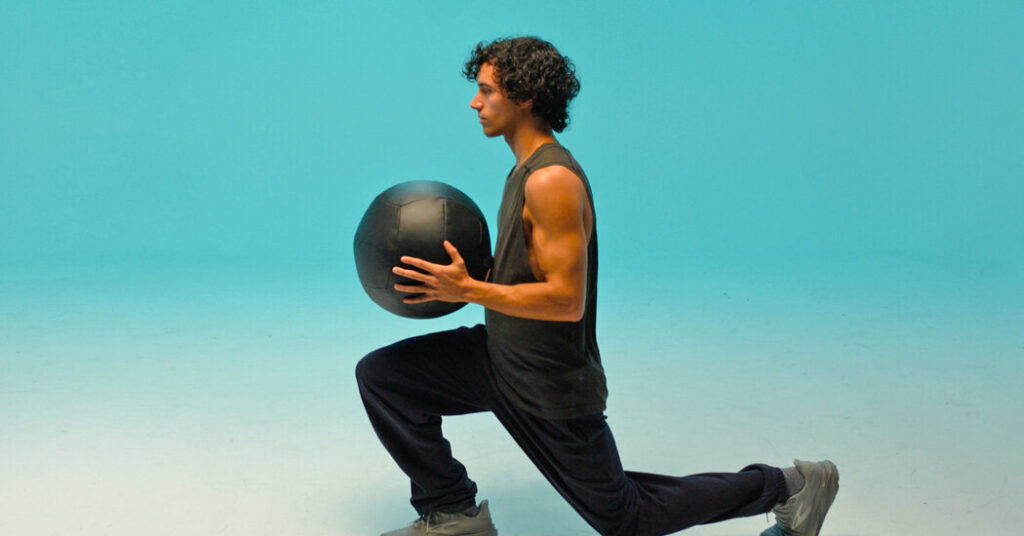
If lifting weights intimidates you, another way to build strength and explosive force is with medicine balls. You can slam them, toss them or simply hold them like a weight.
That versatility makes them perfect for N.F.L. linebackers or 80-year-olds looking for a little more stability, said Rob Silver, a trainer and an associate director at the National Council on Strength & Fitness.
While they are most commonly associated with building power, medicine balls can also be used to develop strength, speed, balance and coordination by utilizing different planes of motion. Plus they can offer a little stress relief.
“I definitely get my aggression out during my medicine ball workouts,” said Rana Napoli, a tech director at a trading firm in Lincolnwood, Ill. When she entered perimenopause in her mid-40s, a doctor encouraged her to strength train with dumbbells and kettlebells, but she hated them.
“My hands kept sliding, my wrists hurt and the handles gave me calluses,” she said. “I was constantly lotioning my hands.”
She found medicine balls easier to hold, and she said they also helped her engage her core. Mr. Silver often uses them to help his older clients, including his 80-year-old mother, build power, which is essential to healthy aging.
How to Choose a Medicine Ball
There are two types of medicine balls: classic and slam balls. Both tend to be around 14 inches in diameter and come in various weights.
The classic medicine ball is meant to bounce — ranging from a lively basketball to a deflated soccer ball. Experts recommend that beginners start with one that has minimal bounce and a soft leather or vinyl shell that is easy to grip. If you plan to toss the ball against a wall, make sure the wall is made from cinder block, brick or poured concrete, Mr. Silver said.
Also, test it with a few bounces before your workout, he added. “Don’t underestimate the potential for that ball to rebound and hit you.”
Slam balls, also known as dead balls, are filled with sand, so they absorb impact and have no bounce. As the name implies, they’re great for slamming on the ground but aren’t meant to be thrown to a partner or against a wall. They are ideal for exercises that build explosive power and core stability, like overhead slams.
Medicine balls tend to cost between $20 and $100. Try various styles at a gym before buying your own, said Stephanie Cooper, an associate professor of kinesiology at the University of San Francisco. One or two balls is typically enough for the average person, she said, and lighter is better to start. New exercisers can do a lot with five- and 10-pound balls, Mr. Silver said, while people who already strength train might start with 10- and 20-pound balls.
The Overview
Time: 20 minutes
Intensity: Medium
What You’ll Need
-
One medicine ball, around five to 10 pounds, with a slight bounce
-
An open space, ideally with a high ceiling
-
A partner (optional)
How Often
If you’re new to strength training, start with once a week. More experienced athletes can do this workout two to three times per week.
Walking Lunges With Medicine Ball Rotation
Purpose: Strengthens the glutes, quads and hamstrings; rotational movement works the obliques, as well as balance and stability
Repetitions: Five per side, 10 total
Hold a medicine ball in front of your chest. Step forward with your left foot into a lunge. Rotate the ball over the left hip, holding it at the same height. Return to center. Step your feet together and stand. Lunge forward with the right foot. Rotate the ball to the right hip and then back to center and the starting position. To increase the difficulty, hold the ball with straight arms.
Underhand Scoop Toss
Purpose: Develops power in the glutes, quads and hamstrings; strengthens the core and shoulders
Repetitions: 10
Stand with your feet shoulder-width apart. Start with the ball at about head height and then drop into a shallow squat as you swiftly bring the ball down in front of your knees with straight arms. Press down through your feet to stand tall as you forcefully toss the ball upward while keeping your elbows straight. For a little more challenge, add a small hop as you throw.
Rotational Medicine Ball Throw
Purpose: Builds power in the glutes, hamstrings and obliques; improves coordination and core stability
Repetitions: Three sets of five per side, 10 seconds of rest between sets.
Stand with your feet shoulder-width apart, knees slightly bent. Hold a medicine ball by your right hip. Use your hips and arms to swiftly arc it up in front of the chest and throw it to the left. You can throw the ball to a partner or against a wall. Stand about five feet from your partner or the wall to start.
The straighter your elbows are, the more challenging the exercise will be. Keep the ball close to your body and your elbows bent. Switch directions and repeat. If you do not have a partner or a stable wall, you can simply twist, hold onto the ball and return to the starting position.
Squat to Chest Pass
Purpose: Builds upper body power; strengthens the glutes, quad, hamstrings, chest and core
Repetitions: Four sets of five reps with 45 seconds of rest between sets
Stand with your feet shoulder-width apart. Hold a medicine ball in front of your chest. Bend your hips and knees into a squat and push down through your feet as you stand up and explosively push the ball out in front of you. Focus on exercising your chest and shoulders rather than your thumbs or wrists. Return to start.
This can be performed as a partner pass or against a wall. Stand about five feet from your partner or the wall to start. If you do not have a partner or a stable wall, you can simply push the ball in front of you, as in a bench press, and return to the starting position.
Alternating Reverse Lunge Medicine Ball Slam
Purpose: Works the quads, glutes, hamstrings and deltoids; improves balance and coordination
Repetitions: Four sets of three per side with 30 seconds between sets
Stand with your feet hip-width apart and hold a medicine ball by your right hip. Step your right foot back into a reverse lunge, keeping your chest tall. Then arc the ball up and around, over your left hip, and slam the ball on the ground outside of the left leg. Pick the ball up, return to the start and repeat on the opposite side.
Eventually try to get comfortable enough that the slam happens at the same time as the reverse lunge.
Medicine Ball Plank Pass
Purpose: Improves core strength and stability
Repetitions: Six per side, 12 total
Start in a plank position with a medicine ball positioned by your left hand. Keep your core engaged as you roll the ball to your right hand without letting your hips shift. Continue passing the ball side to side.
Medicine Ball Russian Twist
Purpose: Strengthens the core, particularly the oblique muscles
Repetitions: Six per side
Sit with your spine at a 45-degree angle from the floor, creating a V-shape between your torso and your thighs. Your feet can be on the ground or can hover for a challenge. Hold a medicine ball at your chest with bent elbows. Twist to the right and then to the left. Start by tapping the ball next to your hip and progress to keeping your arms fully extended or slamming it next to your hip, being mindful of the bounce.
Jen Murphy is a freelance writer based in Boulder, Colo.
On-set trainer: Amanda Katz
The post Hate Weights? Try a Medicine Ball. appeared first on New York Times.