President Ahmed al-Sharaa of Syria could not have struck a better deal than the one he just made with the Kurdish-led militia that had controlled much of the country’s northeast.
For the past year, Mr. al-Sharaa had been caught in protracted discussions with Kurdish leaders over the terms for joining his new government. The Kurds had significant bargaining chips, including the longtime backing of the United States and control of the country’s gas and oil fields. And many Syrians saw the talks as a harbinger of much larger questions about inclusivity of minorities in government and the sharing of political power.
How willing would Mr. al-Sharaa be to decentralize power in his new government? And how long would he be willing to engage in negotiations with groups demanding some autonomy before moving those decisions to the battlefield?
Then, earlier this month, Mr. al-Sharaa’s patience seemed to have run out.
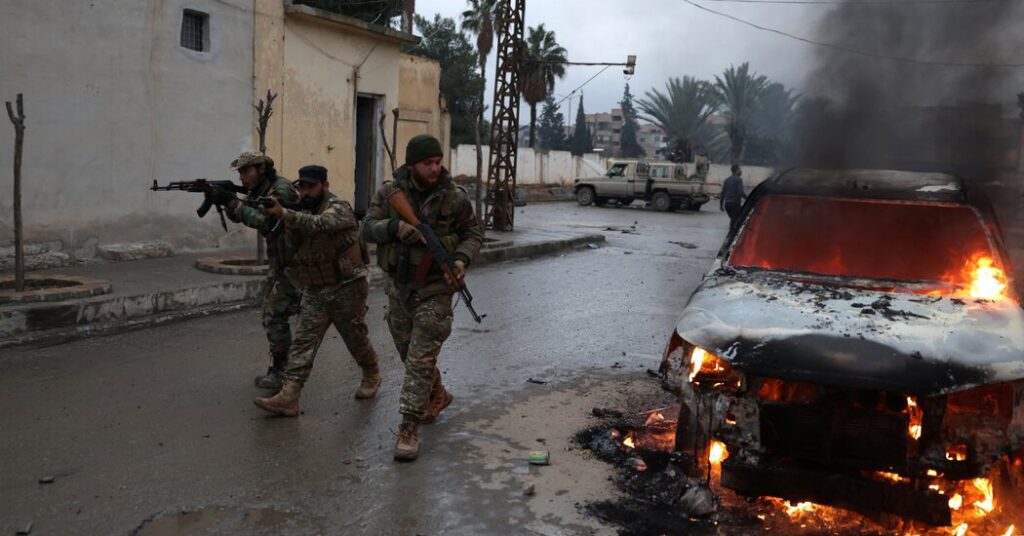
After months of stalled negotiations with the Kurdish-led Syrian Democratic Forces, or S.D.F., the government made a military push into Kurdish-held territory last week. Within days, those forces had reached the outskirts of Raqqa — the largest city administered by the Kurdish authorities — after the Kurds had suffered a series of battlefield defeats.
By Sunday, the leader of the S.D.F., Mazloum Abdi, agreed to a deal with Mr. al-Sharaa that looked like a surrender.
The S.D.F. lost nearly all of the concessions the Syrian government had offered during previous rounds of negotiations. After previously winning its major sticking point — joining the Syrian military in its own distinct battalions — it now appears that its members will join as individuals. The S.D.F. also lost control over Syria’s gas and oil fields, its main leverage in negotiations.
It was a brutal blow to Kurdish leaders, who have loudly criticized Mr. al-Shara’s government for concentrating power in the hands of a small group of loyalists from his former rebel days and for not being inclusive enough of minorities in government.
A day after signing the deal, Kurdish leaders accused government forces of violating the cease-fire and reiterated calls for Mr. al-Sharaa to decentralize his authority in what appeared to be a last-ditch effort to claw back some of the concessions they had previously won.
The agreement itself sent a stark message to other Syrian minorities, including the Druse militias that currently control southern province of Sweida and the Alawites on the coast. Calls have come from within both groups for greater autonomy.
“It’s a significant territorial, military and political win” for Mr. al-Sharaa, said Dareen Khalifa, a senior adviser at the International Crisis Group. “The political message now is that it’s only a matter of time for everyone else.”
Mr. al-Sharaa has pledged that his government will protect the rights of all minorities — something that the United States and others in the international community have said they will be monitoring.
In an overture to Syrian Kurds on Friday, he issued a decree recognizing Kurdish as a national language alongside Arabic, and adopted Nowruz, the Persian New Year, widely celebrated by Kurds, as an official holiday.
Looming over the deal was the United States, a longtime ally of the S.D.F. and partner in its fight to oust the Islamic State from northeastern Syria since 2015. Over the past year, the tensions between the government and the S.D.F. had put the U.S. in a difficult position as it tried to balance between its two Syrian partners.
While the U.S. has maintained its support for Kurdish forces since the Assad dictatorship collapsed in late 2024, the Trump administration has also embraced Mr. al-Sharaa. In November, President Trump hosted the Syrian leader, who was formerly designated a terrorist by the U.S. for his former ties to Al Qaeda at the White House. He waived punishing sanctions on Syria that had devastated its economy.
The S.D.F. appeared to have been banking on its American allies as a bulwark against exactly the kind of military push that the Syrian government made last week, a major miscalculation and not the first time Washington had failed to come to the force’s aid.
While American officials intervened to broker the cease-fire deal, the Kurds got neither the military support they had hoped for nor even an international outcry over the government’s military attack.
Some Kurds even equated the U.S. response with the total abandonment of their longtime ally.
The United States “left the Kurds, their allies, between the fists of ISIS and Al Qaeda,” said Siyamend Ali, a spokesman for the S.D.F., referring to Mr. al-Sharaa’s previous affiliation with Al Qaeda.
The U.S. approach to the clashes between the S.D.F. and the government also sparked divisions in Washington.
As the Syrian government made its lightning advance into Kurdish territory, Senator Lindsey Graham of South Carolina, a Trump ally, threatened to call for sanctions to be reinstated on Mr. al-Sharaa’s government. He repeated the threat on Monday as Kurdish forces claimed that armed groups affiliated with the government had attacked prisons it controlled in the northeast.
“If Syrian government forces continue to advance in the north toward Raqqa, I will push for reimposing Caesar Act sanctions on steroids,” he wrote in a post on X, referring to punitive sanctions that Congress repealed earlier this month. “If you want a conflict with the U.S. Senate and to do permanent damage to the U.S.-Syria relationship keep going.”
It is a threat that Mr. al-Sharaa, who has bet that reviving the country’s economy will shore up support for his government, cannot ignore.
The government’s seizure of the oil and gas fields previously under S.D.F. control is another major win that could offer the government an economic lifeline — and another card to play to further shore up support with the Trump administration.
Still, the clashes that erupted as government forces sought to take control over security infrastructure in the northeast — as agreed upon in Sunday’s deal — highlighted the fragility of Sunday’s agreement.
After President al-Sharaa met with the leader of the S.D.F. in Damascus on Monday, the S.D.F. claimed that their discussions with the government about implementing the new deal had broken down.
“The situation has now deteriorated to an alarming degree,” Adulkarim Omar, a representative of the S.D.F.’s political arm, said in a statement on Tuesday.
The S.D.F.’s near total capitulation also stoked fears that more hard-line elements within the Kurdish forces might splinter and become spoilers to peace in the northeast. Others also worried that the way in which the Syrian government may try to govern the region could unleash a new host of problems.
While Mr. al-Sharaa has rejected his Islamist roots, many Syrians remain to be convinced that he will share power with his former opponents and others.
For much of the past year, the government’s model for exerting control has been to install trusted allies from its rebel coalition in cities across the country. But that approach has largely backfired, leading to poor governance, according to Lara Nelson, policy director at ETANA Syria, a Syrian research group.
“The question now is around the implementation of governance,” Ms. Nelson said. “It has to be governed by the local people who have those organic links to their areas, otherwise it will be unsustainable.”
Hwaida Saad and Raja Abdulrahim contributed reporting.
Christina Goldbaum is The Times’s bureau chief in Beirut, leading coverage of Lebanon and Syria.
The post For Syria’s Government, Kurdish Deal Is a Big Win appeared first on New York Times.