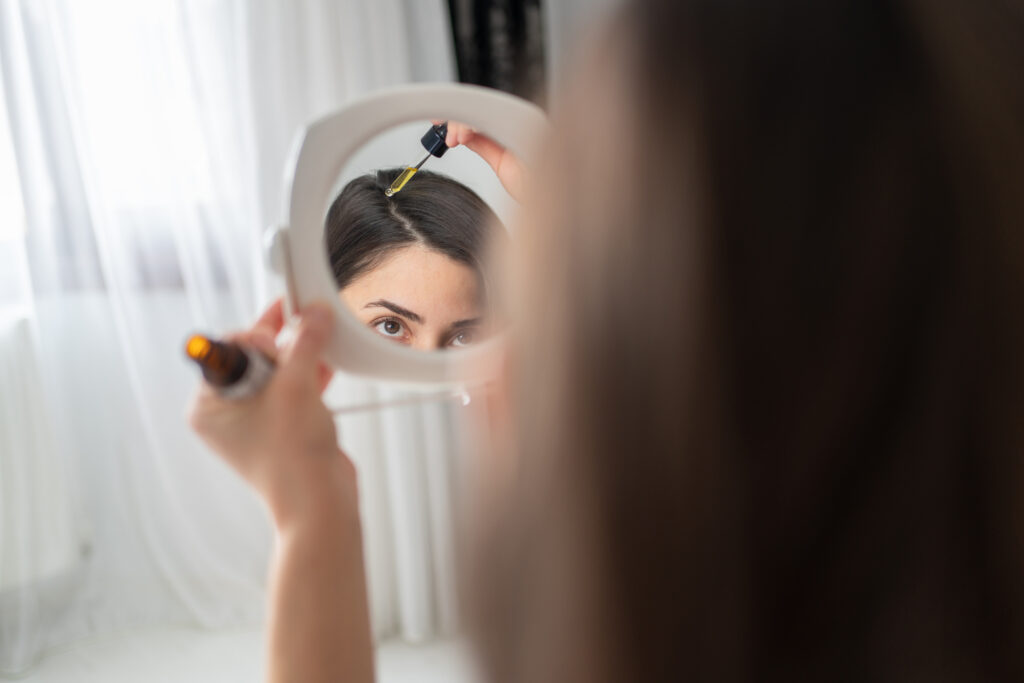
TikTok has been abuzz with praise for rosemary oil for several years, with some users claiming it has helped with their thinning hair and led to longer, thicker locks.
But when it comes to hair health, rosemary alone is unlikely to promote growth in any real way, experts said.
“Hair loss is biologically complex and emotionally charged, which makes it especially vulnerable to oversimplified or exaggerated claims,” said Oma Agbai, an associate clinical professor of dermatology and director of multicultural dermatology and hair loss disorders at the University of California at Davis School of Medicine.
Some people may experience a mild benefit, but it’s “not equivalent to what we see with more effective, evidence-based treatments,” she said.
What is rosemary oil, and what can it do for your hair?
Rosemary oil is an essential oil extracted from the rosemary plant and is commonly used in hair care and skin care products. The reasoning is that its anti-inflammatory and antimicrobial effects may increase blood circulation and decrease inflammation on your scalp, helping to support hair growth.
Although there isn’t strong scientific support for rosemary oil as a hair loss treatment, some studies suggest it may have a modest benefit for people with androgenetic alopecia, the most common form of hair loss, which includes male and female pattern hair loss. But “it’s not magic,” said Adam Friedman, a professor and chair of dermatology at George Washington School of Medicine and Health Sciences.
Androgenetic alopecia is partly driven by hormones called androgens. When levels are high or there’s an increased sensitivity to an androgen called dihydrotestosterone (DHT) because of genetic and environmental factors, hair follicles can shrink, producing thinner hairs and shortening the hair growth cycle. Treatments that reduce DHT may slow pattern hair loss, and rosemary oil may have a limited ability to do that, some research suggests.
In one mouse study, rosemary oil appeared to inhibit an enzyme that converts testosterone into DHT. Some research also suggests rosemary may reduce the ability of DHT to bind to androgen receptors, which is how the hormone affects hair follicles, Friedman said.
But rosemary extract hasn’t been proved in studies to reduce hair shedding or loss or to increase hair growth in any meaningful or reliable way, Friedman said. And there isn’t any solid evidence that it can treat other forms of hair loss such as telogen effluvium, a type of excessive hair shedding caused by stress, illness or pregnancy; alopecia areata, patchy hair loss related to autoimmune issues; or scarring alopecia, which causes permanent hair loss from inflammation and scar tissue, he said.
Why do some people think rosemary oil promotes hair regrowth?
Much of the hype stems from a 2015 randomized trial that has been shared widely on social media. It showed that a topical rosemary oil solution was as effective as 2 percent minoxidil, or Rogaine — which has been extensively studied and is associated with hair growth in some people — in treating androgenetic alopecia in men.
Friedman and other dermatologists noted that the improvements in hair counts — how researchers measured success — were modest and that the study lacked certain fundamental design elements expected in modern clinical trials. It had a relatively small sample size of 100 men, followed them for only six months and, most critically, had no placebo group, “making it impossible to determine whether either treatment was truly effective or if both groups experienced natural hair cycle fluctuations,” Friedman said.
Studies vary in terms of the purity, potency and mixtures containing rosemary oil, making it difficult to draw firm conclusions about the efficacy of the oil, Friedman said.
It may also be a matter of perception for those who swear by rosemary oil. The oil itself may make hair appear shinier and may help prevent breakage, resulting in the appearance of thicker hair, said Shari Lipner, a professor of clinical dermatology at Weill Cornell Medicine. Even without treatment, hair loss from common conditions such as telogen effluvium waxes and wanes, and people who start using rosemary oil as hair shedding peaks will notice that their hair recovers over several months — with or without treatment, she said.
Because rosemary oil may help hair growth at least to some degree, it may be a reasonable add-on or adjunctive treatment for some people with hair loss, particularly for those who can’t tolerate minoxidil, but it’s not a replacement for clinically proven medical therapies, said Paradi Mirmirani, a dermatologist and hair disorder specialist at Kaiser Permanente in Vallejo, California.
Although there isn’t much research recommending an ideal way to use rosemary oil for hair issues, one general method is to mix a few drops of rosemary oil with a carrier oil such as coconut or jojoba to reduce any risk of irritation and then massage it into your scalp.
Rosemary oil tends to be well tolerated “with minimum irritation,” one literature review said about the oil in general.
Are there lifestyle changes that help hair loss?
Rosemary oil aside, a well-balanced diet, sleep, exercise and stress management are important for overall — and hair — health, as are identifying and correcting any nutritional deficiencies that may contribute to hair loss such as iron, zinc, vitamin D or protein, Agbai said.
Limit tight braids, ponytails and extensions, as they can lead to another type of alopecia, traction alopecia, which causes hair loss from constant stress on the hair follicles.
And treating inflammatory scalp conditions such as seborrheic dermatitis can reduce shedding, Agbai said.
What works for hair regrowth?
Natural products such as rosemary oil are generally recommended only as adjuvants, or “sidekicks,” to tried-and-true medications, Friedman said.
For patterned hair loss in particular, dermatologists recommend evidence-backed treatments for hair growth:
- Minoxidil: Oral and topical minoxidil, or Rogaine, have been studied in large, controlled trials and shown to be an effective treatment for hair loss. While oral minoxidil is approved by the Food and Drug Administration to treat high blood pressure, low-dose oral use for hair loss is off-label, and both low-dose oral and topical minoxidil — particularly the 5 percent formulation — are associated with notable hair growth in both men and women with androgenetic alopecia.
- Finasteride: Oral finasteride, which is approved to treat androgenic alopecia in men, has been shown in clinical trials to increase hair count and improve overall hair appearance by reducing DHT.
- Spironolactone: Both oral and topical spironolactone have been studied, more often in women, for alopecia recovery. In clinical trials, it was more effective when used alongside other conventional treatments such as minoxidil, rather than as a stand-alone therapy.
- Dutasteride: A more potent 5-alpha inhibitor, dutasteride is also used off-label to treat androgenic alopecia in men and women and has been shown in studies to reduce DHT and achieve a notable increase in hair count compared with placebo groups.
Bear in mind, with both natural remedies and prescribed medications for hair loss, any gains will be lost once the treatment is stopped, experts said.
Also, because these hair growth medications have other uses — minoxidil for high blood pressure, finasteride for enlarged prostates, spironolactone for fluid retention, for instance — they may interact with other drugs or cause side effects, so consult your doctor before using them to treat hair loss.
Are you wondering whether to believe a hyped-up health tip, viral wellness trend or long-standing scientific claim? Email [email protected] and we may answer your question in a future column.
The post Does rosemary oil regrow hair? Here’s what experts say about the trend. appeared first on Washington Post.